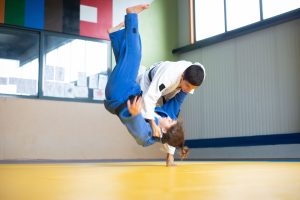
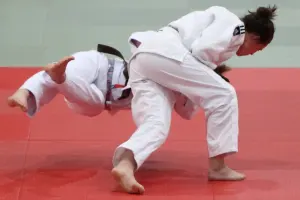
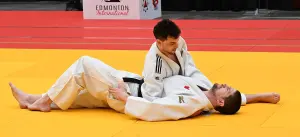
Judo
Judo Terminology
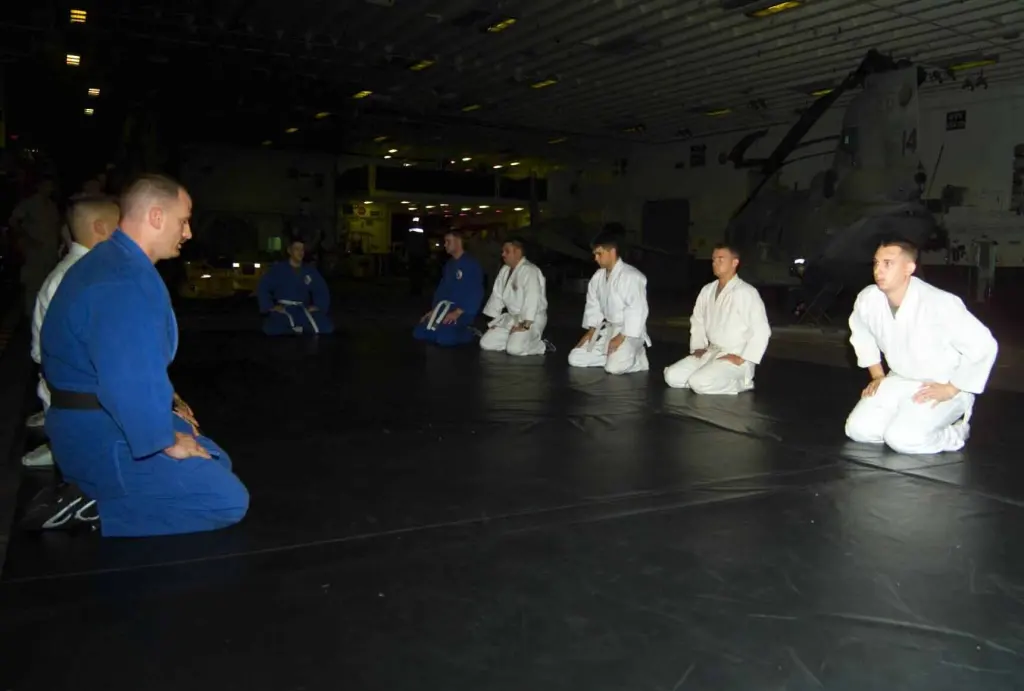
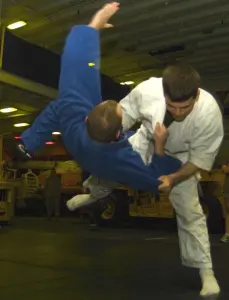
Image: Cpl. Jeff Sisto / United States Marine Corps via Wikimedia Commons · Public domain, U.S. federal government work
Overview
Find the word for the situation.
Read Japanese spelling, pronunciation, meaning and use together. A glossary explains words; the event rulebook defines refereeing thresholds.
Look up a term by use
People
Judoka 柔道家
- Reading
- じゅうどうか · jūdōka
- Meaning
- Judo practitioner
- When used
- Describing a person who practises Judo.
- Related page
- Judo
People
Sensei 先生
- Reading
- せんせい · sensei
- Meaning
- Teacher
- When used
- Addressing a teacher; wider Japanese usage is not confined to Judo.
- Related page
- Dojo Etiquette
People
Tori 取
- Reading
- とり · tori
- Meaning
- Performer of the designated technique
- When used
- Paired drills and kata; partners can exchange roles.
- Related page
- Judo Techniques
People
Uke 受
- Reading
- うけ · uke
- Meaning
- Receiver of the designated technique
- When used
- Paired drills and kata; receiving is an active role.
- Related page
- Ukemi
Dojo
Dōjō 道場
- Reading
- どうじょう · dōjō
- Meaning
- Training hall
- When used
- Naming the place of practice.
- Related page
- Dojo Etiquette
Dojo
Tatami 畳
- Reading
- たたみ · tatami
- Meaning
- Mat surface
- When used
- In Judo, the purpose-made training or competition mats.
- Related page
- Judo Rules
Dojo
Judogi 柔道衣
- Reading
- じゅうどうぎ · jūdōgi
- Meaning
- Judo uniform
- When used
- Equipment and competition clothing; often called gi internationally.
- Related page
- Judo
Dojo
Obi 帯
- Reading
- おび · obi
- Meaning
- Belt
- When used
- Clothing and rank; colour depends on the grading system.
- Related page
- Judo Belt Ranks
Dojo
Shōmen 正面
- Reading
- しょうめん · shōmen
- Meaning
- Formal front
- When used
- Dojo orientation and local etiquette; layouts vary.
- Related page
- Dojo Etiquette
Practice
Ukemi 受身
- Reading
- うけみ · ukemi
- Meaning
- Receiving a fall
- When used
- Supervised breakfall and rolling practice.
- Related page
- Ukemi
Practice
Uchikomi 打込
- Reading
- うちこみ · uchikomi
- Meaning
- Repeated entry practice
- When used
- Fitting in repeatedly, usually without completing the throw.
- Related page
- Uchikomi
Practice
Nagekomi 投込
- Reading
- なげこみ · nagekomi
- Meaning
- Repeated throwing practice
- When used
- Controlled completion of throws with a prepared receiver.
- Related page
- Judo Techniques
Practice
Randori 乱取
- Reading
- らんどり · randori
- Meaning
- Free practice
- When used
- Adapting to a partner within agreed safety constraints.
- Related page
- Randori
Practice
Kata 形
- Reading
- かた · kata
- Meaning
- Formal pattern
- When used
- Agreed roles and sequences for structured study.
- Related page
- Kata In Judo
Practice
Shiai 試合
- Reading
- しあい · shiai
- Meaning
- Contest or match
- When used
- Competition governed by a specified ruleset.
- Related page
- Judo Rules
Technique
Nage-waza 投技
- Reading
- なげわざ · nage-waza
- Meaning
- Throwing techniques
- When used
- Kodokan classification; 68 named throws.
- Related page
- Nage Waza
Technique
Katame-waza 固技
- Reading
- かためわざ · katame-waza
- Meaning
- Control techniques
- When used
- Holds, constrictions and joint techniques; 32 names.
- Related page
- Katame Waza
Technique
Atemi-waza 当身技
- Reading
- あてみわざ · atemi-waza
- Meaning
- Striking techniques
- When used
- Formal kata study, outside ordinary randori and contest.
- Related page
- Judo Techniques
Technique
Kuzushi 崩し
- Reading
- くずし · kuzushi
- Meaning
- Creating or recognising instability
- When used
- Analysing how balance and response are disrupted.
- Related page
- Kuzushi
Technique
Tsukuri 作り
- Reading
- つくり · tsukuri
- Meaning
- Preparation and positioning
- When used
- Fitting the bodies and distance to the intended technique.
- Related page
- Kuzushi
Technique
Kake 掛け
- Reading
- かけ · kake
- Meaning
- Application or completion
- When used
- Analysing the throwing action; may overlap with preparation.
- Related page
- Kuzushi
Contest
Ippon 一本
- Reading
- いっぽん · ippon
- Meaning
- Full-point score
- When used
- Ends the contest when awarded under the applicable rules.
- Related page
- Judo Rules
Contest
Waza-ari 技あり
- Reading
- わざあり · waza-ari
- Meaning
- Score below ippon
- When used
- Two combine into ippon under the cited IJF rules.
- Related page
- Judo Rules
Contest
Yūkō 有効
- Reading
- ゆうこう · yūkō
- Meaning
- Score below waza-ari
- When used
- Present in the cited 2026 IJF edition; does not accumulate into waza-ari.
- Related page
- Judo Rules
Contest
Osaekomi 抑え込み
- Reading
- おさえこみ · osaekomi
- Meaning
- Hold-down announcement
- When used
- The referee recognises qualifying control and starts hold timing.
- Related page
- Osaekomi Waza
Contest
Toketa 解けた
- Reading
- とけた · toketa
- Meaning
- Hold broken
- When used
- Referee announcement ending the hold-down timing.
- Related page
- Judo Rules
Contest
Shidō 指導
- Reading
- しどう · shidō
- Meaning
- Minor infringement penalty
- When used
- A penalty, not a technical score.
- Related page
- Judo Rules
Contest
Hansoku-make 反則負け
- Reading
- はんそくまけ · hansoku-make
- Meaning
- Disqualification
- When used
- Direct serious infringement or third shidō; consequences depend on the offence.
- Related page
- Judo Rules
Contest
Hajime 始め
- Reading
- はじめ · hajime
- Meaning
- Begin
- When used
- Referee command starting or restarting the contest.
- Related page
- Judo Rules
Contest
Mate 待て
- Reading
- まて · mate
- Meaning
- Wait / stop temporarily
- When used
- Referee command interrupting action and contest time.
- Related page
- Judo Rules
No matching terms. Clear the search or choose another use.
At a glance
- Japanese name
- 柔道用語
- Romanisation
- Jūdō yōgo
- Main language
- Japanese
- Technical authority
- Kodokan classification
- Common settings
- Dojo, kata, randori, shiai
Reading this glossary
Judo terminology connects people, places, practice methods, technique families and contest decisions. Use the glossary to find the Japanese spelling, kana reading, romanisation, meaning and usual setting of each term. Long vowels are shown with macrons; unaccented searches work as well.
Writing and pronunciation
Judo is written 柔道 and is romanised jūdō. The macrons mark long vowels; they are often omitted in ordinary English, producing the familiar spelling judo. The first character, jū, is commonly rendered as gentleness, flexibility, or yielding, while dō means a way or path.
Compound terms are normally written in lower case when used as common nouns. The IJF recommends a hyphen in many compounds, including nage-waza and katame-waza. English publications and organisations do not apply every convention identically, so variant spellings do not necessarily indicate different techniques.
Using the terms
Japanese names allow practitioners from different countries to identify the same technical reference, but pronunciation and English translation vary. A term should therefore be connected to its classification, movement, and context rather than learned as an isolated label.
The Judo page provides the broader historical and educational setting, while the IJF technique list supplies the standard names used in international competition.
Roles change
Tori and uke describe the current exercise; they are not permanent identities.
Methods have different jobs
Kata studies agreed forms; randori develops adaptation; shiai applies a competitive ruleset.
Phases overlap
Kuzushi, tsukuri and kake are analytical terms, not three obligatory pauses.
Sources
- International Judo Federation, How to Write Judo.
- International Judo Federation, Judo Techniques.
- Tokyo Judo Federation, English Guide.
- British Judo, IJF and Kodokan Classification of Judo.
- Nippon Budokan, Introduction of Budō Disciplines.
IJF Sport and Organisation Rules, 14 August 2026; Judo Canada, Judo Lexicon.
Last updated: