Judo
Kuzushi
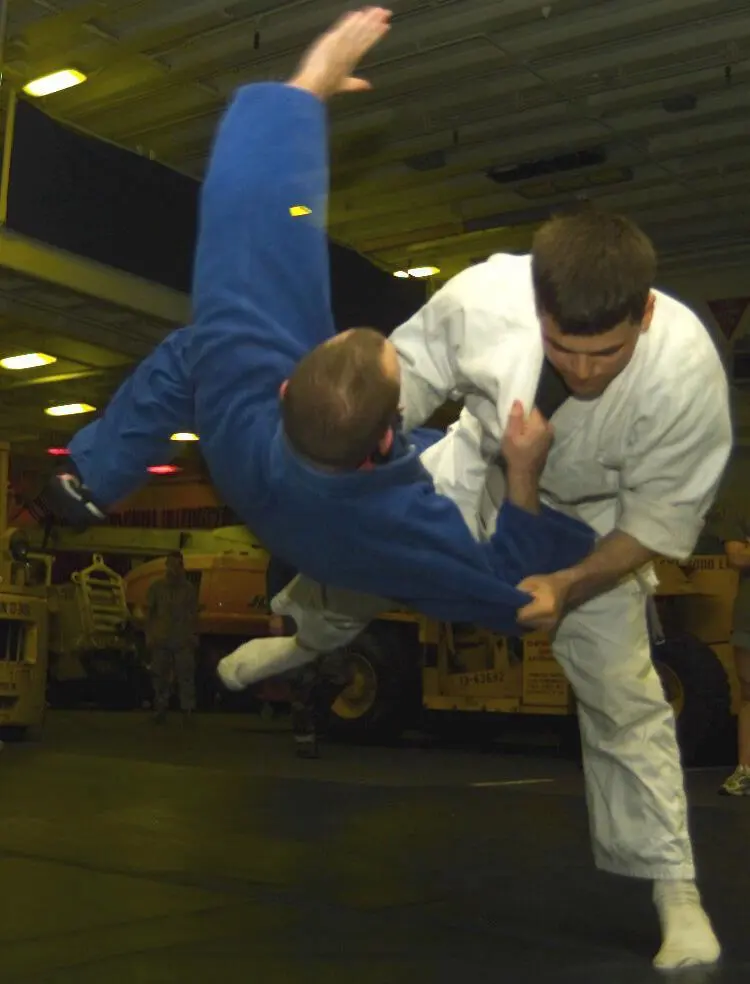
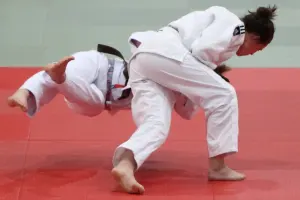
Image: Cpl. Jeff Sisto / United States Marine Corps via Wikimedia Commons · Public domain, U.S. federal government work
Overview
Balance changes before a throw is visible.
Eight directions make a useful teaching map. Real movement, positioning and application overlap.
Left front
Front
Right front
Left
facing front ↑
Right
Left rear
Rear
Right rear
Conceptual plan view. Arrows name directions of disturbed balance; they are not instructions for hand force or a guaranteed throw.
At a glance
- Japanese
- 崩し
- Literal sense
- Breaking down or disturbing
- Primary use
- Creating an opportunity for technique
- Teaching sequence
- Kuzushi, tsukuri, kake
- Common model
- Eight directions of balance
Context
Kuzushi is a Japanese martial term most closely associated with Judo’s analysis of throwing. Written 崩し, it comes from a verb meaning to break down, disturb, or unbalance. In Judo teaching, kuzushi is commonly discussed with tsukuri, the positioning or fitting-in for a technique, and kake, its application. The concept is broader than pulling an opponent in a fixed direction. Balance may be altered through movement, posture, gripping, timing, reaction, or the opponent’s own action, and the three phases can overlap in fluent execution. Kuzushi is therefore best understood as the creation or recognition of a usable loss of stability rather than as a separate preliminary step performed identically for every throw.
Meaning in Judo
In Judo, kuzushi describes a change that makes stable resistance more difficult. It can involve the opponent’s centre of mass, base of support, posture, attention, and ability to step or turn.
The English word off-balancing is useful but incomplete. A person may remain upright yet be unable to respond effectively because weight, feet, and posture have been organised against the intended action.
Kuzushi, tsukuri, and kake
The familiar three-part model links kuzushi with tsukuri and kake. Tsukuri positions the bodies for the selected technique; kake applies or completes it. The model helps learners diagnose why a throw did not develop.
It should not be read as a rigid count of three. Positioning can create kuzushi, and the beginning of kake may deepen it. Advanced execution often appears continuous.
Kuzushi · 崩し
Create or recognise reduced stability. ↔
Tsukuri · 作り
Arrange position, distance and entry. ↔
Kake · 掛け
Apply or complete the action.
Positioning can create imbalance; application can deepen it. Read these as connected aspects, not a stop–start sequence.
Eight directions
Happō-no-kuzushi, the eight directions of kuzushi, is a teaching model that maps forward, backward, sideways, and diagonal disturbances. It gives beginners a clear way to connect a technique with the direction in which stability is reduced.
Real movement is not limited to eight lines. Rotation, changes of height, stepping patterns, grip pressure, and combinations produce continuously changing opportunities.
Movement and reaction
Kuzushi can be created directly through coordinated pushing, pulling, lifting, turning, or body movement. It can also be received from an opponent who steps, resists, attacks, or attempts to recover posture.
This responsive use is connected with Judo’s principle of avoiding unnecessary force. The aim is not simply to pull harder, but to organise action at a moment when resistance is mechanically and tactically disadvantaged.
Grips, posture, and timing
Grips transmit force and information, but kuzushi is produced by the whole body. Foot placement, hip position, posture, distance, and rhythm determine whether the hands can influence balance effectively.
Timing is equally important. A small action during a step or turn can create a larger opportunity than a stronger action against a settled stance.
Throws and transitions
Kuzushi is central to nage-waza because a throw must overcome the opponent’s ability to stand and recover. Each technique uses a characteristic relationship between direction, entry, and completion.
The idea can also illuminate transitions into katame-waza, where posture and base are disrupted to turn, pin, or control. The terminology is most formalised in throwing instruction.
Examples: observing a changing opportunity
During a step
As uke transfers weight, the base of support changes. This illustrates a moment to analyse; it does not prescribe a pull direction for every throw.
During a recovery
A response to one disturbance can open another direction. Observe how the entry changes with the response.
During a transition
Turning or controlling a partner on the ground also changes posture and base. This is a broader application of the idea, distinct from the eight-direction throwing model.
Kata, randori, and analysis
Kata makes the relationship between action, reaction, and balance visible through a prescribed sequence. Repetition allows learners to study direction and timing without requiring every attempt to solve a new tactical problem.
Randori tests whether the same principles can be recognised under resistance and unpredictable movement. Technical and biomechanical analysis can describe forces and stability, but coaching language remains a practical model rather than a complete physical equation.
Sources
Last updated:
.jpg?width=320)