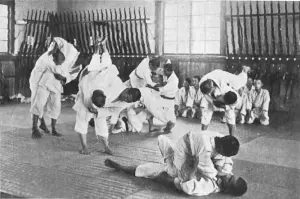
Jujutsu
Jujutsu (Jiujitsu)
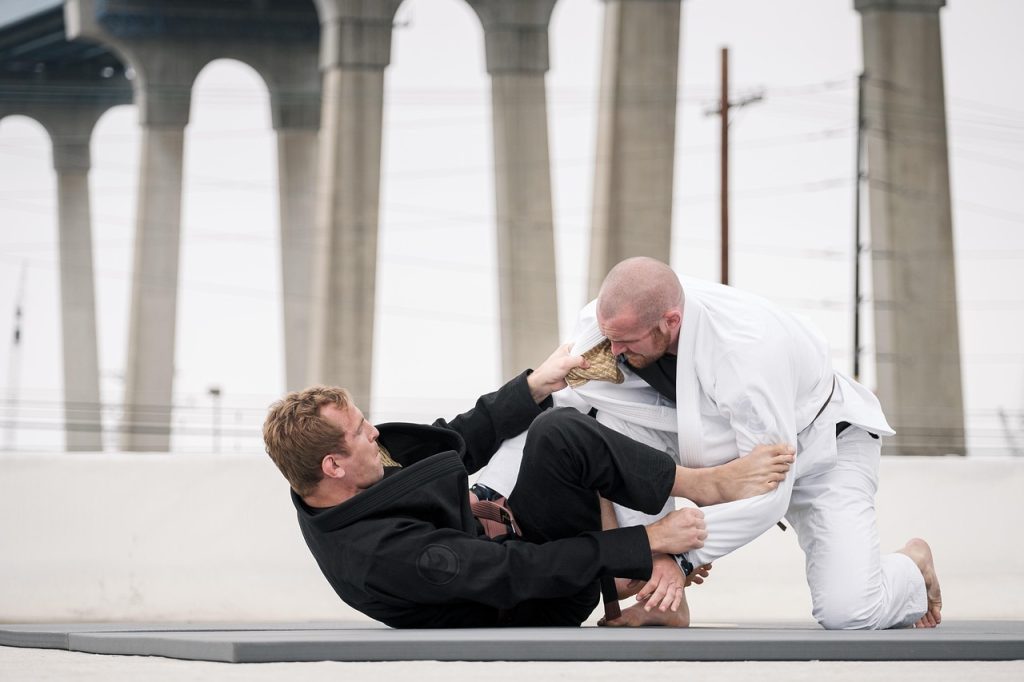
Image: GoldBJJ / Pixabay · Pixabay Content License
Overview
One close-range problem.
Many historical answers.
Jujutsu is a family of Japanese martial traditions for controlling an opponent at close range. Throws, locks, pins, restraints, strikes, escapes, and weapon-related methods appear in different combinations because no single school or syllabus defines the whole category.
Independent lineages with different dates, teachers, kata, weapons, and emphases.
Balance, angle, timing, leverage, position, restraint, and whole-body movement.
Classical kata, self-defence, randori, grading, competition, or composite practice.
- Japanese name
- 柔術 · jūjutsu
- Type
- Family of Japanese grappling and close-combat traditions
- Technical range
- Throws, locks, pins, chokes, restraints, strikes, escapes, and weapons
- Historical reach
- Classical schools, modern organisations, and global descendants
01 Name & etymology
“Gentle art” is memorable—but incomplete.
The name describes an efficient relationship with force, not techniques that are necessarily soft.
Jū
Flexibility · adaptability · yielding
Change the angle, timing, or relationship instead of meeting force in the least efficient way.Jutsu
Art · technique · method
A body of skills and practices, not just one isolated move.Spelling is not lineage evidence. A modern school may choose a spelling to identify itself, but reliable identification still requires its Japanese name, teachers, documents, and curriculum. See Jujutsu Terminology and Jutsu and Dō in Japanese Martial Arts.
02 Classical-school network
Think “library of systems,” not one universal syllabus.
Japanese warrior schools could combine sword, spear, grappling, restraint, armour-related methods, and other skills. During the Edo period, lineages organised and transmitted different branches through structured kata.
Terms including yawara, torite, kogusoku, and jūjutsu appeared in different places and lineages. Several traditions continue today as koryū or kobudō, but their histories should be checked individually.
03 Body principle
A visible throw often begins with an invisible loss of structure.
Distance, timing, feet, hips, spine, and direction of movement create the conditions in which a lock or throw can work.
Change the line
Move, turn, enter, or redirect so force no longer travels through its strongest path.
Break balance
Kuzushi disturbs posture and reduces the opponent’s ability to organise strength.
Secure position
Whole-body connection places leverage, weight, or restraint where it matters.
Apply technique
The throw, lock, pin, strike, or escape becomes the outcome—not the starting point.
04 Technical scope
Five useful categories—never a guaranteed syllabus.
Nage-waza
Throwing methods that turn, lift, trip, or displace the body.
Katame-waza
Pins, joint locks, chokes, controls, and restraining methods.
Atemi-waza
Strikes used as attacks, distractions, or ways to create an opening.
Ukemi
Receiving techniques safely, including falls and rolls.
Buki-waza
Weapon-related practice preserved in some—but not all—lineages.
A classical school may centre paired kata; a modern organisation may add self-defence scenarios, grading, freer practice, or competition. The school name and published curriculum matter more than the label alone.
05 Kata & transmission
Kata records relationships—not only shapes.
In many traditional schools, kata is a two-person study in which a defined attack allows timing, distance, initiative, posture, control, and safety to be examined repeatedly.
Attack and response
The agreed sequence gives both partners a stable structure for study.
Distance and timing
Repetition reveals when structure becomes vulnerable and control becomes possible.
Trust and restraint
Partners signal, receive, and limit potentially dangerous locks and throws.
More than the outer form
Advanced practice can disclose tactical assumptions, rhythm, initiative, and school-specific principles.
06 Modern pathways
Related does not mean interchangeable.
Modern systems selected, reorganised, or locally transformed earlier material for new educational, institutional, and competitive settings.
Judo · Kodokan, 1882
Selected techniques were reorganised into a systematic educational method with safer forms of live practice.
Brazilian Jiu-Jitsu
A separate transnational history produced its own competitive culture and technical priorities.
Aikido
A documented teacher-student connection shaped a distinct modern budō—not a renaming of every jujutsu tradition.
07 Three-way distinction
Category, named system, and modern budō are different kinds of label.
Jujutsu
Many Japanese close-combat traditions with different lineages and curricula.
Ask: which ryūha or organisation?Daitō-ryū Aiki-jūjutsu
One specific system within the wider history, associated with Takeda Sōkaku.
Ask: which branch and teacher?Aikido
Developed by Morihei Ueshiba after extensive study, including Daitō-ryū.
Ask: which organisation and period?Terms such as aiki and aiki no jutsu belong to particular historical and school-specific explanations. They are not universal divisions shared by every jujutsu tradition.
08 Dōjō participation
Before visiting, identify the school behind the label.
- 01
Full school name
Look for the ryūha or organisation—not only “traditional jujutsu.”
- 02
Teachers and credentials
Check how qualifications and lineage are explained.
- 03
Training format
Ask whether practice centres kata, self-defence, freer practice, or competition.
- 04
Beginner safety
Confirm that ukemi, contact limits, tapping, and progression are taught clearly.
A responsible dōjō does not pressure a beginner to endure uncontrolled pain or dangerous techniques.
09 Working vocabulary
Six terms that make descriptions more precise.
- Dōjō
- A place for training.
- Ryūha
- A transmitted school or lineage.
- Koryū
- A classical tradition, generally associated with systems formed before modern budō.
- Kuzushi
- Breaking or disturbing balance.
- Ukemi
- Receiving a technique safely.
- Randori
- Free or less predetermined practice; its form depends on the school.
Sources and further reading
- Takenouchi-ryū, Introduction.
- Japan Kobudo Promotion Society, Member Schools.
- International Journal of Sport and Health Science, The Principle of Ju.
- Research Journal of Budo, Historical Changes from Jujutsu to Kodokan Judo.
- Nippon Budokan, Japanese Kobudō and the Development of Classical Schools.
- Web Japan, Martial Arts: From Ancient Tradition to Modern Sport.
- Web Japan, The History of Judo and Its Jujutsu Roots.
Last updated: