Judo
Katame-waza
Judo › Katame-waza
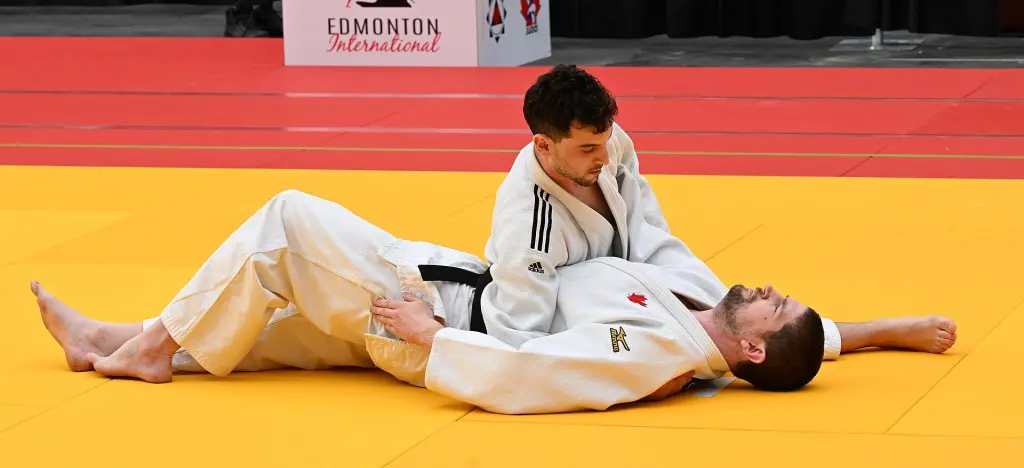
Image: Edmonton International Judo Championship / Flickr via Wikimedia Commons · Public domain
Katame-waza, written 固技, are the grappling and control techniques classified in Kodokan Judo. The recognised list contains 32 techniques: ten osaekomi-waza (holding techniques), twelve shime-waza (strangling techniques), and ten kansetsu-waza (joint techniques). They are frequently associated with ne-waza, or ground techniques, but the terms are not exact synonyms. A katame-waza can begin during a transition from standing, while ne-waza describes the broader ground phase and may include movement that is not itself a named finishing technique. Kata, controlled repetition, and randori provide different ways to study position, escape, continuity, and submission. Competition permits only specified applications, with additional restrictions according to age, level, and governing rules.
Overview
| Japanese | 固技 |
|---|---|
| Meaning | Grappling or control techniques |
| Kodokan total | 32 recognised techniques |
| Divisions | 10 holds, 12 strangles, 10 joint techniques |
| Common context | Ne-waza and standing-to-ground transitions |
Place in Judo
Katame-waza are one of Judo’s three broad technical groups, together with nage-waza and atemi-waza. They organise methods of immobilising, constricting, or controlling a joint.
The Kodokan list is a technical classification. Contest rules determine which applications may score or cause submission in a particular division.
Osaekomi-waza
Osaekomi-waza are holding techniques that control an opponent’s upper body in a recognised pinning relationship. Examples include kesa-gatame, yoko-shiho-gatame, and tate-shiho-gatame.
A named hold is more than a static pose. Weight distribution, base, control of turning space, and adjustment to escape attempts determine whether the position can be maintained.
Shime-waza
Shime-waza are constriction techniques, commonly translated as strangles or chokes. Their names often identify the grip, orientation, or use of the uniform, as in hadaka-jime and okuri-eri-jime.
Because these techniques can cause rapid loss of consciousness or injury, they require qualified instruction, immediate release on submission, and strict observance of age and competition rules.
Kansetsu-waza
Kansetsu-waza are joint techniques. The classified curriculum contains different actions, but ordinary Judo contest restricts joint attacks to the elbow under the current IJF framework.
A curricular name and a legal contest application are therefore distinct. Practice should use progressive control and an immediate response to submission.
Katame-waza and ne-waza
Ne-waza means ground techniques or the ground phase. It includes entries, turnovers, escapes, transitions, and positional movement as well as named katame-waza. The two terms overlap but should not be used as perfect equivalents.
Shichitei Judo illustrates how a different rules environment can give more time and strategic importance to extended ne-waza while remaining part of Judo.
Kata, randori, and transition
Katame-no-kata organises representative controls, strangles, and joint techniques into prescribed sequences. It studies principles of attack, defence, and response rather than reproducing a contest round.
Randori develops adaptation, while transition practice connects a throw or failed throw to ground control. Continuity matters because a brief positional advantage can disappear if the practitioner stops to reset.
Competition and safety
In contest, a qualifying hold can score over a timed period, and a legal strangle or joint technique can end the match by submission. Referees also stop action when progress has ceased or safety requires intervention.
Exact times, prohibited actions, and eligibility differ across rule editions and age groups. The current governing-body document, not a general encyclopedia summary, is the final reference.
Comparison with Brazilian Jiu-Jitsu
Brazilian Jiu-Jitsu shares many grappling problems with Judo but uses a different competition structure, positional scoring system, and range of permitted submissions. A similar-looking control may therefore carry a different strategic value.
Historical connection does not make the modern rulesets interchangeable. The page Judo, Jujutsu and Brazilian Jiu-Jitsu provides a broader comparison.
Sources
Last updated: