
Judo
Seiryoku-Zenyo
.jpg?width=867)
Image: Baseball Magazine Co.; restored by Jdcollins13 / Wikimedia Commons · Public domain
Overview
| Japanese | 精力善用 |
|---|---|
| Translation | Best use of energy |
| Associated with | Jigoro Kano and Kodokan Judo |
| Principle | Effective use of mental and physical energy |
| Paired concept | Jita Kyōei |
Seiryoku-Zenyo (Japanese: 精力善用, seiryoku zenyō) is a principle formulated by Jigoro Kano, the founder of Kodokan judo. It is commonly translated as “maximum efficient use of energy,” “best use of energy,” or “good use of mind and body.” Kano treated it as a general standard for choosing effective action, not only as an explanation of throwing mechanics. Together with Jita-Kyoei, it forms a central expression of the technical, educational, and ethical purpose of judo.
Meaning and terminology
Seiryoku refers to a person’s physical and mental powers, while zenyō means using them in the best or most appropriate way. The English word “efficiency” is useful but incomplete if it suggests speed or minimum effort alone. Kano’s explanations concern the fullest effective use of one’s capacities in relation to a chosen purpose.
The phrase is also written with a macron as Seiryoku-Zenyō. In English-language judo organizations, translations differ, but “maximum efficient use of energy” is widely recognized.
Development in Kano’s thought
Kano established the Kodokan in 1882 after studying several schools of jujutsu. He reorganized techniques around education, systematic practice, and principles that could be examined rationally. The older maxim of yielding to overcome strength remained important, but Kano considered it too narrow to explain every successful technique. Some actions require direct force, timing, balance, or coordinated movement rather than yielding alone.
Seiryoku-Zenyo became a broader account: a judoka should apply physical and mental resources in the manner best suited to the situation. Historical studies of Kano’s writings identify the principle as part of his mature theory of judo and as a concept he extended to conduct outside the dojo.
Technical application in judo
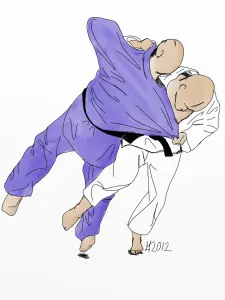
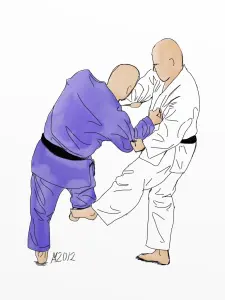
In Judo, efficient action depends on posture, balance, timing, direction, and the use of an opponent’s movement. A successful throw is not simply an attempt to overpower another body. It combines preparatory unbalancing, positioning, and execution so that available force produces the intended result.
The principle also applies to learning. Repeated practice should have a clear purpose; unnecessary tension and unsafe force waste energy and impede improvement. Randori provides changing problems in which practitioners learn to adjust, while kata preserves structured examples of technical principles. Efficiency therefore includes attention, judgment, and control as well as muscular effort.
Physical and mental energy
Kano explicitly referred to both spiritual or mental and physical energies. Seiryoku-Zenyo can therefore include concentration, emotional regulation, planning, and the selection of means. Remaining calm, recognizing the important feature of a problem, and acting at the right moment may be more effective than greater exertion.
This does not mean conserving energy at all times. An effective response may require intense effort. The question is whether the effort is directed appropriately and whether avoidable waste has been reduced.
Relationship to Jita-Kyoei
Efficiency alone does not determine which purposes should be pursued. Jita-Kyoei, usually translated as “mutual welfare and benefit,” provides the complementary social ideal. The two principles connect capable action with the flourishing of oneself and others.
Within partner training, this relationship is concrete. Each participant must offer meaningful practice while maintaining safety and respect. An action that produces a short-term advantage but destroys the conditions for learning would not represent the mature use of either principle.
Applications beyond the dojo
Kano was a professional educator and regarded judo as preparation for life. He applied Seiryoku-Zenyo to study, work, health, and social conduct. Contemporary judo institutions continue to use the phrase when explaining the educational dimension of the art.
Outside judo, the term is sometimes reduced to a productivity slogan. Its historical setting is wider: it joins technical competence, self-cultivation, and responsibility. The principle asks how a person can use all available capacities intelligently in circumstances that also involve other people.
Efficiency does not mean minimum effort
Seiryoku-Zenyo is not a rule to do as little as possible. It asks whether physical and mental energy are used in the most effective way for a legitimate purpose under the actual conditions. Efficient action may be relaxed and economical, but it may also require decisive commitment, repeated practice, careful preparation, or substantial force when those are proportionate to the task. The relevant comparison is between methods and outcomes, not between effort and idleness.
This distinction matters outside technique as well as inside it. Planning, timing, attention, cooperation, and recovery are forms of energy use; an immediately successful action can still be wasteful or harmful over time. The study of Kano’s two Judo principles describes using energy in appropriate quantities case by case and treats the principle as correlated with Jita-Kyoei. Seiryoku-Zenyo helps select effective means, while Jita-Kyoei helps test whether the intended benefit is genuinely mutual.
Related entries
Sources and further reading
Last updated:
.jpg)
.jpg#Licensing)