Judo
Jita-Kyoei

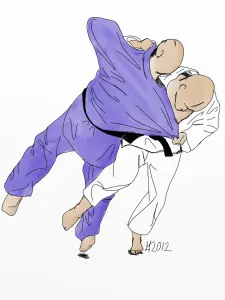
Image: Kodansha Ltd. / Wikimedia Commons · Public domain
Overview
| Japanese | 自他共栄 |
|---|---|
| Translation | Mutual welfare and benefit |
| Associated with | Jigoro Kano and Kodokan Judo |
| Principle | Personal development should contribute to the welfare of others |
| Paired concept | Seiryoku Zen’yō |
Jita-Kyoei (Japanese: 自他共栄, jita kyōei) is a principle associated with Jigoro Kano’s philosophy of judo. It is commonly translated as “mutual welfare and benefit” or “mutual prosperity for self and others.” The phrase describes an ethical ideal in which individual development and the well-being of other people are treated as mutually supporting rather than competing aims. In Kodokan judo, it complements Seiryoku-Zenyo, the principle of using physical and mental energy effectively.
Meaning and terminology
The four characters can be read as “self and others” (jita) and “prosper together” (kyōei). English renderings vary because the term refers to both welfare and flourishing: “mutual welfare and benefit,” “mutual prosperity,” and “prosperity for oneself and others” all appear in discussions of Kano’s thought. The expression is not simply a rule of politeness. It proposes that a durable benefit for one person should be compatible with, and ideally contribute to, the benefit of the wider group.
Development in Kano’s thought
The principle is best read in the context of Jigoro Kano’s work as an educator and the institutional development of the Kodokan, rather than as a later motivational phrase detached from Judo practice.
Jigoro Kano founded the Kodokan in 1882 and presented judo as a system of physical, intellectual, and moral education. His explanations changed over time as he refined the relationship between technical training and conduct in society. Historical research on his writings identifies Jita-Kyoei and Seiryoku-Zenyo as central formulations of his mature philosophy, particularly from the Taisho period onward.
Kano did not restrict the value of judo to contest results or self-defence. Training was also intended to cultivate judgment, self-control, cooperation, and an ability to contribute to society. Jita-Kyoei expressed the social dimension of that educational project.
Role in judo practice
Partner roles and training methods such as tori, uke, kata, and randori are defined in Judo Terminology. Their cooperative structure helps explain how individual improvement can depend on reciprocal practice.
Judo requires partners. Throwing, grappling, breakfalls, and free practice cannot be learned safely through opposition alone; each participant must provide realistic resistance while protecting the conditions in which both can improve. Etiquette, controlled technique, and care for a partner therefore have practical as well as moral functions.
In this setting, Jita-Kyoei does not eliminate competition. Randori and shiai can test skill under pressure, but the contest takes place within agreed rules and a shared practice. The opponent is also the person who makes learning possible. The principle is often used to explain why respect, safety, and reciprocal development remain part of judo even when participants seek victory.
Relationship to Seiryoku-Zenyo
Seiryoku-Zenyo concerns the most effective use of physical and mental energy in pursuing a purpose. Jita-Kyoei supplies a social and ethical direction for that efficiency. Read together, the two principles ask both whether an action is effective and whether its results support shared welfare.
This pairing also guards against a narrow interpretation of efficiency. An immediately successful action may create unnecessary conflict or harm long-term cooperation. From the standpoint of Jita-Kyoei, good judgment includes the effects of an action on partners, institutions, and society.
Educational and social applications
Kano worked as an educator as well as a martial artist, and he applied judo’s principles beyond the dojo. Jita-Kyoei has consequently been discussed in physical education, school communities, organizational ethics, and international exchange. These applications differ in detail, but they share an emphasis on developing the individual through constructive relations with others.
The phrase is sometimes used today as a general slogan for teamwork. In its historical context, however, it belongs to a larger theory of disciplined self-cultivation. Mutual benefit is not passive agreement: it requires capable individuals who can act effectively, regulate themselves, and cooperate toward worthwhile ends.
Contemporary significance
Jita-Kyoei remains part of the vocabulary through which judo organizations describe the educational purpose of the art. It is visible in expectations surrounding safe practice, respect for opponents, teaching responsibility, and the international community of judo. Interpretations vary among instructors and institutions, but the principle continues to distinguish Judo as a “way” of development rather than only a collection of fighting techniques.
A two-part test for applying Jita-Kyoei
A practical application can be tested with two questions. First, does the action develop the practitioner’s physical, intellectual, or moral capacity without needless waste or injury? Second, does it preserve or improve the conditions in which training partners and the wider group can also develop? In a dojo, that can include controlled resistance, honest feedback, safe falling practice, suitable challenge, shared responsibility for hygiene, and respect for different experience levels.
The principle is therefore broader than politeness but narrower than any claim made in the name of collective benefit. It does not erase consent, safety, rules, or individual dignity, and it is not a demand for one-sided self-sacrifice. Historical studies treat Jita-Kyoei together with Seiryoku-Zenyo; one helps evaluate the social purpose of action while the other helps evaluate the use of energy and method. The Research Journal of Budo study of both principles also shows why their meanings should not be reduced to slogans.
Related entries
Sources and further reading
Last updated: