Other Martial Arts
Iaido
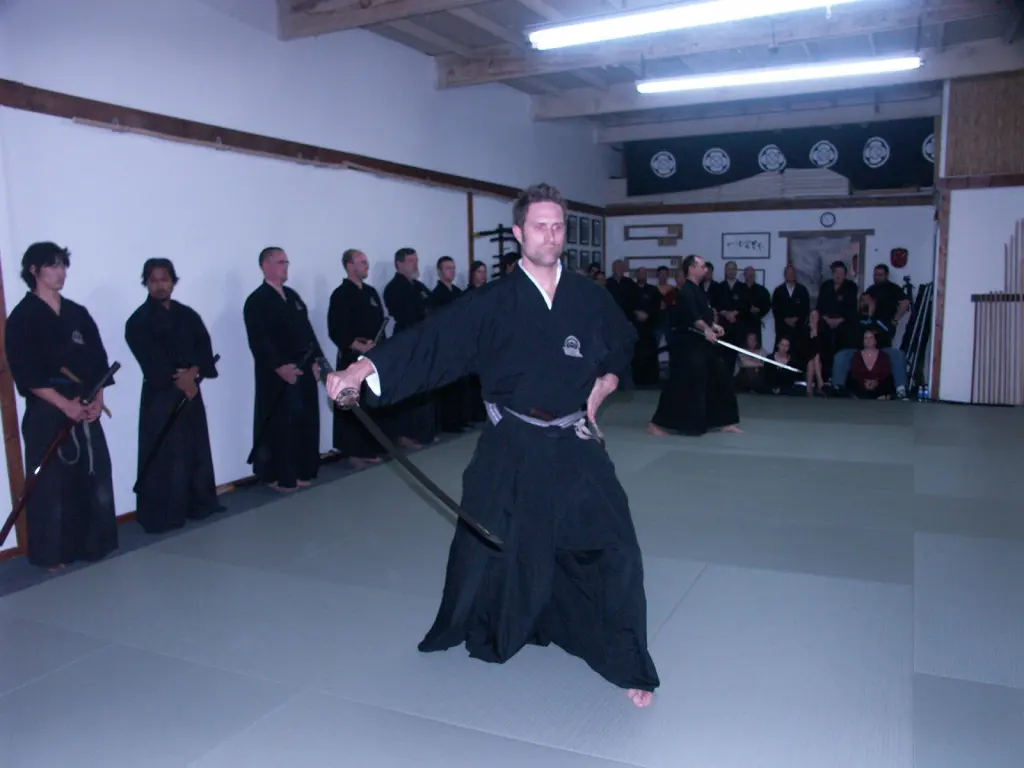
Image: Renfield Kuroda / Wikimedia Commons / Flickr · CC BY-SA 2.0
Overview
The technique begins before the sword leaves its scabbard.
Iaido is a Japanese sword discipline organised around controlled drawing, cutting, blade handling, and resheathing. Most practice uses prescribed solo kata against an imagined situation, so observation, posture, timing, distance, line, and continued awareness matter as much as the visible cut. Practitioners commonly begin with a wooden sword or an unsharpened iaitō; use of a live blade requires appropriate experience, equipment, space, and supervision. The All Japan Kendo Federation provides twelve shared forms for grading and competition, while classical schools preserve separate curricula and licences. Read the art as a continuous decision cycle rather than a sequence of dramatic sword poses.
Posture, gaze, distance, and intention establish the action.
The sword leaves the scabbard as an initial cut or control.
Footwork, line, grip, and body movement arrive together.
A formal blade-clearing action sustains composure and awareness.
Control continues until the sword and practitioner are settled.
- Japanese
- 居合道
“Way of drawing and meeting” - Classification
- Modern Japanese sword discipline
- Main method
- Prescribed solo kata
- Training tools
- Bokutō, iaitō, and—in advanced settings—shinken
- Shared syllabus
- 12 All Japan Kendo Federation forms
- Institutional setting
- Federation Iaido and multiple classical schools
01Historical frame
Older drawing traditions entered modern shared institutions.
Sword-drawing methods were preserved through named schools with different genealogies and technical assumptions. Modern Iaido adds federation grading, competition, and a common syllabus without erasing those distinctions.
- Premodern
School traditions
Systems now grouped under terms such as iaijutsu and battōjutsu developed methods for drawing and using the sword from varied positions and tactical premises.
- Modern era
Budō organisation
Schools, associations, grading systems, and public demonstrations helped recast sword practice after the samurai estate and public sword-wearing had ended.
- 1966–1969
Championship and shared forms
The first All Japan Iaido Championship was held in 1966. In 1969 the federation established seven standard forms for practitioners from different schools.
- 1980–1999
The present twelve
Three forms were added in 1980 and two in 1999, producing the twelve-form federation syllabus used today.
02Kata anatomy
A kata is an interpreted relationship, not only memorised choreography.
The practitioner must make an absent opponent legible through distance, gaze, timing, cutting line, and recovery. Names and details differ by form and school, but five questions organise observation.
- 1What changes before the draw?
Attention, posture, and positioning indicate why action becomes necessary.
- 2How does the draw create an advantage?
Scabbard movement, hand path, body angle, and footwork must clear the blade without losing control.
- 3Where is the imagined target?
Cutting line and distance should describe a coherent spatial problem rather than an empty flourish.
- 4Does the body support the sword?
Balance, grip, breath, and whole-body coordination prevent the arms from acting alone.
- 5Does awareness outlast the cut?
Chiburi, nōtō, and return are performed without mentally abandoning the encounter.
03Equipment & safety
Progression changes the tool; responsibility never disappears.
Instructor policy, school, age, local law, and experience determine what a practitioner uses. The categories below describe common roles, not an automatic timetable.
Bokutō
A wooden sword supports early handling, paired exercises, and some formal practice without a metal edge.
Iaitō
An unsharpened metal practice sword gives scabbard, weight, and fitting feedback while reducing—but not removing—risk.
Shinken
A live blade magnifies every error. Use belongs within qualified supervision, suitable facilities, and disciplined maintenance.
- InspectHandle, peg, fittings, blade, and scabbard
- ClearFloor, ceiling, walls, people, and draw path
- ControlDirection, speed, grip, and resheathing
- FollowInstructor, dōjō, transport, and legal rules
04Two frameworks
A common federation language can sit beside a school lineage.
Many practitioners study both. The relationship varies locally, so neither column should be treated as the higher or more authentic version of the other.
Federation Iaido
Twelve standard forms allow practitioners from different backgrounds to grade, train, demonstrate, and compete through common criteria.
Federation rank records achievement in that framework; it does not automatically confer a classical teaching licence.
Classical schools
A school may preserve its own forms, tactical assumptions, terminology, transmission structure, and supplementary methods.
A classical licence records standing within that lineage; it is not automatically interchangeable with federation dan rank.
05Grading, demonstration & competition
Fixed forms still leave much to judge.
According to the All Japan Kendo Federation’s overview, competitors perform five forms within six minutes. Judges compare more than memory: prescribed detail, sword control, posture, timing, spirit, and the credibility of the imagined encounter all matter.
Does the performance follow the selected forms and institutional standard?
Are drawing, cutting, chiburi, and nōtō managed without unsafe haste?
Do line, gaze, distance, and target remain coherent throughout?
Do preparation, action, recovery, and zanshin form one sequence?
Which federation, school, event, and current rules govern the assessment?
06Boundary checks
Related sword practices ask different questions.
Shared weapons, clothing, or organisations do not make every practice the same. Use the specific school and setting before transferring a claim.
Iaido
Centres controlled drawing and resheathing within prescribed scenarios, usually through solo kata.
Kendo
Uses shinai, armour, paired practice, matches, and kata to study opportunity and valid striking.
Tameshigiri
Tests cutting on prepared targets. Some schools include it, but it is not a universal synonym for Iaido.
The All Japan Kendo Federation administers both Kendo and Iaido. Institutional proximity supports exchange, but one discipline’s rank or competitive skill does not automatically transfer to the other.
Sources and further reading
- All Japan Kendo Federation, The Concept and History of Iaido.
- All Japan Kendo Federation, Organisation.
- Nippon Budokan, Introduction to Iaido.
- Nippon Budokan, Introduction of Budo Disciplines.
- Web Japan, Martial Arts: From Ancient Tradition to Modern Sport.
- Japanese Academy of Budo, An Introductory Study of the History of Budo Technique.
Last updated: