Other Martial Arts
Naginata
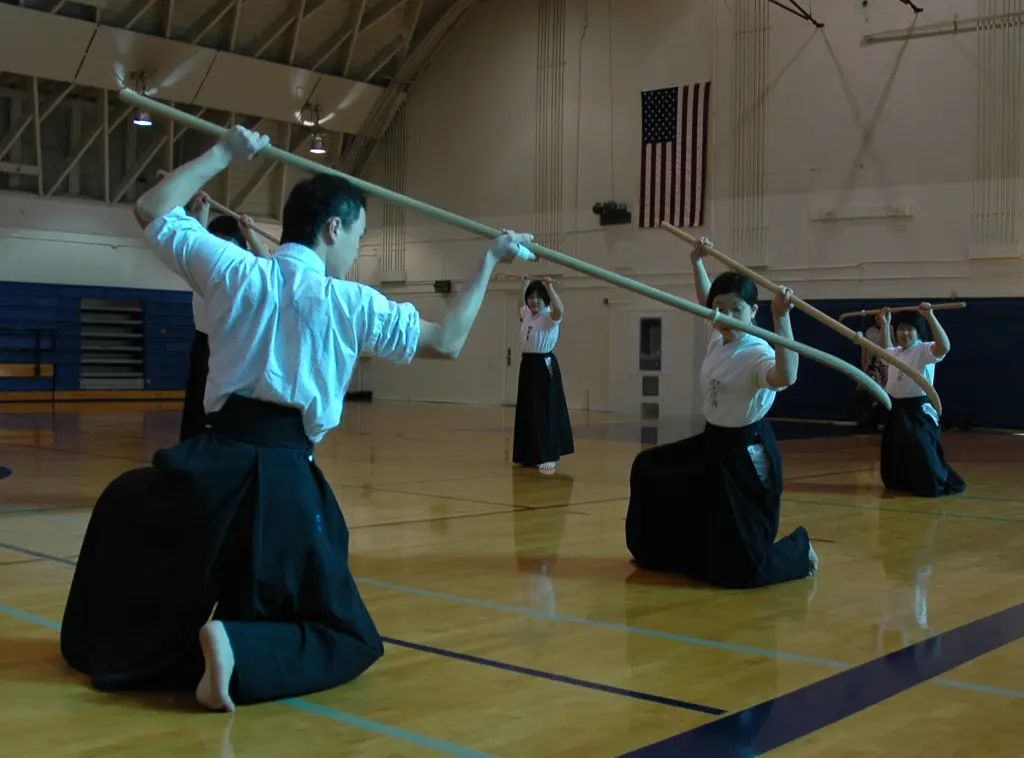
Image: Marshall Astor / Wikimedia Commons / Flickr · CC BY-SA 2.0
Overview
A long weapon turns distance into a moving problem.
Naginata names both a curved-bladed Japanese pole weapon and a modern budō practised with purpose-built training weapons. Modern students learn strikes, thrusts, deflections, footwork, paired forms, and regulated matches, using armour that adds lower-leg protection to equipment related to Kendo. The weapon’s length makes entry, retreat, rotation, high and low targets, and switching the forward side central tactical problems. The discipline’s history includes battlefield use, classical schools, Edo-period household culture, girls’ education, and postwar reconstruction; no single image explains all of it. Today, shiai and judged engi offer two complementary ways to make distance, precision, timing, and etiquette visible.
Use the weapon’s length without surrendering balance or line.
Move between high, mid, and low lines while the opponent responds.
Control the shaft, feet, and awareness when long range collapses.
- Japanese
- なぎなた・薙刀
Naginata - Classification
- Modern budō and pole-weapon discipline
- Historical weapon
- Curved blade mounted on a long shaft
- Practice modes
- Basics, shiai, engi, and demonstration
- Protection
- Men, kote, dō, tare, and sune
- Institutions
- All Japan and International Naginata federations
01Historical frame
One weapon, several social lives.
Blade shape, shaft length, mounting, school method, and social setting changed over time. The modern sport is historically connected to older use, but its safe equipment and national rules are twentieth-century constructions.
- Medieval
Reach on the battlefield
Long-shafted cutting weapons offered leverage and reach in warfare. Later prominence of the spear did not erase the naginata from martial curricula.
- Edo period
Schools and household culture
The weapon remained in composite traditions and became strongly associated with women of warrior households, dowry objects, and moral education.
- Modern schools
Girls’ physical education
Naginata practice entered women’s schooling and mass instruction. Prewar and wartime mobilisation should not be confused with postwar practice.
- 1955 onward
A new national discipline
The All Japan Naginata Federation was founded in 1955. Shared equipment, rules, forms, grading, and events enabled national and later international practice.
02Equipment map
Modern equipment makes full-distance exchange repeatable.
The training weapon is not a sharpened historical polearm. A wooden shaft and flexible bamboo blade are paired with clothing, armour, inspection, and controlled target rules.
Wooden shaft
The long shaft creates reach, rotation, sliding handwork, and two-sided movement.
Flexible blade
A bamboo striking section supports controlled partner practice and competitive exchange.
Bōgu + sune
Head, wrists, torso, waist, and lower legs are protected for the discipline’s target pattern.
Keikogi & hakama
Practice clothing supports wide footwork and a recognisable modern budō setting.
A protected surface is not automatically a valid score. Correct striking part, direction, posture, timing, spirit, and continued awareness remain part of evaluation.
03Distance laboratory
Reach is useful only when the practitioner can continually remake it.
The opponent does not stay at the ideal end of the weapon. Footwork, hand position, side changes, target level, and recovery must adapt as the interval expands or collapses.
Read maai
Know who can reach, what line is open, and how one step changes the relation.
Take the line
Move the weapon and body together instead of reaching with the arms alone.
Change side or level
Use the long shaft to connect high, mid, and low threats from either lead.
Recover awareness
Restore distance, structure, and readiness after attack or defence.
04Two performance modes
Shiai tests adaptation; engi makes coordination inspectable.
Both are rule-governed and both depend on partners. They reveal different qualities, so neither should be used as a complete definition of the discipline.
Shiai
Armoured opponents create and deny opportunities through free movement. Judges evaluate valid actions within current competition rules.
The tactical problem changes with distance, available targets, opponent response, and the ability to continue after contact.
Engi
Pairs perform designated techniques and are judged on accuracy, distance, timing, rhythm, coordination, and etiquette.
Because the sequence is shared, differences in execution become easier to see than in unrestricted exchange.
05Gender & education
The women’s history is central; it is not exclusive.
Naginata’s strong modern association with women reflects warrior-household culture, girls’ education, postwar federation building, and generations of women’s leadership. It should be studied rather than reduced to a timeless stereotype.
06Institutions & world
A national federation created the common platform; local cultures still differ.
The All Japan Naginata Federation was founded in 1955, and the International Naginata Federation in 1990. Schools, universities, community dōjō, national bodies, seminars, grading, and tournaments now connect practitioners across countries.
Naginata
Purpose-built training weapon, shared rules, grading, shiai, engi, and public demonstrations.
Naginatajutsu
Older or lineage-specific methods may use different weapons, forms, licences, tactical premises, and paired curricula.
Kendo
Related armour and judging vocabulary support comparison, but weapon length, targets, footwork, and tactical range differ.
Sources and further reading
- All Japan Naginata Federation, Naginata.
- Nippon Budokan, Introduction to Naginata.
- Japanese Academy of Budo, research on the development of modern Naginata.
- Japanese Academy of Budo, research on Naginata and women’s physical education.
- Nippon Budokan, Introduction of Budo Disciplines.
- Web Japan, Martial Arts: From Ancient Tradition to Modern Sport.
- Japanese Academy of Budo, An Introductory Study of the History of Budo Technique.
Last updated: