Martial Arts
Japanese Martial Arts

Image: Unknown artist; digitised by KB National Library of the Netherlands / Wikimedia Commons / KB National Library of the Netherlands · Public domain
Overview
One subject. Three overlapping histories.
Japanese martial arts are not one family tree. They are better understood as an overlap between inherited schools, modern institutions, and practices repeatedly reshaped by competition, education, migration, and public culture.
Lineages, licences, kata, weapons, and house or domain traditions.
Schools, police, universities, federations, ranks, and competition.
International rules, migration, local reinvention, and cultural exchange.
- Japanese terms
- 日本武術 · Nihon bujutsu
日本武道 · Nihon budō - Historical range
- Late-medieval schools to modern global systems
- Technical range
- Weapons, striking, grappling, throwing, restraint, archery, and horsemanship
- Training formats
- Kata, paired forms, solo practice, randori, shiai, and demonstration
01 Vocabulary
Name the layer before comparing the arts.
These labels overlap. They are historical clues, not fixed rankings of age, value, or effectiveness.
武芸
Bugei
A broad term for martial accomplishments or arts. Its scope changes by period and source.
武術
Bujutsu
Martial techniques or systems. The word does not automatically identify a battlefield art.
武道
Budō
“Martial way”; widely used for modern disciplines combining practice with educational, ethical, or social aims.
古流・古武道
Koryū and kobudō
Labels for old lineages or classical traditions. Institutions do not always draw their boundaries identically.
Reading note: Jutsu and Dō in Japanese Martial Arts explains why the suffix can guide interpretation but cannot replace checking an art’s curriculum and institutional history.
02 Historical spine
Follow changes in patronage, setting, and purpose.
The history becomes clearer when each period is read through one question: where could training continue, and what did that setting reward?
- Before 1600
Composite warrior education
Archery, horsemanship, spear, sword, glaive, grappling, swimming, gunnery, and restraint could belong to a wider military education. Named lineages became increasingly visible from the late medieval period. Takenouchi-ryū and Yagyū Shingan-ryū show why classical practice cannot be reduced to modern unarmed combat.
- 1603–1868
Tokugawa peace changes the training environment
Large-scale domestic warfare declined, yet schools organised kata, licences, teaching lines, and dōjō. Readiness now existed beside employment, identity, education, health, and cultivation. Everyday clothing and urban settings increased the importance of restraint and control in traditions such as Sekiguchi Shinshin-ryū, Yōshin-ryū, and Shibukawa-ryū.
- 1868–1895
From domains to public institutions
The Meiji state dismantled the warrior class and older patronage. Martial practice survived through police training, public demonstrations, commercial dōjō, schools, and universities. The Tokyo Metropolitan Police supported sword training after 1877; Jigoro Kano founded the Kodokan in 1882.
- 1895–1945
National standardisation—and mobilisation
The Dai Nippon Butoku Kai promoted ranks, teaching titles, demonstrations, and shared standards. Budō entered schools and national institutions, but especially in the 1930s and wartime years it was also drawn into nationalism, military usefulness, loyalty, and mobilisation.
- After 1945
Reconstruction, sport, and global circulation
Organisations and school programmes were suspended or reorganised, then returned with revised governance and stronger emphasis on sport, education, recreation, and international exchange. Judo entered the Olympic programme in Tokyo in 1964; other arts expanded through teachers, universities, publishing, film, and migration.
Sacred geography also matters: Kashima Jingu connects Takemikazuchi, Tsukahara Bokuden, and several distinct sword traditions—but association should not be mistaken for one uninterrupted lineage.
03 Major pathways
Classify by technical focus—and then check the institution.
Names tell only part of the story. Rules, teaching structure, governing bodies, and training goals often explain more than a simple armed-versus-unarmed split.
- JujutsuA family of traditions, not one universal syllabus.
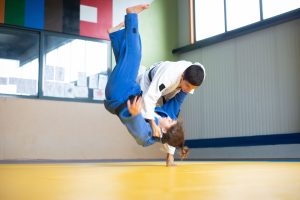
- JudoSelected jūjutsu methods reorganised around kata, randori, education, and later sport.
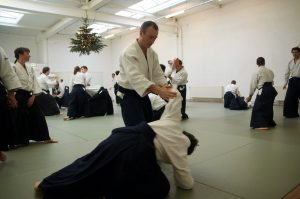
- AikidoUeshiba’s modern reorientation of training strongly informed by Daitō-ryū.
- SumōWrestling, professional organisation, spectacle, and ritual developed across distinct settings.
- KendōProtective sword practice combines shinai competition with formal kata.
- IaidōControlled sword drawing through federation forms and classical-school curricula.
- KyūdōBow traditions reorganised around target practice, procedure, education, and ceremony.
- NaginataHistorical polearm practice linked to paired forms and protective-equipment matches.
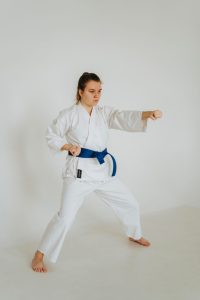
- KarateRyukyuan and Okinawan traditions reshaped into named schools and modern budō institutions.
- Shōrinji KempōA postwar system combining striking, joint control, paired practice, and explicit education.
- Yoseikan BudōA deliberately cross-disciplinary modern pathway rather than a single-source lineage.
- Japan Aikido AssociationAikido kata paired with controlled randori and organised competition.
04 Training logic
Every training format preserves something—and filters something out.
Kata
Stabilises timing, distance, posture, tactics, and technical relationships.
Randori
Introduces freer decision-making and resistance inside agreed boundaries.
Shiai
Rewards tactics that satisfy a particular ruleset, scoring system, and safety model.
Equipment changes practice. Bamboo swords, armour, mats, breakfalls, gloves, weight classes, prohibited techniques, and referees make sustained training possible.
Safety rules also shape evidence. What succeeds in competition shows adaptation to that contest; it does not automatically define the full technical inheritance of an art. Kendō’s yūkō-datotsu, for example, evaluates more than contact alone.
Case study: encounters involving Mataemon Tanabe and Fusen-ryū highlighted newaza, but do not prove that one school created all Judo groundwork. Technical change usually involves teachers, rules, institutions, and retrospective stories.
05 · Network view
Trace transmission without flattening every connection.
The dedicated map separates documented study and reorganisation from contest contact, institutional borrowing, and disputed claims.
06 Common mistakes
Three shortcuts that distort the history.
“Classical” means frozen
Living lineages adapt teaching, emphasis, membership, and public presentation even while preserving inherited kata.
Jutsu became peaceful dō
The vocabulary does not describe one universal moral ladder. Classical arts can cultivate character; modern budō can retain combat and competition.
Shared institutions prove lineage
Uniforms, ranks, university clubs, and federations may be borrowed without one art becoming a technical descendant of another.
07 Living traditions
Global reach multiplies versions; it does not erase local practice.
Preservation
Classical schools continue through licences, demonstrations, and small communities. The Nihon Kobudō Kyōkai presents traditions ranging from swordsmanship and jūjutsu to archery, gunnery, rope restraint, and mounted arts.
Standardisation
Police organisations, schools, universities, national federations, and venues such as Nippon Budokan shape shared rules and public presentation. Yet national, international, event, and youth provisions may still differ; see Kendō Rules.
Reinvention
Teachers, migration, military and university contacts, film, and publishing create new interpretations. Mitsuyo Maeda illustrates how a Japanese martial tradition could change through travel, entertainment, and local adoption.
Sources
- Nippon Budokan, Japanese Budō (Martial Ways).
- Web Japan, Martial Arts: From Ancient Tradition to Modern Sport.
- Nihon Kobudō Kyōkai, index of classical martial traditions.
- Japanese Academy of Budo, An Introductory Study of the History of Budo Technique.
- Japanese Academy of Budo, The Origin of the Militarization of Martial Arts during the Second Sino-Japanese War.
- University of Tsukuba, Dr. Kano Jigoro, the Pioneer of Judo.
- Aikikai Foundation, History of Aikido.
- Japan Karate Association, Funakoshi Gichin.
Last updated: