Jujutsu
Tenjin Shin’yō-ryū Jūjutsu

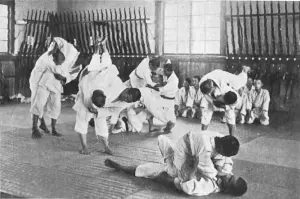
Image: Yoshida Chiharu / Wikimedia Commons · Public domain
Overview
Strike, unbalance, control—and understand the transition.
Tenjin Shin’yō-ryū Jūjutsu (天神真楊流柔術) is a late-Edo jujutsu tradition associated with Iso Mataemon Masatari. School histories describe Iso’s study of Yōshin-ryū and Shin-no-Shintō-ryū and his reorganisation of their material after extensive practical training. The curriculum connects atemi to vulnerable targets with throws, joint controls, strangulations, immobilisation, and kappō revival methods; these are interacting parts of close-range practice, not separate specialist arts. Jigoro Kano studied under Fukuda Hachinosuke and Iso Masatomo before training in Kitō-ryū and founding the Kodokan in 1882. Tenjin Shin’yō-ryū was therefore a major technical source for Judo, while Kodokan Judo remains a distinct educational and martial system built through selection, modification, comparison, and new institutional aims.
Atemi · throws · controls · strangulations · kappō
One important input to Kodokan Judo
- Japanese
- 天神真楊流柔術
- Founder
- Iso Mataemon Masatari
- Formation
- Early 19th century · late Edo period
- Known for
- Atemi, locks, throws, strangulations, and kappō
- Training frame
- Paired kata; line-dependent transmission
- Modern connection
- A major source studied by Jigoro Kano
01Formation
The school is presented as a synthesis, not a spontaneous invention.
Accounts preserved by the tradition connect its formation to Iso’s earlier study and subsequent testing. Exact formation dates vary among secondary sources, so the early nineteenth century is the safest frame.
Yōshin-ryū
One of the two named traditions in the school’s account of Iso’s training.
Shin-no-Shintō-ryū
The second named tradition; spellings and romanisation vary in English sources.
Tenjin Shin’yō-ryū
Iso’s system joined inherited material with experience, pedagogy, and a new transmitted identity.
02Edo-to-Meiji timeline
An Edo dojo became part of modern budō’s prehistory.
The important bridge is documented study: named teachers, a Tokyo training environment, and Kano’s later reorganisation—not a claim that one old curriculum simply changed its name.
- Early 19th c.
Iso forms the tradition
The school’s history connects its creation with training in two earlier jujutsu systems and extensive practical experience.
- Late Edo
Otamagaike dojo
Iso taught in the Kanda Otamagaike area of Edo; the tradition describes a large curriculum and broad following.
- 1877 onward
Kano studies the school
Kano trained under Fukuda Hachinosuke and then Iso Masatomo before continuing his jujutsu study elsewhere.
- 1882
The Kodokan begins
Kano founded a new system with different educational, institutional, and technical organisation.
Saigō Shirō also trained at the Tenjin Shin’yō-ryū dojo of Inoue Keitarō before entering the Kodokan in 1882.
03Connected technique
The decisive idea is the link between actions.
Names identify technical families. Kata shows how one family changes the conditions for the next.
Strike or pressure a vulnerable target to change attention, posture, or response.
Break or redirect balance rather than contest strength directly.
Apply joint control, restraint, or a takedown as structure changes.
Secure the opponent according to the form and tactical context.
This is a reading model, not a claim that every kata follows the same four steps.
04Training & kappō
“Life and death” describes a paired body of knowledge.
The tradition is known for sappō, methods capable of disabling, and kappō, traditional revival methods. Historical inclusion does not make kappō a substitute for modern emergency medicine.
Paired kata
Standing and seated forms organise responses to grabs, strikes, posture changes, and close-range attacks.
Names, order, and interpretation may differ by lineage.
Kappō
Revival and emergency-response methods were transmitted alongside techniques of control and injury.
In a present emergency, follow qualified medical guidance and local emergency procedures.
05Documented route to Judo
Study became input; input became reorganisation.
Tenjin Shin’yō-ryū and Kitō-ryū are often highlighted because Kano studied both deeply. The relationship is strong without being an identity statement.
Early teacher
Continued study
Compared, selected, modified, and systematised material.
Education, kata, randori, ethics, and public organisation.
06Present-day transmission
A living name may contain more than one lineage claim.
Tenjin Shin’yō-ryū continues through several lines. Demonstration bodies, organisations, teachers, and branch records can document current activity, but no undated claim should be applied automatically to all groups.
- 1Identify the branch
State which organisation or teacher is being described.
- 2Date leadership claims
Titles and succession can change; a source needs a publication or access context.
- 3Keep curricula attributed
A demonstrated or published syllabus may represent one transmission rather than the whole name.
07Common misconceptions
Three distinctions keep the history legible.
Tenjin Shin’yō-ryū has techniques and training purposes beyond modern contest rules.
Striking operates inside a connected grappling and control sequence.
Kano studied multiple traditions and built a distinct institution and pedagogy.
Sources and further reading
Last updated: