Jujutsu
Fusen-ryū Jūjutsu

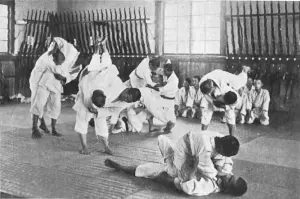
Image: Asahi Shimbun / Wikimedia Commons · Public domain
Overview
One ground-fighting specialist changed the conversation—not the origin of all newaza.
Fusen-ryū Jūjutsu (不遷流柔術) is a late-Edo Japanese jujutsu tradition associated with the Buddhist priest and martial artist Takeda Motsugai. It later became widely known through Mataemon Tanabe, whose success in ground engagement placed him in the history of early Kodokan Judo. Tanabe’s reputation is historically important, but it should not be expanded into the claim that Fusen-ryū invented ground fighting or transferred a complete newaza syllabus to Jigoro Kano after one decisive team match. Ground methods already existed in several jujutsu traditions and early Kodokan practice. The more defensible picture is one of specialist skill, repeated contests, technical exchange, and gradual systematisation.
Fusen-ryū
A wider jujutsu curriculum associated with Takeda Motsugai.
Mataemon Tanabe
Highly effective transitions, controls, holds, and strangulations.
Kodokan newaza develops
Research, encounters, rules, and multiple practitioners—not a single-source copy.
- Japanese
- 不遷流柔術
- Founder
- Takeda Motsugai
- Historical frame
- Late Edo period onward
- Best-known figure
- Mataemon Tanabe
- Known for
- Jujutsu and later newaza history
- Evidence lesson
- Influence is not the same as sole invention
01Name & origins
The tradition is broader than its later ground-fighting reputation.
The name is associated with Takeda Motsugai, whose religious name included Fusen. Accounts connect the school especially with western Japan and Okayama.
Takeda Motsugai
A Buddhist priest and martial artist remembered as a broad practitioner and teacher.
Western Japan
Local records and school histories are especially important to reconstructing transmission.
Branch and date matter
Original curriculum claims should be attached to a specific line or historical document.
02Mataemon Tanabe
A documented instructor became the school’s best-known competitive figure.
Regional records connect Tanabe with school, police, prison, dōjō, and Dai Nippon Butokukai settings.
- Okayama
Shizutani teaching
Tanabe appears in accounts connected with instruction at the historic school.
- Public service
Police and prison instruction
His teaching reached professional institutions as martial arts were being reorganised.
- Kobe
Dōjō activity
He maintained a teaching presence beyond one local school setting.
- Contest record
Ground control
Accounts repeatedly emphasise taking opponents down and finishing with holds or strangulations.
For the person, teaching career, contests, and later claims in fuller detail, see Mataemon Tanabe.
03The newaza story
Secure evidence supports repeated influence, not one simple transfer event.
The popular version compresses a long technical environment into a single dramatic cause.
Tanabe excelled on the ground
His contests and reputation made ground engagement strategically visible.
He faced Kodokan practitioners
Exchange occurred while Judo methods were still being tested and refined.
One decisive team contest
The record is less secure for a single event that immediately changed the whole Kodokan syllabus.
Fusen-ryū invented all newaza
Ground techniques existed in several jujutsu traditions and early Kodokan practice.
04Curriculum & tactics
A ground transition sits inside jujutsu, not outside it.
Accounts include standing controls and throws as well as techniques applied after contact reaches the ground. Exact content differs across time and transmission.
Read grips, balance, stance, and the opponent’s habits.
Move deliberately rather than fall into an uncontrolled scramble.
Use body position and pressure to establish control.
Finish within the technical and contest setting.
05Relationship to Judo
Kodokan groundwork emerged through research, contest, rules, and systematisation.
Tanabe matters because he demonstrated the tactical value of skilled ground engagement. Kodokan katame-waza was nevertheless organised within Judo rather than copied unchanged from one school.
Challenge and contest
Results exposed strategic strengths and weaknesses under particular rules.
Specialist knowledge
Kodokan practitioners researched older schools and trained with experienced grapplers.
Judo katame-waza
Holds, strangulations, and joint locks became part of a distinct Kodokan system.
06Present-day verification
A contemporary claim needs more than the school name.
Fusen-ryū is far less visible internationally than Judo or Brazilian Jiu-Jitsu, and present-day uses of the name may represent different lines or reconstructions.
- 1Named teachers
Trace the instructor line rather than relying on technical resemblance.
- 2Curriculum records
Check whether both standing and ground material are documented.
- 3Organisation and place
Identify the group and its regional history.
- 4Claim type
Separate continuous transmission, adaptation, and reconstruction.
07Common misconceptions
Three popular summaries are too absolute.
Multiple Japanese grappling traditions already included ground techniques.
The evidence supports a longer process of exchange and development.
Tanabe’s special reputation should not replace the wider curriculum.
Sources and further reading
Last updated: