Judo
Osaekomi-waza

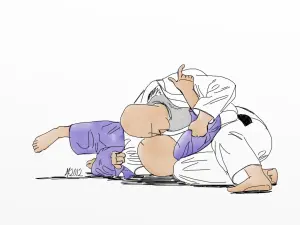
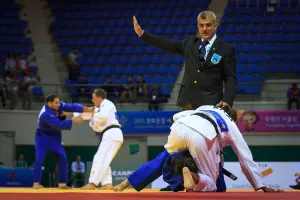
Image: Judcosta / Wikimedia Commons · CC BY-SA 4.0
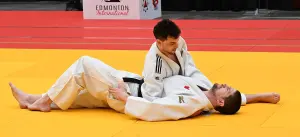
Osaekomi-waza (抑込技) are the holding or pinning techniques within Kodokan Katame-waza. The current Kodokan list contains ten named holds, including kesa-gatame, kata-gatame, the shihō-gatame family, uki-gatame, and ura-gatame. The category matters because it organises technical study, kata, randori, and transitions on the ground. It must not be confused with a contest referee’s osaekomi call: Kodokan classification identifies techniques, while current IJF rules apply position, control, and time criteria to award a score. Osaekomi-waza are usually practised in Ne-waza, but ne-waza is the broader phase and is not a synonym for this category.
Overview
| Japanese | 抑込技 |
|---|---|
| Reading | おさえこみわざ |
| Romanisation | osaekomi-waza; common search form: osaekomi waza |
| Meaning | Holding or pinning techniques |
| Martial art | Judo |
| Parent category | Kodokan katame-waza |
| Current Kodokan list | 10 techniques |
Definition
The Kodokan defines osaekomi through control of an opponent who is principally on the back, with the holder above and generally facing the opponent while maintaining control for a period of time. The holder must not be constrained by the opponent’s legs around the trunk or legs.
This functional definition allows movement and transitions. A hold is not defined by stillness, and a momentary resemblance to a named position does not establish effective control.
The 10 Kodokan osaekomi-waza
The current Kodokan technique list names the following ten holds. Older books may show a smaller list because the official catalogue has been revised; historical lists should not be presented as the complete current classification.
| Technique | Japanese | Basic orientation |
|---|---|---|
| Kesa-gatame | 袈裟固 | Diagonal scarf-hold control |
| Kuzure-kesa-gatame | 崩袈裟固 | Modified scarf-hold control |
| Ushiro-kesa-gatame | 後袈裟固 | Reverse-facing scarf hold |
| Kata-gatame | 肩固 | Shoulder and head-arm control |
| Kami-shiho-gatame | 上四方固 | Control from above the head |
| Kuzure-kami-shiho-gatame | 崩上四方固 | Modified control from above |
| Yoko-shiho-gatame | 横四方固 | Four-corner control from the side |
| Tate-shiho-gatame | 縦四方固 | Lengthwise four-corner control |
| Uki-gatame | 浮固 | Floating hold |
| Ura-gatame | 裏固 | Rear or reverse-side hold |
How holds are classified
Kodokan names distinguish the principal orientation and control relationship: diagonal scarf positions, head-and-arm control, four-corner controls from above, side, or lengthwise positions, and the uki- and ura-gatame relationships. Individual grips and leg positions may vary without automatically creating a new official name.
Classification is not the same as contest legality. A Kodokan-named hold can fail the IJF criteria if the opponent is not sufficiently on the back, if the holder is below, or if the opponent’s legs control the holder.
Osaekomi in contest
Current IJF rules researched: 14 August 2026. Osaekomi scores yuko at 5–9 seconds, waza-ari at 10–19 seconds, and ippon at 20 seconds. In golden score, five seconds of valid osaekomi earns yuko and ends the contest.
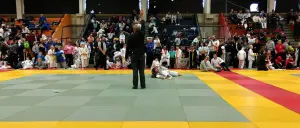
For a valid call, the opponent must be controlled from the side, rear, or top with the back or complete upper-back area on the tatami; the holder must be above and applying pressure in a recognised control relationship; and the holder must not have the body or legs controlled by the opponent’s legs.
| Time | Current IJF score |
|---|---|
| 5–9 seconds | Yuko |
| 10–19 seconds | Waza-ari |
| 20 seconds | Ippon |
Escapes and transitions
Escape training studies space, turning, base disruption, and recovery of leg control. The holder studies following movement and changing between valid positions without losing upper-body control. These are reciprocal skills rather than a fixed attacker-defender script.
Under current IJF rules, osaekomi time can continue while the holder changes from one valid hold to another if control remains continuous. The clock stops when the criteria are lost or the referee calls toketa.
Osaekomi-waza in Katame-no-kata
Katame-no-kata presents five selected osaekomi-waza: Kesa-gatame, kata-gatame, kami-shiho-gatame, yoko-shiho-gatame, and kuzure-kami-shiho-gatame. Each is studied with formal resistance and responses.
The five kata techniques are not the entire current Kodokan osaekomi list. The current catalogue contains ten, so kata selection and syllabus classification must be kept distinct.
Training context
Osaekomi-waza are studied through static positioning, escape-and-retention drills, transitions, kata, and randori. Good practice develops mobile control without placing uncontrolled pressure on the partner’s neck, ribs, or joints.
Because body size, age, and experience affect safe intensity, instructors should scale resistance and time. A partner’s signal or the instructor’s command ends the action immediately.
Historical and current lists
Judo publications from different periods do not always present the same number of named osaekomi-waza. This reflects changes in the formal catalogue and in how variants were named, not the sudden invention of all underlying control positions.
TokyoWaltz uses the current Kodokan list of ten for classification and dates current IJF scoring separately. Both are update-sensitive institutional facts.
Sources
- Kodokan Judo Institute, Judo Technique Names.
- Kodokan Judo Institute, Definitions of Judo Techniques, 2022.
- Kodokan Judo Institute, Promotion Examination Text: Kodokan Judo, 2026.
- Kodokan Judo Institute, Katame-no-kata.
- Kodokan Judo Institute, Bulletin of the Association for the Scientific Studies on Judo, Volume 16, 2017.
- International Judo Federation, Sport and Organisation Rules, 14 August 2026.
- Nagai et al., Performance Analysis Code for Judo Ne-waza, Japanese Journal of Rugby Science and Performance.
Last updated: