
Judo
Judo Rules
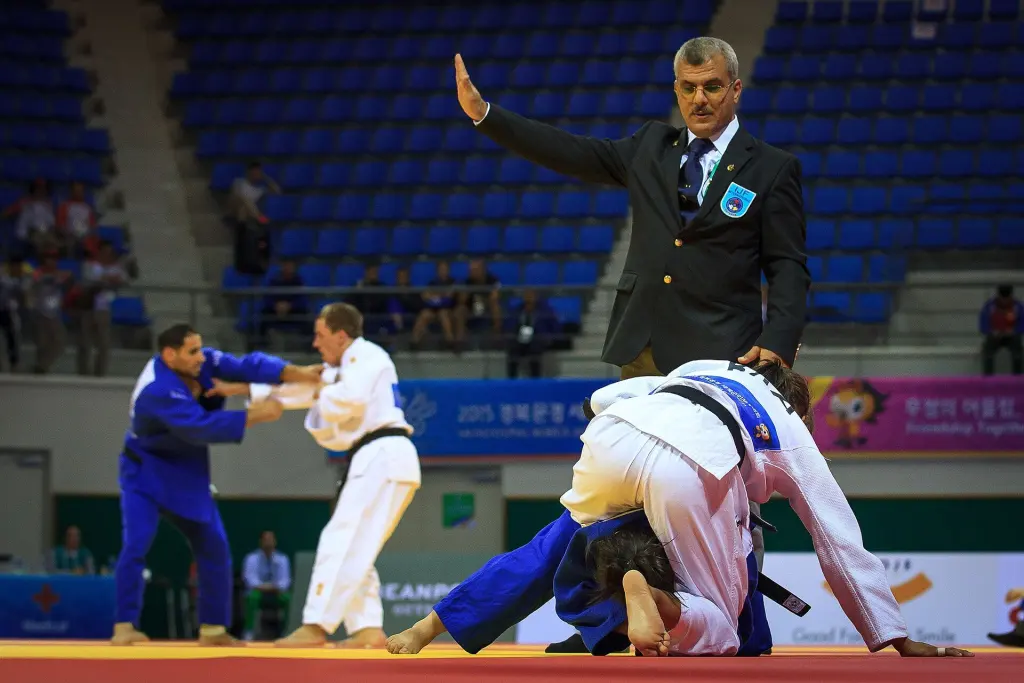
Image: Johnson Barros, Ministério da Defesa / Wikimedia Commons · CC BY 2.0
Overview
Read the rules for the event.
Scope: IJF senior, junior and cadet competition. Rule edition: Sport and Organisation Rules, 14 August 2026. Japanese adoption and age restrictions are identified separately.
Senior · Junior · Cadet
Four minutes of real contest time; age-specific restrictions still apply. Check the organiser’s event notice before applying these rules.
01 · Scores
Ippon, waza-ari, yūkō and hold timing.
02 · Penalties
Shidō, hansoku-make and prohibited actions.
03 · Match flow
Start, stop, regular time and golden score.
At a glance
- Martial art
- Judo
- Ruleset covered
- International Judo Federation Sport and Organisation Rules
- Current IJF rules researched
- 14 August 2026
- Japanese national reference
- All Japan Judo Federation
- Standard contest time
- Four minutes
- Current technical scores
- Yūkō, waza-ari, ippon
Context
Judo rules determine how a contest starts, continues, scores, and ends, but no single competition rulebook defines all Judo practice. This article covers the International Judo Federation's Sport and Organisation Rules (SOR) for senior, junior, and cadet events, with Japanese adoption notes from the All Japan Judo Federation. It distinguishes IJF competition from Kodokan technical classification, kata, dojo training, and special national or youth regulations. The current system awards ippon, waza-ari, and yūkō; two waza-ari equal ippon, while yūkō accumulate without becoming waza-ari. Penalties are shido and hansoku-make. Because these details change, the rule version and event notice matter as much as the general principle.
What rules this article covers
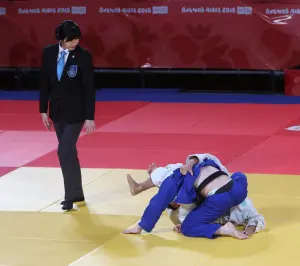
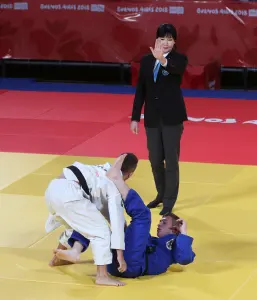
Judo at the Asian Games illustrates why rules need an edition date: categories, scoring interpretations, team formats, and technical handbooks must be checked for the specific Games.
Current IJF rules researched: 14 August 2026. The SOR governs IJF events and supplies the reference adopted by many national federations. The AJJF applied the January 2026 interpretation to its hosted competitions from 1 April 2026, while allowing particular events to specify adjustments.
The rulebook does not decide which techniques exist in the Kodokan syllabus. A throw may remain an official Kodokan name yet be unusable in its ordinary form under current contest restrictions. Kata, randori, school competition, Shichitei Judo, and youth events may apply different boundaries.
Youth and national differences
Cadet IJF rules add safety restrictions. Using the head to throw or defend receives shido, and reverse seoi-nage is not scored and is penalised. National youth rules may further prohibit shime-waza or kansetsu-waza and can shorten contest or pin times.
In Japan, the AJJF announced adoption of the 2026 IJF interpretation for its hosted events from 1 April. It separately allowed organisers of non-AJJF-hosted competitions to decide how to handle yūkō where equipment and fairness made immediate adoption difficult. Current event rules therefore take precedence over a general web summary.
Scores and hold timing
| Valid hold duration | Score |
|---|---|
| 5–9 seconds | Yūkō |
| 10–19 seconds | Waza-ari |
| 20 seconds | Ippon |
How to win
A contest ends immediately with ippon, two waza-ari, a qualifying submission or incapacity, the opponent's hansoku-make, withdrawal, or failure to appear. At the end of regular time, the athlete with the higher technical score wins.
Shido are not converted into points. A difference of one or two shido does not decide a tied regular-time contest; the athletes enter golden score with scores and penalties carried forward.
Ippon
A standing throw scores ippon when it is skilfully controlled to the end with speed, force, and the opponent landing on the back. The SOR presents these as four criteria: speed, force, back impact, and control.
Ippon is also awarded for 20 seconds of valid osaekomi, a clear submission by tapping twice or saying maitta, or the opponent's incapacity under a permitted choke or elbow lock. Hansoku-make gives the opponent a win equivalent to ippon.
Waza-ari
Waza-ari is awarded for a throw that approaches but does not meet all ippon criteria, including qualifying landings beyond 90 degrees on the shoulder axis towards the back. It is also awarded for 10–19 seconds of osaekomi.
Two waza-ari in one contest produce waza-ari-awasete-ippon. The second score ends the contest immediately.
Yūkō
The current 2026 SOR includes yūkō as a third technical score. It covers specified lesser landings, including a side landing at 90 degrees and certain upper-back or buttock landings, and 5–9 seconds of osaekomi. Landing on the front of the stomach, both hips or both knees before or simultaneously with the specified side landing does not score yūkō. See Article 15 for the complete landing criteria and illustrations.
Yūkō accumulate numerically but never equal waza-ari. An athlete with one waza-ari therefore leads any number of yūkō. Older summaries that say modern IJF Judo has only ippon and waza-ari are out of date for this rule version.
Osaekomi
A valid pin must correspond to a recognised Kodokan osaekomi form or variation, control the opponent from the side, rear, or above, and place the opponent's full back or upper back on the tatami. The holder must not have the body controlled by the opponent's legs.
The referee announces osaekomi when the criteria are met and toketa when control is broken. Five seconds scores yūkō, 10 seconds waza-ari, and 20 seconds ippon under the current SOR.
Penalties and permitted actions
Shido
Shido is the penalty for a slight infringement such as lack of combativity, a false attack, illegal but non-dangerous gripping action, passivity, or repeated disorder of judogi or hair after warning. Two shido may be recorded; the third becomes hansoku-make.
A contest cannot be decided by a single shido or by shido count alone. The third penalty disqualifies the athlete from that contest, while ordinarily allowing later participation if the competition format still provides it.
Hansoku-make
Hansoku-make is disqualification. It may result indirectly from three shido or directly from a grave infringement. In either case, the opponent wins the contest by ippon-equivalent result.
The consequence beyond that contest depends on the offence. Certain dangerous techniques produce direct hansoku-make but allow continuation in the wider competition; acts against the spirit of Judo, including specified high-risk or unsporting actions, remove the athlete from the competition.
Legal and prohibited actions
Legal technique is evaluated by the action performed, not only by its traditional name. Prohibited acts include leg grabbing in a standing phase, applying joint locks to joints other than the elbow, kani-basami, kawazu-gake, dō-jime, dangerous head diving, and actions endangering the neck or spine.
The SOR distinguishes lower-risk illegal actions punished with shido from higher-risk actions punished with direct hansoku-make. Referees may consider intention and the actual danger created.
Current gripping rules
Conventional kumi-kata receives up to 45 seconds before attack when there is positive progression. Same-side, cross, belt, pistol, pocket, and other non-classical grips are allowed when used positively to prepare attacks. A grip used to bend, block, or avoid action is shido.
Breaking with one hand is allowed. Breaking with two hands without retaining at least one grip is shido. The rules also penalise grip avoidance, defensive sleeve-end control, covering the lapel, and other specific blocking actions. See Kumi-kata for the tactical and teaching context.
Current leg-grab rules
All jacket grips and contact below the belt down to the top of the inner thigh may be used positively. Hooking a leg with the hand or arm, gripping the trousers, or touching the leg below the top of the inner thigh while the action is tachi-waza is forbidden and receives shido.
A leg may be gripped after both athletes are clearly in ne-waza and the standing action has ended. This phase distinction explains why Kodokan leg-grabbing throws remain named Judo techniques even when their direct standing forms are restricted in IJF competition.
How the contest proceeds
- Hajime starts or restarts action.
- Mate interrupts action and stops contest time.
- At four minutes, compare technical scores if no earlier win.
- If still tied, carry scores and penalties into unlimited golden score.
Contest area
The competition area contains a contest area and surrounding safety area. A standing action remains valid while at least one athlete is touching inside, provided the action began within the boundary. Referees judge continuity and proximity rather than treating every step across the line as an automatic stop.
In groundwork, an action that begins inside may continue outside when a pin, choke, or elbow lock remains active. Athletes may be stopped when contact or technical progress is lost, or when safety requires repositioning.
Contest duration
Senior, junior, and cadet IJF contests for men and women are four minutes of real contest time. The clock stops on the referee's mate and restarts on hajime. Osaekomi time is measured separately while the main contest clock operates as prescribed.
If regular time ends without a winner, the contest proceeds to golden score. Event schedules, team ties, or special domestic regulations may add procedures outside the individual contest itself.
Golden score
Golden score has no time limit. Scores and shido from regular time carry over. The first yūkō, waza-ari, ippon, hansoku-make, or withdrawal ends the contest.
If osaekomi begins before the golden-score clock is stopped, the contest continues until five seconds for yūkō, an escape, submission, or a higher score. This differs from older rules under which lesser scores or penalty differences were handled differently.
Historical changes · separate from the current rules
Judo contest rules have changed repeatedly in scoring, penalties, gripping, boundary treatment, contest time, and ground continuation. Yūkō and koka existed in earlier international rules, were removed, and yūkō returned in the 2025–2028 cycle. Leg-grab restrictions developed through 2010s revisions rather than through a change to the Kodokan technique catalogue.
Historical rules should be dated rather than described as errors. They shaped the tactics of their period, while modern revisions reflect changing aims of safety, clarity, technical activity, and international presentation.
Sources
- International Judo Federation, Sport and Organisation Rules, version 14 August 2026.
- International Judo Federation, Rules documents.
- All Japan Judo Federation, Refereeing regulations and rules.
- All Japan Judo Federation, Application of the 2025–2028 IJF rules from 1 April 2026.
- All Japan Judo Federation, Handling of yuko at non-AJJF-hosted competitions, 21 April 2026.
- All Japan Judo Federation, 2025–2028 IJF rule changes.
- Murayama Terushi, Changes in the refereeing rules of Judo and Kendo, Japan Journal of Budo.
Last updated:
.jpg)