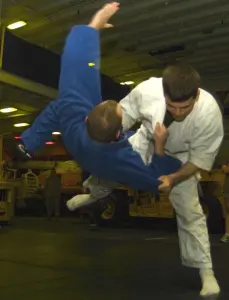
Judo
Kata in Judo
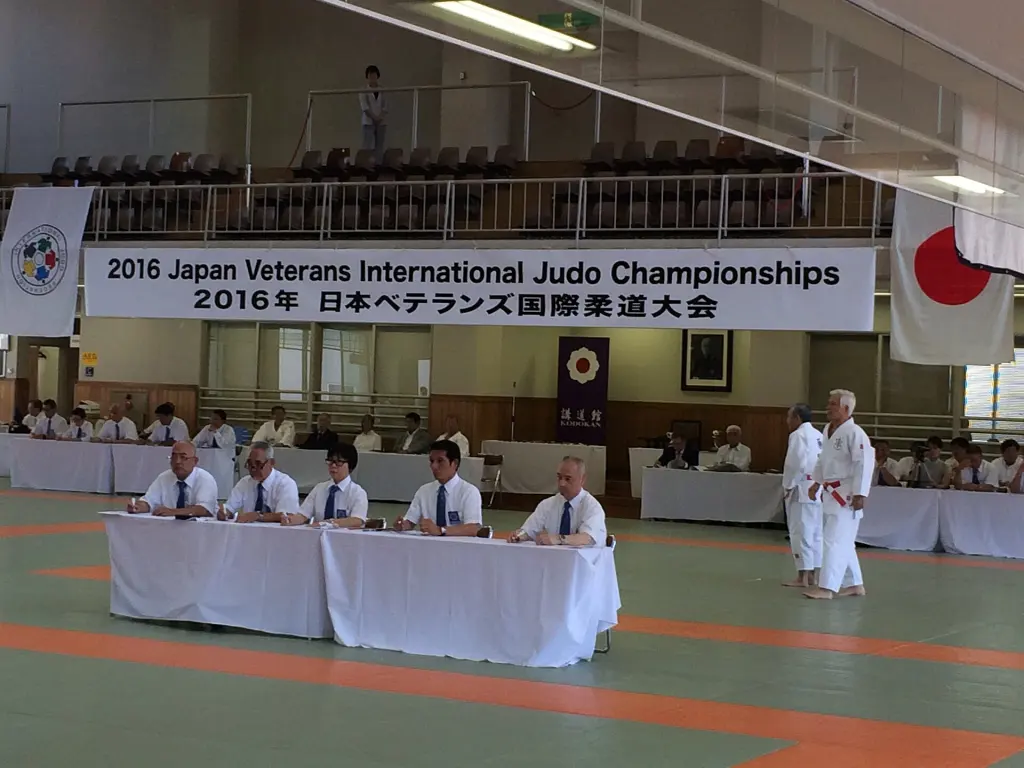
Image: Sanshiro5304 / Wikimedia Commons · CC BY-SA 4.0
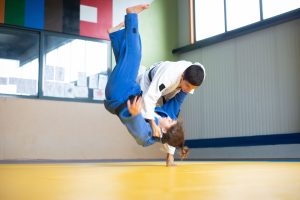
Kata in Judo are codified forms of practice, usually performed by two partners in the roles of tori and uke. Each kata organises attacks, responses, movement, distance, and etiquette so that a particular set of principles can be studied consistently. Kata is not limited to a display for grading or competition, and it is not the same kind of solo sequence commonly associated with some other martial arts. Kodokan forms address throwing, grappling, self-defence, gentleness, historical jujutsu, physical education, and abstract principles. Together with randori, lecture, and discussion, kata forms part of Kano's wider method for transmitting Judo beyond the techniques that can be practised freely in contest-like conditions.
Overview
| Japanese | 形 |
|---|---|
| Meaning | Form or model |
| Usual format | Paired practice |
| Roles | Tori and uke |
| Kodokan forms | Nine recognised kata |
| International competition | Selected kata under IJF rules |
What kata means in Judo
A Judo kata is an organised teaching model, not merely a memorised list of techniques. The prescribed sequence allows partners and observers to examine posture, distance, initiative, kuzushi, control, and the logic connecting attack and response.
Most Kodokan kata are paired. Tori performs the designated response and uke initiates or receives it, but both roles require technical knowledge and active coordination.
Kata and randori
Kata and randori solve different teaching problems. Randori develops adaptation against unscripted resistance; kata provides a stable form in which principles can be isolated and actions unsuitable for free practice can be transmitted.
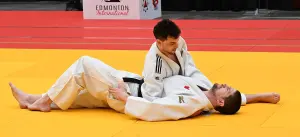
Nage-no-Kata and Katame-no-Kata are sometimes grouped as Randori-no-Kata because they formalise principles central to throwing and grappling used in randori.
Kodokan forms
The Kodokan recognises Nage-no-Kata, Katame-no-Kata, Kime-no-Kata, Ju-no-Kata, Kodokan Goshin-jutsu, Itsutsu-no-Kata, Koshiki-no-Kata, Seiryoku-Zenyo-Kokumin-Taiiku, and Kodomo-no-Kata. The forms differ in purpose, structure, and date of development.
This list should not be confused with the smaller programme used at a particular kata competition. Governing bodies select eligible forms and divisions for each event.
Throwing and grappling forms
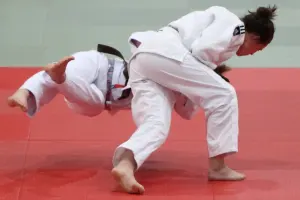
Nage-no-Kata presents representative throwing principles across hand, hip, foot or leg, rear-sacrifice, and side-sacrifice groups. Katame-no-Kata studies models of holding, strangling, and joint techniques together with methods of response.
Their formal versions are not templates to copy unchanged in every contest exchange. They clarify principles that practitioners later adapt through other practice methods.
Combative and historical scope
Kime-no-Kata and Kodokan Goshin-jutsu include responses to attacks that cannot be reproduced as ordinary randori. Koshiki-no-Kata preserves forms derived from Kito-ryu jujutsu and connects Kodokan Judo to an important technical source.
Itsutsu-no-Kata uses highly abstract movement, while Seiryoku-Zenyo-Kokumin-Taiiku joins physical education with attack-and-defence practice. Kata therefore preserves more than a contest syllabus.
Grading and competition
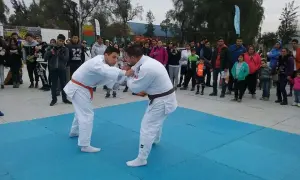
Kata is used in instruction, promotion requirements, demonstrations, and international competition. Competitive kata evaluates a pair's execution under detailed criteria, but the existence of kata contests does not make scoring the sole reason to study the forms.
Requirements vary by organisation and grade. Practitioners should use the current Kodokan textbook and the rules of the relevant federation rather than assume one universal examination format.
Learning and interpretation
External order is necessary, but accurate kata also depends on attack intention, spacing, timing, and understanding why each action produces the next. Empty imitation can preserve a sequence while losing its teaching value.
Interpretive explanations can differ among instructors. Official reference forms provide a common basis, while historical and biomechanical research can clarify how and why a movement is performed.
Sources
- International Judo Federation, Sport and Organisation Rules, 14 August 2026.
- Judo Canada, Judo Lexicon.
- International Judo Federation, Kata: The Forms.
- International Judo Federation, The Need to Study Kata.
- International Judo Federation, Kodokan Kata Textbooks.
- Kodokan, 2024 Summer Course I: Kata.
- Research Journal of Budo, What a School Judo Should Be as Budo.
Last updated: