Judo
Ukemi
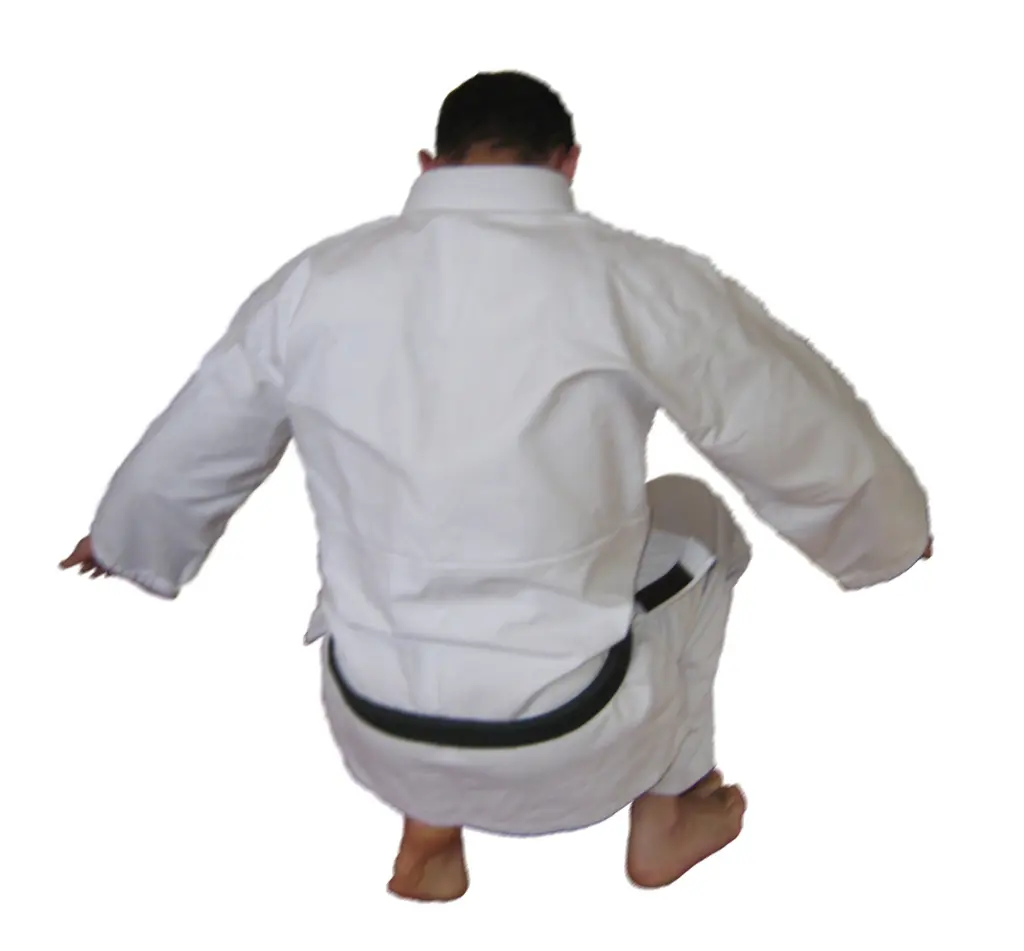
Image: Hoosic06 / Wikimedia Commons · CC BY-SA 3.0
Overview
Different falls. A shared safety purpose.
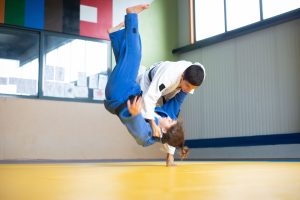
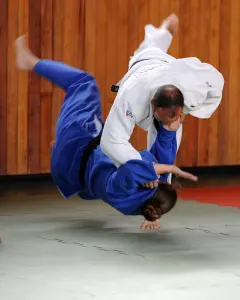
Ukemi develops the ability to receive a fall under supervision. Direction labels describe families of receiving actions, not a complete landing method.
Backward · Ushiro-ukemi
Rearward receiving action
Sideward · Yoko-ukemi
Receiving on either side
Forward · Mae-ukemi
Forward receiving action
Rolling · Mae-mawari-ukemi
Forward rotation through a rolling path
At a glance
- Japanese
- 受身
- Reading
- Ukemi
- Common translation
- Breakfall
- Main directions
- Backward, sideward, forward, and rolling
- Central safety aim
- Protect the head and manage impact
- Practice setting
- Solo drills and receiving throws
Context
Ukemi, written 受身, are the methods of receiving a fall in Judo. English often translates the term as breakfall, but ukemi includes coordinated posture, rolling or landing, head protection, distribution of impact, breathing, and recovery. Common exercises prepare backward, sideward, forward, and rolling falls before students receive progressively stronger throws from a partner. Ukemi does not make every fall harmless, and striking the mat with the arm is only one part of some forms. Its practical value lies in reducing avoidable impact and fear while allowing throwing practice to develop under supervision. Competition landings also involve tactical choices, but safe training ukemi should not be distorted solely to avoid a score.
Meaning and role
The characters in ukemi refer to receiving with the body. In Judo the receiver is not passive: posture, timing, muscle action, arm position, and orientation influence how force reaches the body.
Ukemi supports nage-waza, kata, randori, and contest. It is a continuing skill rather than a beginner exercise discarded after grading.
Basic forms
Common teaching categories include ushiro-ukemi for a rear fall, yoko-ukemi for a side fall, mae-ukemi for a forward fall, and mae-mawari-ukemi for a forward rolling fall. Names and progression can vary among organisations.
The direction label describes the receiving action, not necessarily the name of the throw. A single throw can require adjustment according to height, rotation, grip, and available space.
| Type | Purpose in the curriculum | What the diagram cannot teach |
|---|---|---|
| Ushiro-ukemi · 後ろ受身 | Prepare for rearward falls. | Coordinated head protection, trunk position and arm timing. |
| Yoko-ukemi · 横受身 | Prepare for receiving to either side. | Landing angle, limb position and adaptation to the partner. |
| Mae-ukemi · 前受身 | Study a controlled forward receiving action. | Appropriate support, impact management and safe starting height. |
| Mae-mawari-ukemi · 前回り受身 | Study receiving through a forward roll. | The rolling path, head clearance and transition to the landing. |
Head and neck protection
A central principle is preventing the head from striking the tatami. Experimental research using osoto-gari has found that correctly performed ukemi reduces head acceleration by avoiding head contact and managing the fall.
This does not eliminate concussion or neck risk. Beginners need gradual height and speed, and any symptoms after impact require appropriate medical assessment rather than more practice.
Impact and use of the arms
Many breakfalls use one or both arms to contact the mat as the body lands. The action is coordinated with body angle and timing; reaching rigidly toward the floor with the hand can transfer force into the wrist, elbow, or shoulder.
Not every ukemi uses the same arm action. Forward rolls, competition landings, and throws with unusual rotation require different solutions, so one visible slap should not be treated as the entire method.
Learning progression
Instruction commonly begins close to the mat, then increases movement, height, direction, and partner involvement. Students may progress from rocking and rolling to controlled throws only after they can maintain head position and body organisation.
Age, previous injury, mobility, mat quality, and confidence affect progression. A fixed number of repetitions cannot substitute for an instructor observing the actual landing.
- Low, controlled solo work
- Direction and movement
- Controlled partner receiving
- Gradual adaptation in practice
An instructor decides when to progress or return to a simpler exercise. This diagram does not authorise independent throw practice.
Ukemi in partner practice
Tori remains responsible for control while uke performs ukemi. A technically skilled receiver cannot compensate for a throw driven outside the practice area, completed onto another pair, or continued after loss of control.
In uchikomi the throw is often not completed; nagekomi and randori demand fuller receiving skills. Partners should agree on pace and stop when fatigue degrades safe reactions.
Training and contest landings
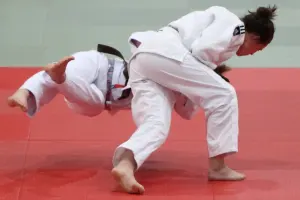
Contest athletes may rotate, bridge, or post in an attempt to avoid a score. Some actions are dangerous or restricted, and rule interpretations change. Such tactics should not be presented to beginners as standard ukemi.
Training ukemi prioritises receiving force and returning safely to practice. Current competition rules remain relevant, but they do not replace the broader safety objective.
Sources
- International Judo Federation, Sport and Organisation Rules, 14 August 2026.
- Judo Canada, Judo Lexicon.
- International Judo Federation, How to Write Judo.
- Neurologia Medico-Chirurgica, Ukemi Technique Prevents Elevation of Head Acceleration.
- Japanese Journal of Sport Education Studies, Teaching Methods of Performing Ukemi.
- Judo Canada, Judo for Children under the Age of 10.
Last updated: