Judo
Koshi-waza
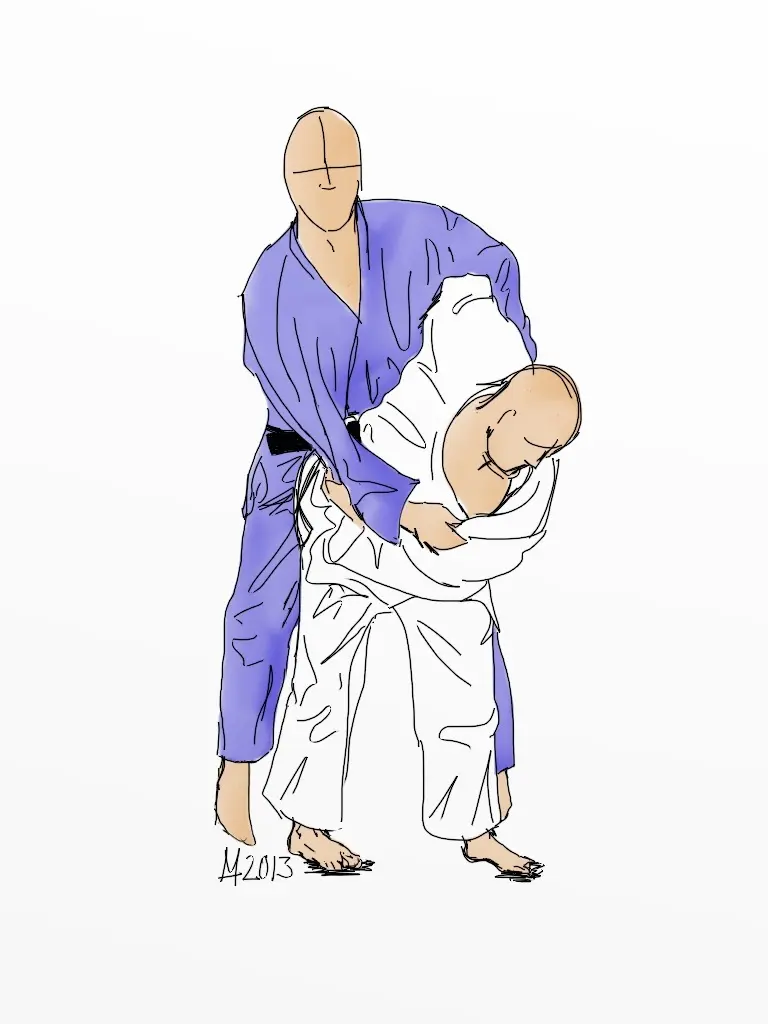
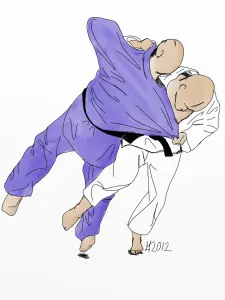
Image: Mhultstrom / Wikimedia Commons · CC BY-SA 3.0
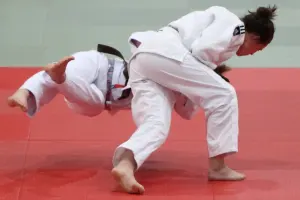
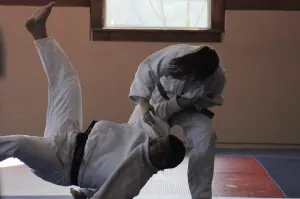
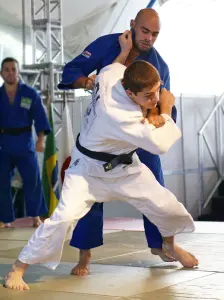
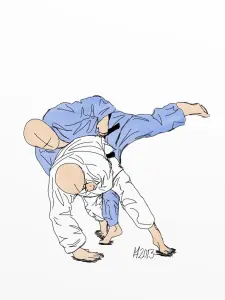
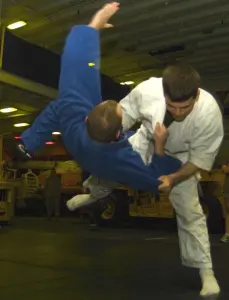
Koshi-waza (腰技, hip techniques) are one of the three standing branches of Nage-waza in Kodokan Judo. The Kodokan recognises 10 techniques in which the hip or rear waist provides the principal loading, turning, supporting, or projecting mechanism. They range from the shallow hip contact of uki-goshi to deeper loading throws, sweeping hip actions, and counters such as utsuri-goshi and ushiro-goshi. Koshi-waza are important because they show that Judo classification follows the principal mechanism of a standard form, not the technique's appearance alone. The hands, feet, posture, and timing remain essential, and current competition rules regulate how a hip throw is applied rather than simply approving every action carrying a koshi-waza name.
Overview
| Japanese | 腰技 |
|---|---|
| Reading | こしわざ |
| Romanisation | koshi-waza |
| Meaning | Hip techniques |
| Martial art | Judo |
| Parent category | Nage-waza → tachi-waza |
| Official Kodokan total | 10 techniques |
| Technical authority | Kodokan Judo Institute |
Name and classification
Koshi (腰) refers to the hip or waist region, while waza (技) means technique. Koshi-waza sit beside Te-waza and Ashi-waza within tachi-waza, the standing-throwing branch of Kodokan Judo. Sutemi-waza form the other main branch of throwing techniques.
The Kodokan's 2026 promotion text explains that all throwing categories use the hands, feet, and hips. The category name marks the body region whose work is especially conspicuous in the representative form. It should not be read as an assertion that the hip acts independently.
The 10 Kodokan koshi-waza
The current Kodokan list contains the following 10 hip techniques. The names are technical classifications; they do not prescribe one universal grip, stance, or entry.
| Technique | Japanese |
|---|---|
| Uki-goshi | 浮腰 |
| O-goshi | 大腰 |
| Koshi-guruma | 腰車 |
| Tsurikomi-goshi | 釣込腰 |
| Sode-tsurikomi-goshi | 袖釣込腰 |
| Harai-goshi | 払腰 |
| Tsuri-goshi | 釣腰 |
| Hane-goshi | 跳腰 |
| Utsuri-goshi | 移腰 |
| Ushiro-goshi | 後腰 |
Technical principle
Koshi-waza use the hip region in several distinct ways. Uki-goshi places relatively shallow hip contact into a turning action. O-goshi and tsurikomi-goshi load the receiving partner more clearly onto the rear hip. Koshi-guruma uses the hip as a turning axis, while harai-goshi and hane-goshi combine hip placement with a sweeping or springing leg action.
Utsuri-goshi and ushiro-goshi are commonly studied as responses to an opponent's attack and use lifting or repositioning around the hip line. These differences show why 'hip throw' is a family name rather than a single mechanic.
Kuzushi, tsukuri and kake
Kuzushi makes or recognises instability; tsukuri establishes the relationship of feet, hips, trunk, and grip; and kake applies the projecting action. In koshi-waza, insufficient kuzushi may leave the thrower trying to lift a stable partner with the lower back or arms rather than placing the hip into an efficient relationship.
The phases overlap in fluent performance. Pulling and lifting action, body rotation, and hip placement may develop together, particularly when the throw is adapted to a moving partner. The model is useful for analysis but should not be mistaken for three mandatory pauses.
Place in kata and the Kodokan syllabus
The koshi-waza set of Nage-no-kata consists of uki-goshi, harai-goshi, and tsurikomi-goshi. These three formal examples examine different uses of the hip and are performed to both sides within the kata's prescribed structure.
Koshi-waza also occur across the Gokyō no Waza, the 40-throw teaching syllabus. The category is broader than the Gokyo: sode-tsurikomi-goshi is among the 10 current Kodokan hip-technique names but is not one of the 40 Gokyo throws.
Variation and neighbouring classifications
Official Kodokan definitions give representative right-sided forms. Practitioners legitimately vary grip, stance, entry depth, direction, and degree of hip loading according to movement and body relationship. A shallow uki-goshi and a deeper o-goshi therefore should not be collapsed into one rigid execution.
The classification boundary is clearest when comparing harai-goshi with the Ashi-waza technique uchi-mata. Both may include a strong sweeping leg and similar turning movement, but the Kodokan classifies them by their recognised principal mechanics. Japanese movement research has likewise shown that the traditional body-part categories do not fully describe every structural similarity among throws.
Training context
Koshi-waza are studied through kata, Uchikomi, controlled throwing practice, and randori. Early practice commonly emphasises stable posture, appropriate hip placement, and a controlled finish so that the receiving partner can use ukemi.
Uchikomi isolates entry and fitting but does not reproduce every condition of a live exchange. Nagekomi adds completion, while randori tests timing, direction, combinations, and the ability to abandon or change an entry when the relationship is unsuitable.
Competition rules and restrictions
The IJF Sport and Organisation Rules reviewed here are dated 14 August 2026. They contain no blanket prohibition on the koshi-waza category. A recognised hip throw can score when the action satisfies the general requirements for a valid Judo throw and avoids prohibited grips or dangerous movement.
Technique names do not override safety rules. The current SOR specifically lists head-diving actions during throws such as harai-goshi and tsuri-goshi among dangerous techniques punished with direct hansoku-make. Gripping, defensive posture, false attack, and transitions are also judged under the wider rules.
IJF rules govern IJF competition rather than all Judo. National federations, youth divisions, kata events, and dojo training may use additional restrictions or different evaluation criteria.
Sources
- Kodokan Judo Institute, Judo Technique Names.
- Kodokan Judo Institute, Names of Judo Techniques, 1 April 2017.
- Kodokan Judo Institute, Definitions of Judo Techniques.
- Kodokan Judo Institute, Promotion Examination Text: Kodokan Judo, 2026.
- Kodokan Judo Institute, Kata.
- All Japan Judo Federation, Number of Judo Techniques.
- International Judo Federation, Judo Techniques.
- International Judo Federation, Sport and Organisation Rules, 14 August 2026.
- Mito Noriyuki and Kamiya Tadaaki, A Study on the Classification of Judo Throwing Techniques Based on Movement Structure.
Last updated: