Cultural Geography
Edo
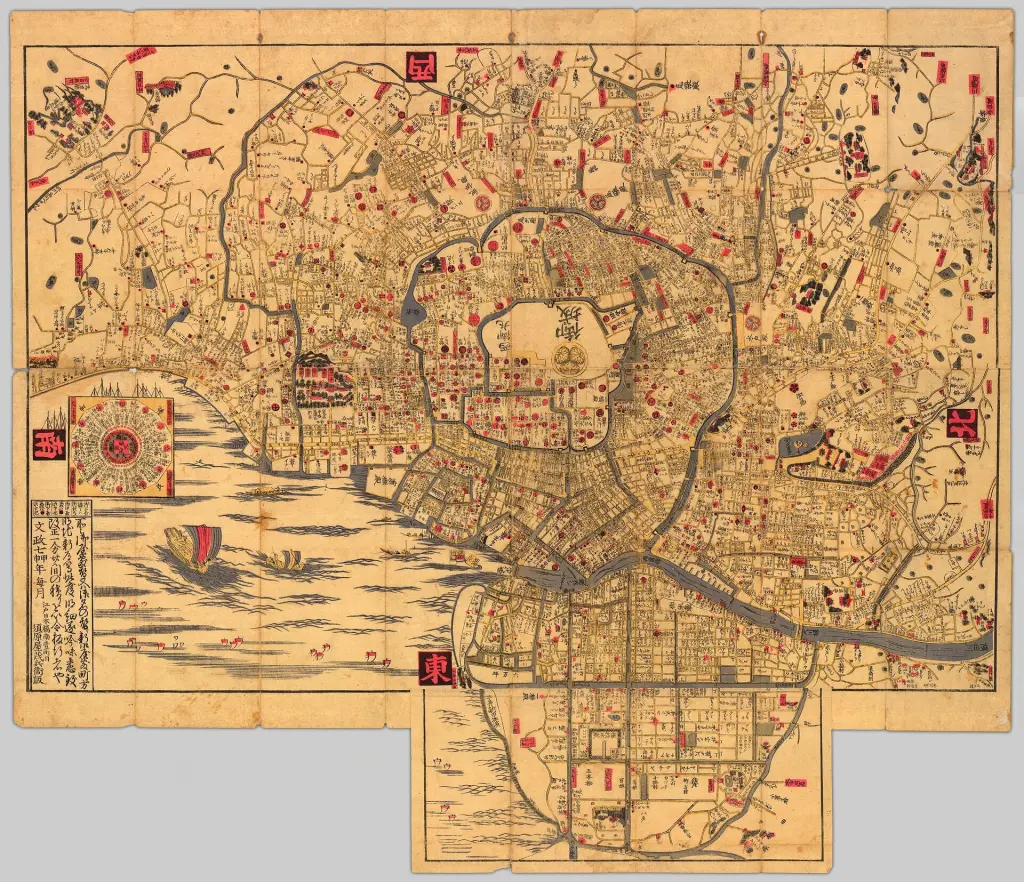
Image: Suharaya Mohē / Wikimedia Commons · Public domain
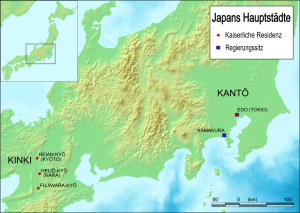
Edo was the early modern city centered on Edo Castle and the government of the Tokugawa shogunate. Tokugawa Ieyasu entered the region in 1590 and established the shogunate there in 1603. Castle works, daimyo compounds, commoner districts, temples, waterways, roads, and repeated rebuilding turned Edo into one of the world's largest cities by the eighteenth century. The emperor and imperial court remained in Kyoto, so Edo was a de facto political capital rather than the sole center of every kind of authority. It also became a major market and a center for publishing, theater, visual art, and popular culture. In 1868 the city was renamed Tokyo. Edo therefore names a historical city, not the whole Edo period and not simply present-day Tokyo under an older label.
Overview
| Japanese name | 江戸 |
|---|---|
| Romanization | Edo |
| Political role | Seat of the Tokugawa shogunate |
| Shogunate established | 1603 |
| Urban center | Edo Castle and surrounding districts |
| Renamed | Tokyo in 1868 |
Name, place, and scope
Edo first identified a settlement and castle area near the head of Edo Bay. Its written characters are often glossed as “bay entrance” or “estuary,” reflecting a lowland environment crossed by rivers, inlets, and reclaimed shoreline. The city expanded across what are now central and eastern parts of Tokyo.
Edo also lends its name to the Edo period, conventionally 1603–1868, but city and period are not interchangeable. Tokugawa society extended across domains with different local institutions, economies, languages, and urban forms, while Edo itself changed dramatically within those centuries.
Ieyasu and the shogunate
Tokugawa Ieyasu entered Edo in 1590 after receiving lands in the Kantō region. He enlarged the castle, improved roads and waterways, and positioned the site as a regional base. His appointment as shogun in 1603 made Edo the headquarters of a new military government.
Successive shoguns expanded the castle and city through works involving many daimyo. The sankin-kōtai system required domain lords to maintain Edo residences and spend alternating periods there, concentrating retainers, consumption, information, and political surveillance in the city.
Castle and social districts
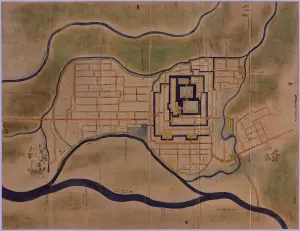
Edo Castle formed the political and spatial center. Daimyo estates occupied extensive areas around it, while townspeople's districts clustered more densely in lower-lying zones. Temples and shrines were numerous and sometimes placed along edges or relocated after fires and urban works.
Maps often color-code samurai land, commoner neighborhoods, religious precincts, waterways, and open areas, but the categories were internally diverse. Status shaped residence and regulation without producing perfectly sealed social zones; servants, merchants, craftspeople, pilgrims, entertainers, and officials moved across them.
Water, roads, and commerce
Naitō Shinjuku was established as a post station on the Kōshū Kaidō, linking the later district’s name to Edo’s road and travel economy.
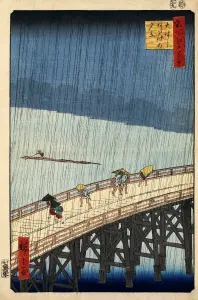
Canals, moats, rivers, coastal shipping, bridges, and warehouses supplied a city whose consumption exceeded its immediate hinterland. Nihonbashi became a commercial and geographic reference point, while the major highways radiating from Edo connected it to post towns, pilgrimage routes, and domain networks.
Land reclamation and channel engineering created usable districts but also reshaped flooding and waterfront ecology. Osaka remained crucial to national trade, especially as a wholesale center, so Edo's rise did not eliminate a polycentric early modern economy.
Population, fire, and rebuilding
By the early eighteenth century Edo's population is commonly estimated at more than one million, although counts depend on which groups and districts are included. Large numbers of male retainers contributed to a distinctive demographic structure, while commoner neighborhoods supported dense networks of rental housing and local commerce.
Major fires repeatedly destroyed wide areas, most famously the Meireki Fire of 1657. Reconstruction altered streets, bridges, temple locations, firebreaks, and open spaces. Fire brigades and building practices developed in response, but risk remained a routine condition of the wooden city.
Publishing, entertainment, and urban culture
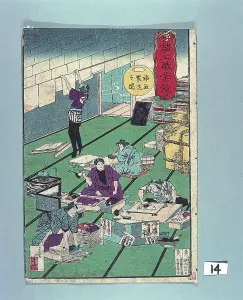
A large literate market sustained booksellers, lending libraries, guidebooks, fiction, maps, and illustrated prints. Ukiyo-e represented actors, courtesans, famous places, fashions, humor, travel, and historical subjects for audiences shaped by Edo's commercial culture.
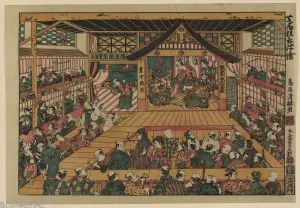
Kabuki theaters, sumo venues, pleasure districts, seasonal festivals, and pilgrimage circuits produced different urban publics. “Popular culture” did not mean an unregulated or classless sphere: censorship, licensing, status, gender, occupation, and money structured access and representation.
From Edo to Tokyo
The 1868 transition continued beyond the renaming of Edo: the modern Tokyo metropolis grew through new institutions, repeated reconstruction, rail-centered expansion, and the incorporation of communities far outside the former castle town.
The Tokugawa shogunate collapsed in 1868, and Edo was renamed Tokyo, the “eastern capital.” Emperor Meiji moved into the former shogunal castle, which became the Imperial Palace, while new ministries, military institutions, industries, railways, and municipal systems transformed the city.
Many roads, waterways, district names, property patterns, religious sites, and cultural practices retained early modern layers, yet earthquake, war, reconstruction, and metropolitan expansion remade them. Treating Tokyo as unchanged Edo hides this discontinuity; treating 1868 as a complete break hides the city's inherited geography.
Sources
Last updated: