Edo Print & Poetry
Japanese Woodblock Printing
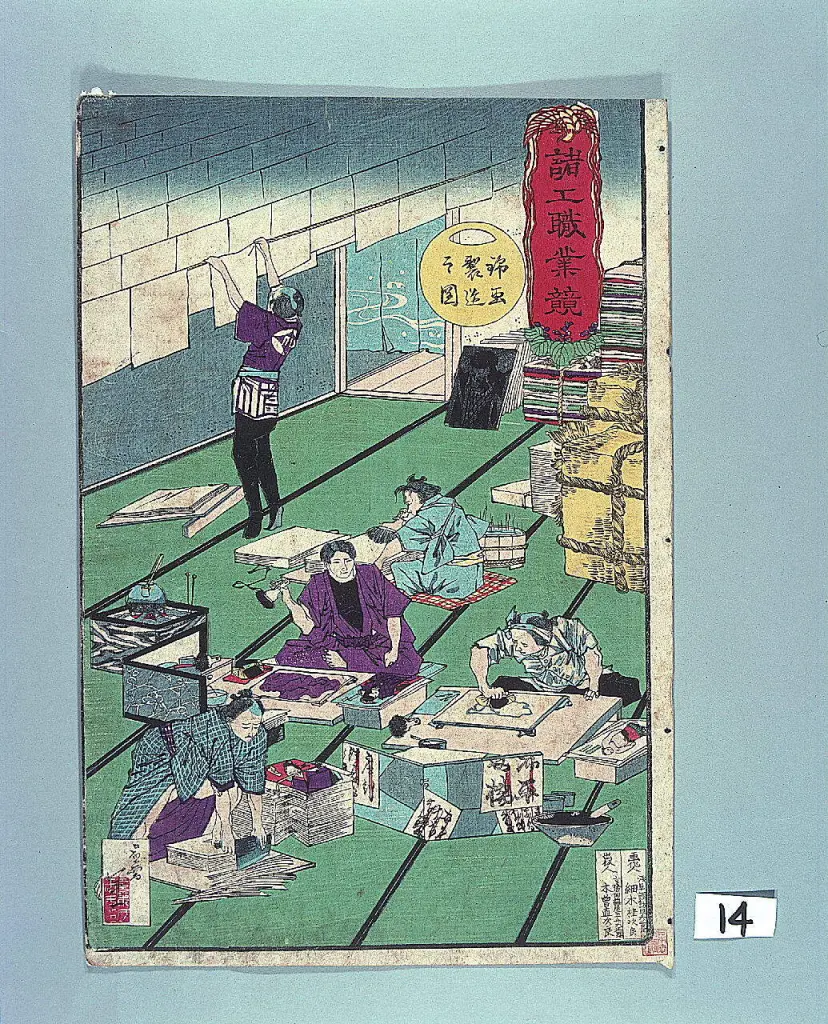
Image: Hosoki Toshikazu / National Institute of Japanese Literature via Wikimedia Commons · Public domain
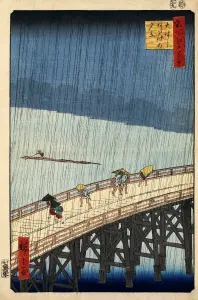
Japanese woodblock printing is a relief-printing tradition in which carved wooden blocks transfer text and images to paper. Its history in Japan extends from Buddhist printing and movable textual culture to Edo-period commercial publishing, ukiyo-e, modern creative-print movements, and contemporary workshops. In the classic multicolor process, a publisher commissions a design, an artist prepares the image, a carver cuts a key block and color blocks, and a printer aligns handmade paper with registration marks before rubbing each impression with a baren. Water-based pigments and absorbent washi allow transparent layers, crisp lines, and graded color. Yet there is no single timeless method: materials, labor divisions, formats, and artistic ideals changed with the purpose and period of the print.
Overview
| Japanese terms | Mokuhanga (木版画); Edo woodblock craft is also called Edo moku-hanga |
|---|---|
| Basic method | Relief printing from carved wooden blocks |
| Typical materials | Cherry wood, washi, water-based pigment, rice paste, and baren |
| Registration | Kento marks align successive color blocks |
| Classic roles | Publisher, artist, carver, and printer |
| Major uses | Religious texts, books, maps, popular prints, and independent art |
Scope and terminology
Mokuhanga literally means woodblock print and can cover many periods and purposes. It is not identical to ukiyo-e, which is an artistic and commercial category that also includes paintings. Nor does every Japanese print use wood: metal, stone, stencil, screen, and digital processes have also contributed to Japanese print history.
In relief printing, the raised areas of a block receive pigment and print, while cut-away areas remain blank. Text and images are carved in reverse so that the impression reads correctly. A design may use one block, both sides of a block, or many separately carved blocks.
Early religious and textual printing
Printing in Japan long predates the Edo period. Early surviving examples include Buddhist texts and images made for ritual distribution. Temples, court institutions, and learned communities used printing to reproduce scriptures and commentaries, while later commercial centers greatly expanded the range of readers and subjects.
This longer history matters because the familiar full-color ukiyo-e sheet was not the origin of Japanese printing. It was one highly developed result of centuries of block preparation, paper manufacture, book production, and the organization of specialist labor.
Commercial publishing in the Edo period
Edo-period publishers produced illustrated books, fiction, guidebooks, maps, educational texts, broadsheets, and single-sheet pictures for growing urban markets. They chose projects, managed costs, arranged specialist labor, and sold through shops and distribution networks. Regulations and censorship could affect subject matter, inscriptions, and publication marks.
Reusable blocks made editions possible, but editions were not mechanically identical. Blocks wore down, colors changed, and printers adjusted moisture, pressure, and gradation. Early impressions may preserve fine lines or special effects that disappeared in later printings.
From design to carved blocks
For a traditional pictorial print, the artist's final drawing was pasted face down on a smooth cherry-wood block. The carver removed the nonprinting areas, leaving the main lines in relief. Because carving consumed the drawing, the first key-block impressions became working proofs for planning the colors.
Separate blocks were then carved for individual colors or combinations of nonadjacent color areas. The division demanded careful interpretation: the carver translated drawn lines into durable ridges and prepared registration marks that would guide every later impression.
Printing color and registration
The printer moistens washi, brushes pigment and a small amount of rice paste onto a block, places the sheet against kento registration marks, and rubs its reverse with a baren. The sheet is lifted, dried or rested as required, and printed again from successive blocks.
Accurate registration keeps outlines and colors aligned. Controlled wiping or brushing creates effects such as bokashi, a smooth gradation used for skies, water, and shadows. Embossing, mica, burnishing, and unprinted areas can add texture and light without abandoning the relief process.
Materials and tools
Dense, fine-grained cherry wood was prized for detailed blocks, though other woods have been used. Handmade Japanese paper combines strength with flexibility and absorbency. Water-based pigments produce a different surface from the oil-based inks familiar in many Western relief prints.
Knives and chisels shape the block; brushes distribute pigment; registration notches position the paper; and the baren supplies pressure from the back. Material choices are technical and aesthetic: paper sizing, grain direction, pigment particles, humidity, and the printer's touch all influence the result.
Modern movements and continuity
In the twentieth century, shin-hanga revived publisher-led collaboration for new audiences, while sōsaku-hanga artists emphasized the ideal of drawing, carving, and printing their own works. These movements overlapped with traditional workshops, art schools, international print exchanges, and changing definitions of authorship.
Contemporary makers continue both collaborative and self-produced approaches. Conservation specialists also study pigments, paper, block wear, and edition history. Japanese woodblock printing is therefore a living set of practices, not only a technique preserved from Edo-period popular art.
Sources
- The Metropolitan Museum of Art, Woodblock Prints in the Ukiyo-e Style.
- Victoria and Albert Museum, Japanese Woodblock Prints (Ukiyo-e).
- Asian Art Museum, The Ukiyo-e Woodblock Printing Process.
- Tokyo Metropolitan Government, Edo Moku-hanga.
- The British Museum, How to Make a Woodblock Print like Hiroshige.
- The Printing Museum, Tokyo, General Exhibition.
Last updated: