Historical Figures
Katsushika Hokusai
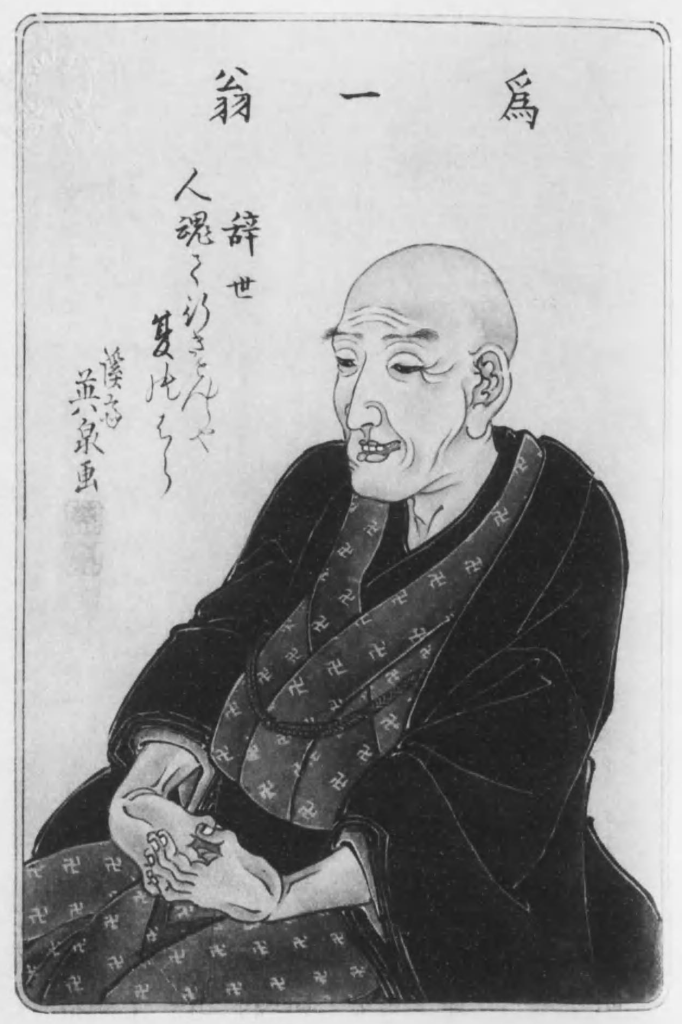
Image: Keisai Eisen / National Diet Library Digital Collections via Wikimedia Commons · Public domain
Katsushika Hokusai (1760–1849) was a Japanese print designer, painter, and book illustrator whose long career transformed Edo-period visual culture. Born and based largely in Edo's Sumida area, he entered the Katsukawa school as a young man, then repeatedly changed artistic names and explored new subjects, patrons, and formats. His landscape series Thirty-six Views of Mount Fuji includes Under the Wave off Kanagawa, widely known as The Great Wave. Yet Hokusai's work extends far beyond that image: actor prints, privately commissioned surimono, drawing manuals, illustrated books, nature studies, religious subjects, and late paintings reveal persistent experimentation. His designs were realized within the collaborative world of Japanese woodblock printing, where publishers, carvers, and printers shaped every printed impression.
Overview
| Japanese name | 葛飾北斎 |
|---|---|
| Born | 1760, Edo |
| Died | 1849, Edo |
| Occupations | Print designer, painter, and book illustrator |
| Formation | Katsukawa school under Katsukawa Shunshō |
| Known for | Thirty-six Views of Mount Fuji and Hokusai Manga |
| Active | Approximately 1775–1849 |
Early life and Katsukawa training
Hokusai was born in Edo in 1760 and spent most of his life in the eastern districts now associated with Sumida. Details of his childhood are incomplete, but he trained under Katsukawa Shunshō, a leading designer of actor prints, and published as Shunrō from the late 1770s.
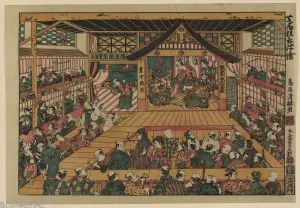
Katsukawa training grounded him in commercial design, especially images connected with kabuki. He later moved beyond the school's conventions and patrons, developing a career that crossed popular publishing, private poetry circles, instructional books, and painting.
Changing names and artistic independence
Like many Edo-period artists, Hokusai used multiple names. Changes from Shunrō to Sōri, Hokusai, Taito, Iitsu, and Gakyō Rōjin Manji marked shifts in affiliation, career stage, or artistic identity rather than simple aliases used at random.
He also moved residences frequently within Edo. The changing signatures and locations can complicate chronology, but they reflect his restless movement among markets and media. “Katsushika” referred to the eastern Edo area with which he identified.
Books, surimono, and drawing manuals
Hokusai designed illustrated fiction, poetry books, albums, instructional works, and privately commissioned surimono. These projects encouraged detailed observation and inventive combinations of text and image. They also connected him with writers, publishers, students, and poetry groups beyond the market for ordinary single-sheet prints.
The multi-volume Hokusai Manga, first published from 1814, gathers thousands of figures, animals, landscapes, occupations, comic incidents, and drawing studies. Despite its title, it is not a direct example of modern narrative manga; its pages function more as sketchbooks, models, and visual encyclopedias.
Landscape and Mount Fuji
Around 1830 Hokusai issued Thirty-six Views of Mount Fuji, a series that ultimately contained more than its title's thirty-six designs. It treated Fuji as a distant landmark, a weather-bound presence, and a frame for labor, travel, waves, bridges, and urban life.
Under the Wave off Kanagawa combines a towering wave, boats, and a small, stable Fuji. Imported Prussian blue helped define the series' palette. Its later fame should not obscure neighboring designs, whose varied viewpoints made landscape a powerful subject for popular prints.
Collaborative print production
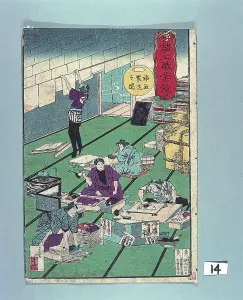
Hokusai made designs, not complete commercial editions single-handedly. A publisher selected and financed a project, carvers cut the key and color blocks, and printers controlled paper, registration, pigment, gradation, and pressure. The names of these specialists were often not preserved.
Attribution to Hokusai identifies the designer's central creative role, but the visible object records shared labor. Blocks could be printed in different color schemes and states, and later impressions could lose fine detail as wood surfaces wore.
Late work, painting, and legacy
In later life Hokusai increasingly pursued painting and ambitious book projects while continuing to work through financial difficulty, illness, fire, and repeated moves. His subjects included birds, plants, animals, legendary figures, landscapes, and religious imagery. He died in Edo in 1849.
His works circulated internationally in the nineteenth century and influenced artists far beyond Japan. Modern museums and scholarship have broadened the picture beyond The Great Wave, emphasizing his books, paintings, workshop relationships, long experimentation, and the unequal histories through which Japanese art was collected abroad.
Ōi and the Obuse paintings
Hokusai’s daughter Oei, who worked under the name Katsushika Ōi, assisted him and also pursued her own work as an ukiyo-e artist. Her role should not be reduced to anonymous help in her father’s studio: the Ota Memorial Museum identifies Yoshiwara by Night (Yoshiwara kōshi saki no zu) as one of her representative paintings, distinguished by its contrasts of light and shadow. Her independently attributed work and her assistance to Hokusai are related but distinct parts of her career. Sources: The Sumida Hokusai Museum; Ota Memorial Museum of Art.
Hokusai’s later painting also extended beyond Edo. The Hokusai Museum in Obuse dates his first visit to 1842 and describes the support of the local patron Takai Kōzan, who provided a studio. Its account records ceiling paintings for the Higashimachi festival float in 1844 and the Kanmachi float in 1845. These commissions show another setting for his art: paintings made for local festival structures, alongside the books and commercial prints for which he is widely known. The museum notes that explanations for his initial journey differ; patronage should not be presented as the only settled reason. Source: Hokusai Museum, Obuse and Hokusai.
Timeline
1760 — Born in Edo.
1770s — Enters the Katsukawa school and publishes as Shunrō.
1790s — Works under new names and expands into surimono and illustrated books.
1814 — The first volume of Hokusai Manga appears.
Around 1830–1832 — Thirty-six Views of Mount Fuji is published.
1834–1840s — Produces major late books and paintings.
1849 — Dies in Edo.
Sources
Last updated: