Performing Arts
Kabuki
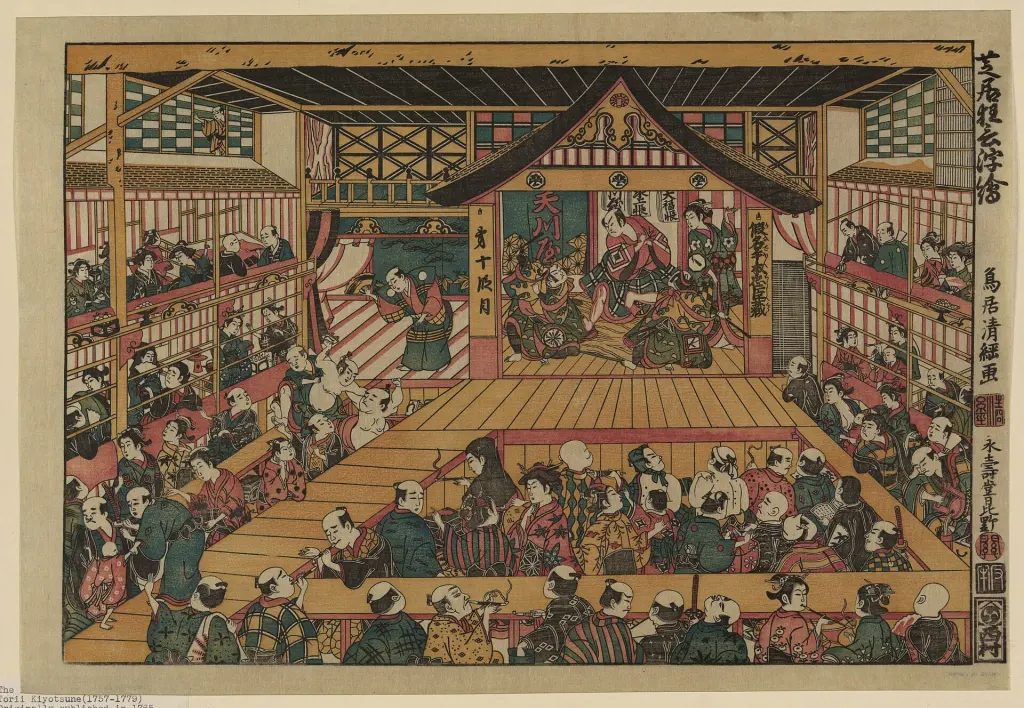
Image: Torii Kiyotsune / Wikimedia Commons; Library of Congress · Public domain
Kabuki (歌舞伎) is a Japanese theatre tradition that combines acting, music, dance, costume, makeup, and elaborate stage technology. It emerged in the early seventeenth century and became a major form of urban entertainment during the Edo period. Modern Kabuki is performed by male actors, including onnagata specialists in female roles, but the form’s beginnings included female and adolescent troupes before authorities prohibited them. Kabuki is not one uniform acting style: its repertory includes historical and domestic drama, dance pieces, adaptations from puppet theatre, and later works written under changing social conditions. Actor lineages, conventional role types, and audience-facing stage devices remain central to its identity.
Overview
| Japanese name | 歌舞伎 |
|---|---|
| Classification | Traditional actor-centred theatre |
| Origin | Early seventeenth century |
| Major role traditions | Onnagata, aragoto, and wagoto |
| Distinctive stage features | Hanamichi, revolving stage, and trap lifts |
| International status | Inscribed by UNESCO in 2008 |
Name and origins
Izumo no Okuni is the performer associated with the kabuki odori staged in Kyoto in 1603, although her personal biography survives only in fragmentary records and later narratives.
Kabuki is written with characters commonly understood as song, dance, and skill, although the name is also connected with kabuku, to lean or behave in an unconventional manner. Early kabuki-odori is associated with the performer Izumo no Okuni in Kyoto at the beginning of the seventeenth century.
Female troupes and then adolescent male troupes were prohibited by the authorities. Adult male performance became the durable institutional form. This history explains why the modern convention of men playing all roles should not be projected unchanged onto Kabuki’s earliest decades.
Edo-period development
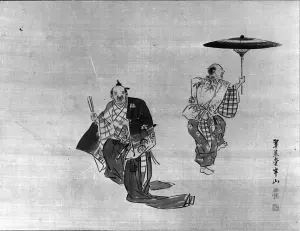
The theater’s celebrity culture also circulated through ukiyo-e, especially actor portraits that advertised roles, costumes, and performance lineages to an urban audience.
Chikamatsu Monzaemon helped establish professional playwriting in Genroku-period Kabuki through his close work with Sakata Tōjūrō I before concentrating on jōruri.
Kabuki grew with the commercial cities of Edo, Osaka, and Kyoto. Playwrights, actors, musicians, costumers, publishers, and theatre managers developed a repertory responsive to townspeople while operating under regulation. By the nineteenth century, many present-day acting and production conventions were established.
Theatres were also part of a wider print and celebrity culture. Actor portraits, playbills, guidebooks, and inherited stage names allowed audiences to compare performers across roles and generations. Fires, censorship, and changing districts repeatedly reshaped the physical institutions without ending the form.
Actors and acting styles
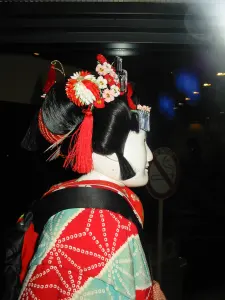
Onnagata examines the female-role tradition, its character conventions, and the distinction between stage portrayal and an actor’s private identity.
The focused guide to kabuki actors explains inherited stage names, house affiliations, shūmei succession, role categories, and training in greater detail.
Onnagata specialize in female roles. Aragoto, associated especially with Edo, uses forceful movement, speech, and makeup for larger-than-life heroes; wagoto, associated with the Kamigata region, emphasizes a softer manner in romantic male roles. These are important styles, not a complete classification of every performance.
A mie is a climactic pose in which motion concentrates into a held image. Kumadori makeup uses lines and colours to amplify character in selected roles. Other techniques include stylized fighting, dance, puppet-like ningyōburi acting, and rapid hikinuki costume changes.
Stage and production
The hanamichi is a raised passage through the audience used for entrances, exits, and important scenes. Revolving stages permit visible or rapid changes of setting, while lifts and trap mechanisms bring actors or scenery through the floor. Chūnori can carry an actor above the stage or spectators.
Musical sound may come from visible ensembles, narrators, singers, and offstage geza musicians. Wooden clappers punctuate beginnings, endings, and action. These systems are not decorative additions: they organize attention and allow the actor’s body to interact with an architecture designed for transformation.
Plays and repertory
Kanadehon Chūshingura illustrates how an eleven-act puppet drama entered kabuki repertory and continues through performances of selected acts.
Jidaimono treat historical settings and political conflicts; sewamono focus on the lives and pressures of townspeople; shosagoto foreground dance. The categories overlap, and a full programme may present selected acts rather than an entire long play.
Many works entered Kabuki from ningyō jōruri, now commonly called Bunraku, retaining forms of narrated shamisen music and sometimes puppet-inspired movement. Other pieces draw from Noh and Kyōgen, while modern playwrights and directors have created works from contemporary literature and popular media.
Names, lineages, and training
Kabuki stage names can be inherited through formal name-succession ceremonies called shūmei. A name connects a performer with earlier actors, characteristic roles, and an audience’s accumulated expectations. Lineage is theatrical and professional as well as genealogical; adoption and discipleship have also carried names and techniques.
Training begins with dance, voice, movement, and role-specific practice. Historically, families dominated access, but national training programmes have broadened routes into the profession. Musicians, narrators, stage assistants, wig makers, costumers, and technicians sustain parallel specialist traditions.
Modern status and recognition
Tokyo’s Kabuki-za has served as a principal commercial Kabuki theatre since 1889, with the present fifth building opening in Ginza in 2013.
After the Meiji Restoration, reformers and actors redefined Kabuki as a national classical art while continuing to produce new work. Film, broadcasting, reconstructed theatres, touring, and subtitled performances later changed how it reached audiences.
UNESCO proclaimed Kabuki in 2005 and inscribed it on the Representative List in 2008. Major theatres preserve the classical repertory, but Kabuki remains a living performance system in which casting, interpretation, and technology continue to generate new versions of inherited plays.
Sources
Last updated: