Aesthetic Concepts
Japanese Aesthetics
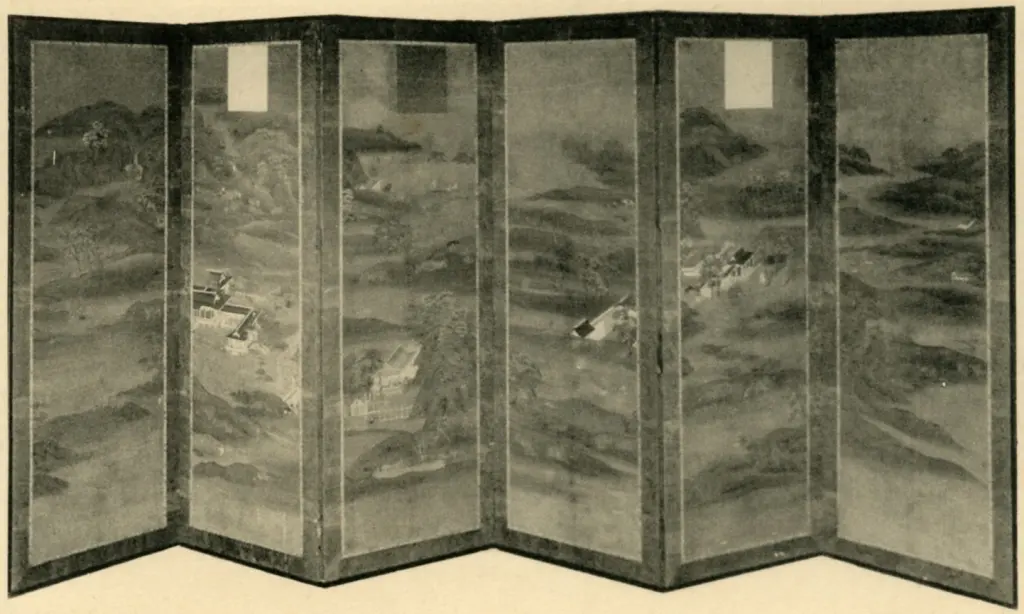
Image: Unknown artist / Wikimedia Commons; Tohoku University · Public domain
Meaning · Medium · Historical context
A vocabulary with many histories.
Japanese aesthetics brings together reflections on beauty and artistic experience from literature, performance, tea, material arts and other fields. Its concepts developed in different settings. They are most useful when meaning, context and a particular example remain connected.
Compare meaning, context and example
These short descriptions are entry points into different histories. The examples are illustrative interpretations, not tests that automatically identify a work or a national character.
| Concept | Working meaning | Context | Illustrative example |
|---|---|---|---|
| Mono no aware · もののあはれ | Sensitivity to the emotional force and passing of things. | Literary interpretation, notably Norinaga’s reading of Genji. | A narrative moment of parting, where awareness of change intensifies feeling. |
| Wabi · 侘び | Cultivated restraint associated with modest or austere circumstances. | Tea practice and material culture. | An unostentatious tea setting whose choices are carefully considered. |
| Sabi · 寂び | Appreciation associated with age, weathering and a subdued quality. | Poetry and material arts; meanings vary by period. | A weathered surface considered in relation to time and use. |
| Yūgen · 幽玄 | Depth or suggestiveness exceeding what is stated directly. | Medieval poetics and Noh theory. | Restrained performance that invites an audience to imagine what is not shown. |
| Ma · 間 | An interval understood through the elements around it. | Spatial relations, music, performance and modern design discussion. | A pause whose timing changes the force of the next movement. |
| Iki · 粋 | Knowing, restrained urban stylishness. | Edo social and fashion culture; later philosophical analysis. | Understated dress and manner understood within an urban social setting. |
Wabi and sabi are separated here to preserve their different emphases; Wabi-sabi explains the later paired term. The historical discussions below provide the qualifications that a short comparison cannot carry.
At a glance
- Academic term
- 日本美学 · Nihon bigaku
- Formation
- Modern aesthetics developed from the late nineteenth century
- Earlier traditions
- Poetics, theatre, tea writing, collecting and urban taste
- Reading principle
- Identify the context before applying the label
Term and scope
The Japanese word bigaku translates aesthetics as an academic field, but much reflection on art in Japan predates that vocabulary. Poets, playwrights, tea practitioners, monks, painters, and connoisseurs developed critical terms inside particular practices. Modern surveys bring those terms together for comparison, while historical study asks who used each term, in which medium, and with what meaning.
Ask what the term helps you notice
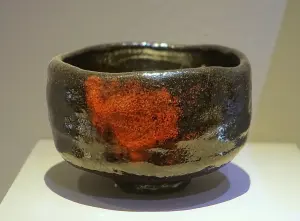
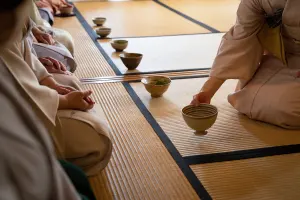
A tea bowl
Its modest presentation might prompt a discussion of wabi; its aged surface might prompt a discussion of sabi. Neither label follows merely from a crack.
A pause
Ma directs attention to the relation between moments. Yūgen asks about depth and suggestion. A pause alone does not prove both.
Urban dress
Iki belongs to a particular social history. Treating it as another word for rustic simplicity loses the distinction.
A useful interpretation names the work, date, medium and social setting before applying the term. The Stanford Encyclopedia of Philosophy supplies a historical overview, alongside the specialist and museum sources below.
Literature, feeling, and transience
Classical Japanese literature gives these ideas distinct narrative and poetic settings. The Tale of Genji, The Pillow Book, and The Tale of the Heike differ sharply in form and period, so later aesthetic labels should not be treated as rules their authors simply applied.
Haiku brings seasonal language and juxtaposed perceptions into a compact form, but its history also leads back to the social practice of hokku and linked verse.
Classical poetry and narrative cultivated sensitivity to seasons, separation, changing fortunes, and the emotional force of things. Mono no aware later became a major interpretive term for this responsiveness, especially through Motoori Norinaga's study of The Tale of Genji. Impermanence is important in this history, but it does not make every Japanese artwork an expression of melancholy.
Medieval suggestion and depth
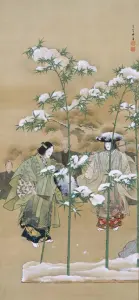
Medieval poetic criticism developed yūgen as a term for profundity, overtones, and an effect exceeding explicit statement. The idea acquired a central place in theories of Noh, where restrained movement, chant, music, costume, and an audience's imagination can disclose more than direct representation.
Tea and material arts
From the medieval and early modern periods, Japanese tea ceremony shaped architecture, gardens, ceramics, lacquer, flowers, calligraphy, and collecting. Wabi and sabi came to describe related but distinct values involving austere circumstances, weathered materials, restraint, and cultivated simplicity. Their later compound, wabi-sabi, should not be reduced to a preference for defects.
Space, time, and relation
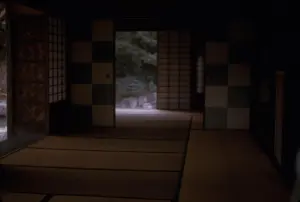
Ma names an interval or between-ness and can apply to both spatial and temporal relationships. In architecture it may concern spacing, thresholds, or the relation between elements; in performance it may concern pause, timing, and anticipation. The term has ordinary linguistic uses as well as modern aesthetic interpretations.
Edo urban style
Iki emerged from the social and fashion culture of Edo, particularly the pleasure quarters. It valued an urbane, restrained, and knowing style rather than rural austerity. Kuki Shūzō's 1930 philosophical analysis made iki prominent in modern aesthetics, while also showing how difficult it is to translate a culturally embedded term into a single foreign equivalent.
Modern use and limits
Institutions such as the Omiya Bonsai Art Museum show why broad aesthetic labels should be tested against specific materials, cultivation practices, display histories, and living collections.
Twentieth- and twenty-first-century designers, museums, scholars, and popular writers have extended these concepts far beyond their original settings. Comparison can reveal meaningful continuities, but broad claims about a uniquely Japanese love of minimalism or imperfection often erase luxury, color, abundance, conflict, and regional difference. A wiki approach therefore treats aesthetic vocabulary as a set of historical lenses rather than an essence of national character.
Sources
- Stanford Encyclopedia of Philosophy, Japanese Aesthetics
- JAANUS, Japanese Architecture and Art Net Users System
- Urasenke Konnichian, An Introduction to Chado
- Kyoto National Museum, Chanoyu: The Arts of Tea Ceremony
- Japan Arts Council, Introduction to Nohgaku
- Japan Arts Council, Nohgaku and Muromachi culture
- The Metropolitan Museum of Art, The Arts of Japan
Last updated: