Cultural Geography
Jōkamachi
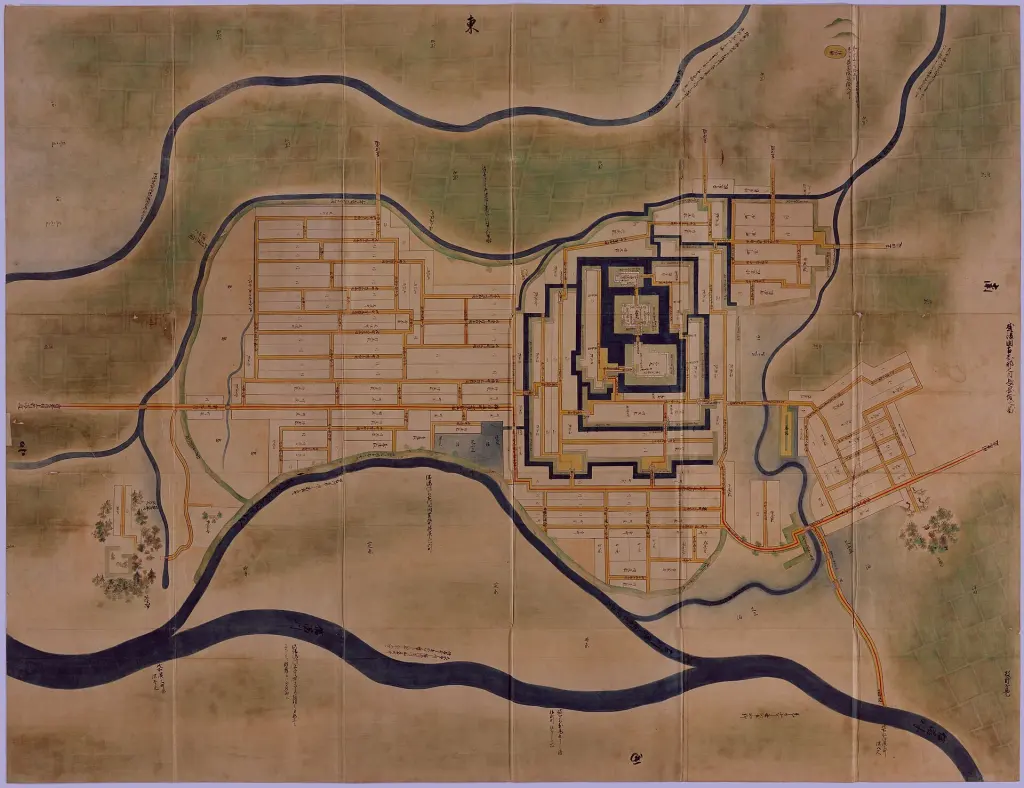
Image: Nagaoka Domain / Wikimedia Commons · Public domain
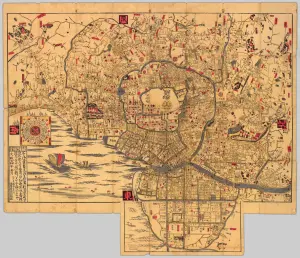
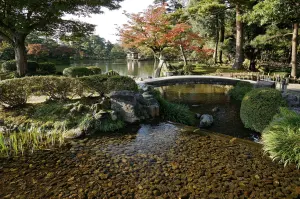
Jōkamachi, literally “town below the castle,” describes an urban type organized around a lord's castle and domain government. Castle towns expanded especially during the late sixteenth and early seventeenth centuries as rulers concentrated retainers, merchants, craftspeople, temples, roads, and supplies near fortified seats. Their layouts often separated or clustered social and occupational groups, incorporated moats and waterways, and linked surrounding villages to regional markets. Yet no single plan defines every jōkamachi: terrain, the size and status of a domain, earlier settlement, commercial routes, fire, warfare, and later modernization produced wide variation. Edo was the greatest shogunal castle city, while regional examples such as Kanazawa reveal how castle-town frameworks still influence modern streets and heritage districts.
Overview
| Japanese name | 城下町 |
|---|---|
| Romanization | Jōkamachi |
| Literal meaning | Town below or under the castle |
| Principal expansion | Late sixteenth through seventeenth centuries |
| Core functions | Castle, domain administration, residence, production, and trade |
| Urban legacy | Street, waterway, district, and property patterns in many modern cities |
Term and scope
Jōkamachi combines jō, castle, shita, below or under, and machi, town. The term emphasizes a settlement's relationship to a castle and its ruling household rather than elevation alone. English “castle town” is useful, although European and Japanese examples developed within different political and social systems.
A fortified residence with a small settlement was not automatically a fully developed castle town. Historians examine administrative roles, resident populations, markets, street plans, land allotment, religious precincts, and connections to a domain's villages when deciding how an urban center functioned.
Medieval origins and consolidation
Settlements grew around many medieval fortifications, ports, temples, and market sites, but late sixteenth-century political consolidation accelerated a distinctive castle-town form. Powerful lords moved warriors from scattered rural bases into headquarters and gathered merchants and artisans who could provision armies and administrations.
Castle relocation sometimes created a new city; elsewhere rulers enlarged or reorganized older settlements. The process could include compulsory moves, land grants, tax privileges, temple relocation, road diversion, and construction by domain labor. It was neither purely spontaneous nor fully controlled from above.
Castle and domain administration
The governance of Kōriyama by Toyotomi Hidenaga shows how a powerful late sixteenth-century lord joined castle building, territorial administration, and urban reorganisation.
The castle was a fortified residence, ceremonial center, warehouse complex, and seat of administration. Its innermost compounds were usually reserved for the lord and close retainers, while offices, gates, barracks, and outer enclosures connected government to the surrounding town.
Under the Tokugawa order, a jōkamachi typically served as the capital of a domain. Its political importance varied with domain size, location, the lord's rank, and relations with the shogunate. Some domains used administrative seats without a full castle, complicating a simple castle-equals-capital rule.
Residential and occupational organization
Samurai districts commonly occupied large plots near the castle or at strategically important approaches. Merchants and craftspeople lived in denser town blocks, sometimes grouped by trade, while temples and shrines formed precincts with religious, social, and spatial functions. Outcaste communities and service workers faced distinct restrictions and locations.
These patterns expressed status, taxation, fire management, production, and defense, but boundaries were not perfectly fixed. Subletting, workshops, servants, itinerant trade, demographic change, and commercial growth complicated official maps and regulations.
Roads, moats, water, and defense
Moats, rivers, embankments, gates, bridges, and changes in street direction could slow movement and define castle enclosures. Roads also had to carry processions, goods, firefighting crews, and daily traffic, while canals and wells supplied households, gardens, workshops, and transport.
Popular accounts often claim that every bent or offset street was designed to confuse attackers. Some routes did serve defensive purposes, but topography, older property lines, drainage, gate approaches, and later alteration also shaped irregular plans. Function must be evaluated locally rather than inferred from form alone.
Commerce, culture, and regional variation
Matsumoto shows how castle towns could change under successive lords. After entering the domain in 1590, Ishikawa Kazumasa and his son Yasunaga expanded castle and town works begun under the Ogasawara, with Yasunaga advancing the tower construction after Kazumasa’s death.
Nagoya is a major example of planned castle-town formation: Tokugawa construction and the Kiyosu relocation reorganised people, institutions, trades, and streets, while later port, railway, industrial, wartime, and postwar layers transformed that framework.
Kishiwada’s castle-town history remains visible in the routes and origin tradition of the Kishiwada Danjiri Festival, although its present floats and organisations developed over many later generations.
Castle towns developed along different economic paths. Osaka combined a shogun-controlled castle with waterborne distribution, wholesale markets, performance, and merchant institutions whose reach extended far beyond the surrounding domain.
Castle towns linked agrarian domains to regional and national markets. Rice taxes, domain monopolies, craft goods, food supply, lending, transport, and services supported merchant institutions and specialized neighborhoods. Schools, festivals, performing arts, gardens, and publishing also developed within particular domain cultures.
Scale ranged from large centers such as Kanazawa and Nagoya to small towns with compact administrative districts. Coastal shipping, post roads, river valleys, mountains, and climate affected their forms. Jōkamachi is therefore a comparative category, not a claim that all castle towns looked or operated alike.
Modern transformation and preservation
Aizuwakamatsu is a useful case of a castle town whose modern identity combines surviving urban traces, a reconstructed keep, war memory, museums, and working neighbourhoods.
The abolition of domains in the nineteenth century removed the administrative basis of castle towns. Castles were demolished, repurposed, or occupied by military and government institutions, while former samurai estates were subdivided and new railways and roads shifted commercial centers.
Many present-day cities nevertheless retain street alignments, waterways, temple clusters, district names, gardens, earthen works, or surviving residences. Heritage programs and tourism highlight selected layers, as in Kanazawa, but preservation is uneven and can simplify the lives of commoners, laborers, and marginalized groups who also made the town function.
Sources
- Yuzuru Fujioka, Certain Geographic Characters of Jokamachi.
- Hiroyuki Tajima and Kenzo Fujiwara, Urban Structure of Japanese Castle Towns in Jori Districts.
- National Museum of Japanese History, Castles and the Unification of the Realm.
- Kanazawa City Tourism Association, Castle-town Kanazawa.
- Kanazawa City, Kanazawa: A Castle Town.
Last updated: