Historical Figures
Matsuo Bashō
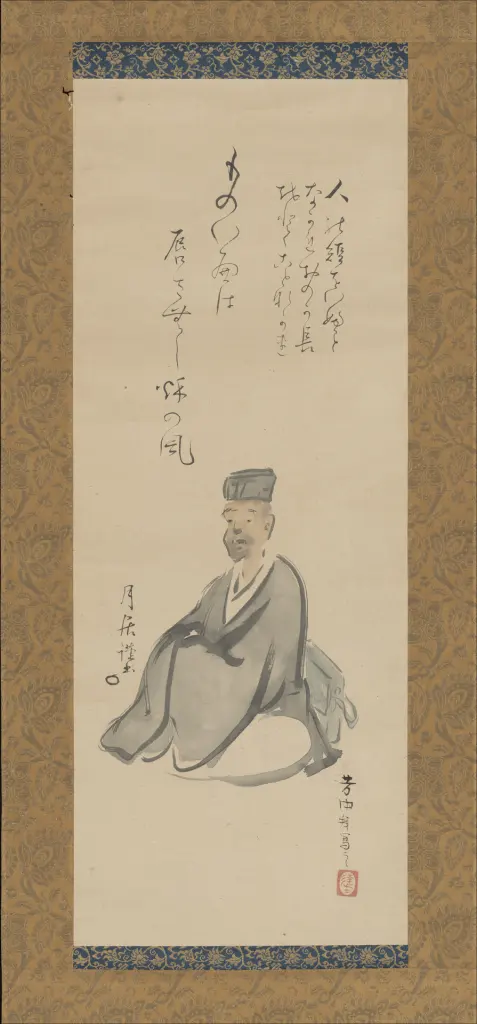
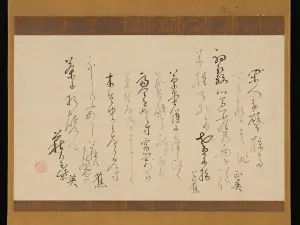
Image: Nakamura Hōchū / Yale University Art Gallery via Wikimedia Commons · Public domain
Matsuo Bashō (1644–1694) was an Edo-period poet, teacher, and travel writer who transformed haikai and the opening verses known as hokku. Born in Iga Province, he moved to Edo, built a circle of students, and adopted the name Bashō after a banana plant associated with his riverside dwelling. Journeys became central to his literary practice. In prose-and-verse works such as Oku no hosomichi, commonly translated as The Narrow Road to the Deep North, places, earlier literature, weather, hardship, and encounters shape one another. Bashō is now celebrated as a master of haiku, but that modern label became common only after his lifetime. Reading him through hokku, linked verse, haibun, and collaborative teaching reveals a wider and more social poetics.
Overview
| Japanese name | 松尾芭蕉 |
|---|---|
| Born | 1644, Ueno in Iga Province |
| Died | 1694, Osaka |
| Occupations | Haikai poet, teacher, and travel writer |
| Principal forms | Hokku, linked verse, and haibun |
| Known for | Oku no hosomichi (The Narrow Road to the Deep North) |
| Associated places | Iga, Edo's Fukagawa district, and travel routes across Japan |
Iga and early haikai
Bashō was born Matsuo Kinsaku in 1644 in Ueno, Iga Province, in present-day Mie Prefecture. As a young man he entered the service of Tōdō Yoshitada, with whom he shared an interest in haikai. After Yoshitada's early death, Bashō eventually left Iga.
His early poems participated in fashionable comic linked verse. Rather than beginning as an isolated nature poet, he learned within a social practice that depended on rules, wit, literary allusion, host–guest relations, and the ability to link one verse to the next.
Edo and a community of poets
Bashō moved to Edo in the 1670s and established himself as a haikai teacher. He judged sequences, organized gatherings, edited collections, and attracted students. Teaching provided both livelihood and a network through which poems, travel, and reputations circulated.
His work developed in conversation with multiple haikai styles. He retained humor and ordinary language while seeking greater depth, historical resonance, and responsiveness to the present scene. The school later called Shōmon formed around practice and transmission rather than a fixed manifesto alone.
Bashō-an and the poet's name
In 1680 Bashō withdrew to a hut in Fukagawa on the eastern edge of Edo. A student gave him a bashō, or Japanese banana plant, whose broad leaves and vulnerability to wind and weather appealed to the poet. The dwelling became known as Bashō-an, and the plant supplied the name by which he is remembered.
The hut represented neither complete isolation nor withdrawal from literary society. Students and visitors came there, and Bashō continued to teach, correspond, publish, and travel. Its riverside setting nevertheless offered a different relation to the dense commercial center across the Sumida River.
Journeys and haibun
From the 1680s Bashō undertook demanding journeys through Japan. Travel exposed him to weather, illness, precarious lodging, religious sites, famous poetic places, and communities of disciples. He revised these experiences into literary works rather than presenting unedited diaries.
His travel writing combines prose and verse in forms now called haibun. The prose frames encounters and allusions; a hokku may turn, condense, or complicate the scene. Earlier poets and historical memories remain present within apparently immediate observations.
Oku no hosomichi
In 1689 Bashō departed Edo with his companion Kawai Sora on the journey that became Oku no hosomichi. The route passed through northern Honshu and along the Japan Sea before turning inland. Bashō revised the work for years; it was published posthumously.
The title has several English translations, including The Narrow Road to the Deep North and The Narrow Road to the Interior. The text joins physical travel to a journey through cultural memory, invoking earlier poetry, battle sites, sacred landscapes, and the fragility of human achievement.
Poetics, seasons, and interpretation
Bashō's teaching is associated with ideals such as karumi, or lightness, and with the demand to renew poetic language through close attention. His verses use season words, sound, allusion, humor, and juxtaposition, but no single formula describes the changes across his career.
Later accounts sometimes portray him simply as a Zen sage or solitary mystic. Buddhist ideas and practices mattered in his world, yet his poetry also grew from collaborative verse, literary study, patronage, teaching, and carefully revised travel prose. Context resists turning individual poems into universal slogans.
Afterlife and the modern idea of haiku
Bashō died in Osaka in 1694 while traveling. His students preserved, edited, and debated his work, and later generations made him a central figure in Japanese literary history. Memorial sites and travel routes continue to shape public encounters with his life.
In the Meiji period, Masaoka Shiki criticized excessive reverence for Bashō even as he helped recast selected hokku as independent haiku. Modern anthologies and translations widened Bashō's global audience, but they often separate verses from the linked sequences, prose settings, and social occasions that first gave them meaning.
Timeline
1644 — Born in Ueno, Iga Province.
1660s — Composes early haikai while associated with Tōdō Yoshitada.
1670s — Moves to Edo and establishes himself as a teacher.
1680 — Settles at the first Bashō-an in Fukagawa.
1684–1688 — Undertakes journeys later shaped into prose-and-verse works.
1689 — Begins the northern journey behind <em>Oku no hosomichi</em>.
1694 — Dies in Osaka.
Sources
- Government of Japan, Matsuo Basho: The Unparalleled Haiku Poet.
- Government of Japan, Masaoka Shiki: A Poet Who Brought Innovation to Haiku.
- Poetry Foundation, Haiku (or Hokku).
- Bashō Memorial Museum, Bashō and Iga.
- National Diet Library, Oku no Hosomichi and Travel.
- Poetry Foundation, Bashō.
- State University of New York Press, Bashō's Haiku.
Last updated: