Martial Arts Figures
Morihei Ueshiba

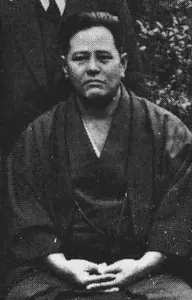
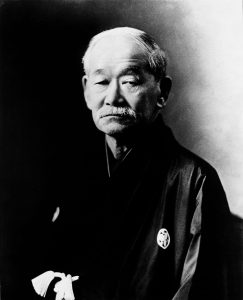
Image: Unknown photographer / Wikimedia Commons · Public domain
Morihei Ueshiba (1883–1969) was a Japanese martial artist and the founder of Aikido. His technical education was rooted above all in Daitō-ryū Aiki-jūjutsu, which he studied under Takeda Sōkaku, while his religious outlook was strongly affected by the Ōmoto movement and its leader, Deguchi Onisaburō. From the 1920s through the postwar years, Ueshiba gradually reorganized his practice, teaching institutions, and terminology. The result was not a single moment of invention but a long development from Daitō-ryū-based instruction through forms known as aiki-bujutsu and aiki-budō to modern Aikido. Later practitioners commonly call him Ōsensei, “great teacher.”
Overview
| Japanese name | 植芝 盛平 |
|---|---|
| Born | 14 December 1883 Tanabe, Wakayama Prefecture, Japan |
| Died | 26 April 1969 (aged 85) Tokyo, Japan |
| Occupation | Martial artist and instructor |
| Known for | Founder of Aikido |
| Principal martial teacher | Takeda Sōkaku |
| Religious influence | Deguchi Onisaburō and Ōmoto |
| Institutions | Kobukan dōjō; Aikikai Foundation; Aiki Shrine |
| Also known as | Ōsensei (a title used by later Aikido practitioners) |
Early life
Ueshiba was born in Tanabe, on the Kii Peninsula, in 1883. Accounts from the Aikikai and his home city place his youth in a family active in local affairs. As a young man he tried several occupations and undertook military service during the Russo-Japanese War. Biographical narratives often list brief encounters with a number of martial traditions during this period. Their exact length and significance are not equally well documented, so they should not be treated as a single continuous lineage. The decisive technical relationship in his later career began after he moved to Hokkaidō.
Hokkaidō and Takeda Sōkaku
In 1912 Ueshiba joined a settlement project at Shirataki in northern Hokkaidō. He met Takeda Sōkaku at Engaru in 1915 and began intensive study of Daitō-ryū. The official Daitō-ryū history records that Ueshiba invited Takeda to Shirataki and continued training under him for several years. Their connection did not end when Ueshiba left Hokkaidō: Takeda later visited him at Ayabe, and in 1922 issued him a kyōju dairi, an instructor-level teaching authorization.
Daitō-ryū supplied much of the joint-control, throwing, and body-management vocabulary from which Ueshiba’s later art developed. Historical research based on training records and contemporary documents supports this close relationship while also showing that Ueshiba’s methods and presentation changed over time. Aikido is therefore connected to Daitō-ryū but is not simply another name for it.
Ayabe and Ōmoto
Ueshiba left Hokkaidō in 1919 after learning that his father was seriously ill. On the journey south he visited Ayabe, the center of the new religious movement Ōmoto, and met its leader Deguchi Onisaburō. After his father’s death, Ueshiba settled at Ayabe with his family. He opened a small training space usually called the Ueshiba-juku and taught members of the religious community and nearby naval personnel.
Deguchi’s teachings gave Ueshiba a religious language through which he later explained martial practice: purification, reconciliation, the unity of the human and natural worlds, and the responsibility to overcome conflict rather than cultivate it. These ideas mattered to his interpretation of budō, but they did not replace technical training. At Ayabe the religious and martial strands of his career developed together.
Tokyo and the Kobukan
The Kobukan opened in 1931 on the site now occupied by the Aikikai Hombu Dojo.
Ueshiba’s demonstrations in the 1920s attracted military officers, politicians, and established martial artists. He moved to Tokyo in 1927 and taught at several temporary locations before opening the Kobukan dōjō in Shinjuku in 1931. Instruction during this period was commonly described by names such as Daitō-ryū Aiki-jūjutsu, Ueshiba-ryū, aiki-bujutsu, or aiki-budō. Terminology varied by document and date; it is misleading to project today’s standardized name and curriculum unchanged onto the 1920s and 1930s.
Kanō Jigorō visited a Ueshiba demonstration in 1930 and subsequently sent students, including Tomiki Kenji, to train with him. The encounter is one example of the exchanges linking early Aikido to the wider world of modern Japanese budō rather than isolating it from Judo and other disciplines.
From aiki-budō to Aikido
The name “Aikido” was adopted within Japan’s wartime martial-arts administration in 1942. That date is important institutionally, but the art continued to evolve before and after it. Ueshiba’s prewar instruction could include vigorous throws, pins, weapons work, and responses to armed attacks. In later demonstrations he increasingly emphasized connected movement, timing, and control without a contest format.
Scholars examining Ueshiba’s Daitō-ryū training and early technical records describe a gradual process of adaptation rather than a clean break. His students also learned at different stages and developed distinct interpretations. This helps explain why present-day Aikido organizations can share a founder while differing in posture, training intensity, weapons practice, and pedagogy.
Iwama and the postwar period
In 1942 Ueshiba withdrew from much of his Tokyo teaching and moved to Iwama in Ibaraki Prefecture. There he farmed, trained, and established the Aiki Shrine. The Iwama years became especially important to his integration of empty-hand practice with the sword and staff, although interpretations of that relationship differ among later schools.
After Japan’s defeat, organized budō faced restrictions and institutional disruption. The Aikikai Foundation, led administratively by Ueshiba’s son Kisshōmaru and supported by senior instructors, rebuilt public practice in Tokyo. Ueshiba continued to teach and demonstrate in both Iwama and Tokyo. The postwar organization helped Aikido spread through universities, workplaces, police groups, and overseas dōjō.
Teaching and ideas
Ueshiba did not leave one systematic technical manual that fixes a universal curriculum. His teaching combined demonstration, repetition, short verbal images, religious discourse, and correction through physical contact. Recorded statements often present budō as a means of reconciliation or of protecting life. They are influential, but translations and later selections can detach them from the Ōmoto vocabulary and historical circumstances in which they were spoken.
Aikido practice typically uses paired roles: one partner initiates an attack and the other redirects, unbalances, throws, or pins. Ueshiba did not organize the art as a competitive sport. This non-competitive structure distinguishes most Aikido institutions, although it does not by itself define how gently or forcefully a particular dōjō trains.
Students and institutional legacy
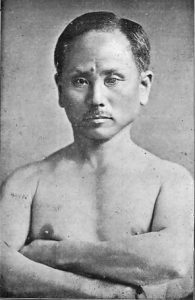
Minoru Mochizuki, a Kodokan judoka introduced to Ueshiba in 1930, later opened the Yoseikan dojo and became an early teacher of Aikido in France.
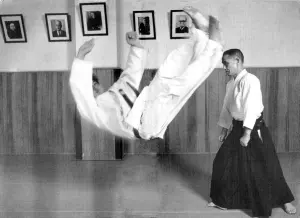
Kenji Tomiki combined training under Ueshiba with Kodokan educational theory and later developed a system joining Aikido kata with controlled randori.
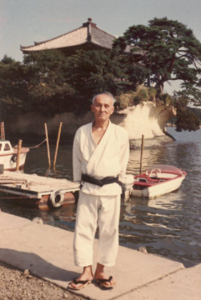
Gozo Shioda, who trained at the Kobukan from 1932, later founded Yoshinkan Aikido and developed a highly structured postwar teaching method.
Students associated with different phases of Ueshiba’s teaching founded major branches or carried Aikido into new settings. They include Tomiki Kenji, Shioda Gōzō, Tōhei Kōichi, Saitō Morihiro, and his son Ueshiba Kisshōmaru. Their approaches should not be treated as interchangeable: each selected and systematized material for a particular institutional purpose.
The Aikikai became the largest international Aikido organization, while groups such as Shōdōkan, Yōshinkan, Ki Society, and Iwama-lineage organizations developed their own pedagogies. Ueshiba’s lasting importance lies both in the techniques he transmitted and in the adaptable ethical and institutional framework through which those techniques became a worldwide budō.
How the meaning of aiki changed
Ueshiba did not use aiki as one fixed technical definition throughout his life. Research by Kudō Ryūta and Shishida Fumiaki traces both a technical register and an Ōmoto-influenced religious and ethical register in the founder’s language. His pupils then explained the term differently: as balance-breaking, coordination with natural law, unity with universal ki, or a combination of martial and spiritual practice.
This semantic development helps explain why Aikido cannot be defined only by translating its three characters, and why it is misleading either to erase or to overstate its relationship with Daitō-ryū Aiki-jūjutsu. Ueshiba’s instruction under Takeda Sōkaku is documented, while the Aikikai chronology records a gradual institutional sequence culminating in adoption of the name Aikido in 1942 rather than a single moment of invention.
Historical interpretation
Ueshiba’s life is documented through organizational histories, family recollections, photographs, films, technical records, and academic studies, but these sources do not always serve the same purpose. Devotional biographies often interpret unusual demonstrations or spiritual experiences literally. Technical lineages sometimes minimize influences outside their own branch. Historical study works best when dated records are compared across Aikikai, Daitō-ryū, Ōmoto, and independent scholarship.
Two conclusions are especially well supported. First, Takeda’s Daitō-ryū was fundamental to Ueshiba’s technical formation. Second, Ueshiba changed the art’s organization, aims, language, and practice over several decades. Recognizing both facts avoids the opposing myths that Aikido appeared without a technical past or that it never became distinct from that past.
Timeline
- 1883 — Born in Tanabe, Wakayama Prefecture.
- 1912 — Moves with a settlement group to Shirataki, Hokkaidō.
- 1915 — Meets Takeda Sōkaku and begins Daitō-ryū training.
- 1920 — Settles at Ayabe and teaches at the Ueshiba-juku.
- 1922 — Receives Daitō-ryū kyōju dairi authorization.
- 1927 — Moves to Tokyo.
- 1931 — Opens the Kobukan dōjō.
- 1942 — The name Aikido is adopted; moves to Iwama.
- 1943 — Establishes the Aiki Shrine at Iwama.
- 1969 — Dies in Tokyo on 26 April.
Related
Sources
- Aikikai Foundation, “History of Aikido”.
- Aikikai Foundation, “What is Aikido?”.
- Daitō-ryū Aiki-jūjutsu Headquarters, “Daitō-ryū and Aikido”.
- Shishida Fumiaki, “A Study of the Historical Process of the Establishment of Aikido”, Research Journal of Budo 25, no. 2 (1992).
- Kudō Ryūta, “A Historical Study of the Formative Process of Aikido as a Modern Budō”, Japan Journal of the History of Physical Education and Sport 35 (2018).
- Kudō Ryūta and Shishida Fumiaki, study of aiki in Ueshiba’s thought, Japan Journal of Physical Education, Health and Sport Sciences 55, no. 2 (2010).
- Tanabe City, biographical materials on Ueshiba Morihei.
Image: Morihei Ueshiba, 1939. Photographer unknown; source reproduced by Aikido Journal and made available through Wikimedia Commons. Public domain in Japan and the United States.
Last updated: