Martial Arts Figures
Hironori Ōtsuka
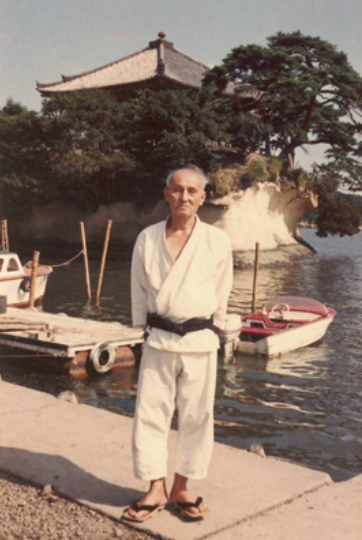
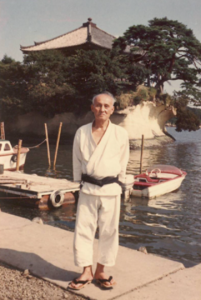
Image: HistoryTuan / Wikimedia Commons · CC BY-SA 4.0
Hironori Ōtsuka (大塚博紀, 1892–1982) was a Japanese martial artist and the founder of Wadō-ryū Karate. Before studying Okinawan Karate with Gichin Funakoshi and exchanging with teachers including Kenwa Mabuni and Chōki Motobu, he had trained extensively in Shindō Yōshin-ryū jūjutsu. Wadō-ryū therefore developed as more than a regional variant of Shotokan: Ōtsuka reorganised striking, body shifting, partner practice and grappling-related concepts through an existing Japanese jūjutsu education. His career matters to Karate history because it shows how Okinawan material was reinterpreted within mainland budō institutions. The name Wadō-ryū emerged through several stages in the 1920s and 1930s, so a single neat founding date can be misleading.
Overview
| Japanese | 大塚博紀 |
|---|---|
| Reading | おおつか ひろのり |
| Romanisation | Ōtsuka Hironori; English name order: Hironori Ōtsuka |
| Born | 1 June 1892, Shimodate, Ibaraki Prefecture |
| Died | 29 January 1982 |
| Birth name | Ōtsuka Kō (大塚孝) |
| Martial arts | Karate and jūjutsu |
| Associated style | Wadō-ryū |
| Key earlier tradition | Shindō Yōshin-ryū jūjutsu |
Name and identity
Ōtsuka was born 大塚孝 (Ōtsuka Kō) on 1 June 1892 in Shimodate, now part of Chikusei in Ibaraki Prefecture. The Wadō-ryū federation states that 博紀, read Hironori, was a martial name he adopted later.
English sources often write Otsuka or Ohtsuka. TokyoWaltz uses Ōtsuka. The name Hironori Ōtsuka was later inherited by his son and, in 2016, by the third head of one Wadō-ryū organisation; dates and titles are therefore essential when identifying the founder.
Jūjutsu formation
Ōtsuka began martial training as a child and entered the dōjō of Tatsusaburō Nakayama, a teacher of Shindō Yōshin-ryū jūjutsu, in 1905. Official Wadō-ryū history also records his investigation of other jūjutsu schools during his student years.
This background matters technically. Evasion, body shifting, unbalancing, joint control and partner forms were not later decorations added to an otherwise complete Karate system; they formed part of the lens through which Ōtsuka understood Karate.
Study with Gichin Funakoshi
Ōtsuka began studying Karate with Gichin Funakoshi in 1922, the year Funakoshi settled in Tokyo after a public demonstration. He became involved in teaching and in the development of partner practice around the emerging mainland Karate community.
The relationship was influential but did not produce a permanent institutional identity. Differences over training method and Ōtsuka's continuing jūjutsu perspective contributed to the development of an independent approach.
Exchange with Mabuni and Motobu
The official chronology records Ōtsuka visiting Kenwa Mabuni in 1928 and Chōki Motobu in 1929. Both contacts broadened his exposure beyond Funakoshi's circle.
Later lineage narratives differ in how much influence they assign to each teacher. It is safer to document meetings and areas of exchange than to attribute every Wadō-ryū movement to a single source.
Formation and naming of Wadō-ryū
Ōtsuka entered his own Karate as Wadō-ryū Karate-jutsu in a budō organisation by 1929. In 1938 he registered the name Shinshū Wadō-ryū Karate-jutsu with the Dai Nippon Butokukai, and the official chronology records the shorter Wadō-ryū form from 1939.
These stages explain why sources give different foundation dates. They mark emergence, organisational affiliation and formal naming rather than one instant in which the complete modern curriculum appeared.
Technical character
The JKF describes Wadō-ryū as drawing on Shotokan-related Karate together with jūjutsu and sword principles. Characteristic ideas include moving off the attack line, controlling distance and using body movement rather than meeting force only with force.
Modern Wadō organisations use related terms and paired forms but do not always preserve an identical syllabus. Technical descriptions should therefore be attributed to a particular federation instead of treated as universal Karate mechanics.
Institutions and public recognition
Ōtsuka received budō titles through the Dai Nippon Butokukai before 1945 and continued organising Wadō-ryū after the war. The official history records his appointment as a vice-president when the All Japan Karatedo Federation obtained incorporated status in 1969.
Such positions show his place in national organisation, but ranks and honorific titles issued by one body should not be confused with a universal measurement across all Karate groups.
Succession and use of the name Hironori
Ōtsuka died on 29 January 1982. Subsequent organisational divisions produced more than one major Wadō body, each preserving relationships to the founder's teaching.
His son adopted the name Hironori Ōtsuka as the second head of Wadō-ryū. A third head assumed the same name in 2016 within the Wadō-ryū Karate-dō Renmei. References to “Hironori Ōtsuka” after 1982 may therefore identify a successor rather than the founder.
Legacy
Ōtsuka's work made Wadō-ryū one of the major Karate traditions represented in Japanese federation structures and an international school with several organisations. Its history demonstrates that mainland Karate developed through selection, reinterpretation and exchange with other Japanese martial arts.
Academic work continues to examine which paired methods derive directly from Shindō Yōshin-ryū and which were reformulated within Wadō-ryū. Conclusions remain technical and source-dependent rather than settled by lineage slogans.
Sources
- All Japan Karatedo Federation, Wadō-ryū.
- Wado-Ryu Karate-Do Federation, Meiji-period history.
- Wado-Ryu Karate-Do Federation, Taishō-period history.
- Wado-Ryu Karate-Do Federation, Shōwa-period history.
- Research Journal of Budo, A Study of the Technical Origins of Wadō-ryū Karate.
- Wado-Ryu Karate-Do Federation, Third headmaster name succession report.
Last updated: