Martial Arts Figures
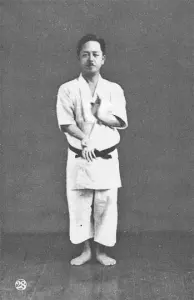
Kenwa Mabuni
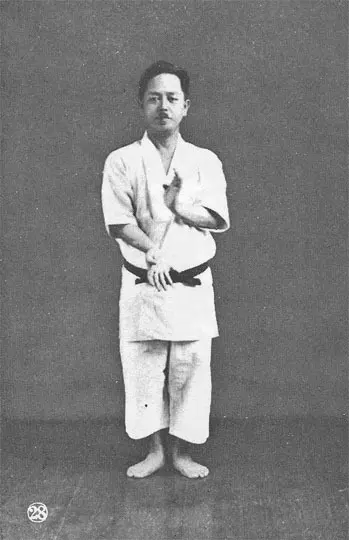
Image: Nakasone Genwa (publication source) / Karate-dō Taikan (1938), via Wikimedia Commons · Public domain
Kenwa Mabuni (摩文仁賢和, 1889–1952) was an Okinawan Karate teacher and the founder of Shitō-ryū Karate. He studied principally with Ankō Itosu of the Shuri tradition and Kanryō Higaonna of the Naha tradition, while also researching kata and weapons with other Okinawan teachers. After moving to Osaka, Mabuni taught, published and organised Karate for a mainland Japanese audience. His importance lies in the breadth of the curriculum associated with him and in his effort to preserve kata together with technical analysis rather than simply collecting names. Institutional sources date different stages of Shitō-ryū's emergence to 1931, 1934 or 1939; these dates should be read as organisational, naming and registration milestones, not collapsed into a single uncontested founding moment.
Overview
| Japanese | 摩文仁賢和 |
|---|---|
| Reading | まぶに けんわ |
| Romanisation | Mabuni Kenwa; English name order: Kenwa Mabuni |
| Born | 14 November 1889, Shuri, Okinawa |
| Died | 23 May 1952 |
| Martial art | Karate |
| Associated style | Shitō-ryū |
| Principal teachers | Ankō Itosu and Kanryō Higaonna |
| Mainland base | Osaka |
Early life in Shuri
Mabuni was born in Shuri on 14 November 1889. The official Shitō-kai history states that he began studying with Ankō Itosu at about thirteen and later entered the circle of Kanryō Higaonna through Chōjun Miyagi.
Itosu and Higaonna are commonly associated with Shuri-te and Naha-te respectively. Those later geographical labels help orient readers, but they should not imply two sealed technical systems or that Mabuni learned only from two people.
Teachers and wider research
Mabuni also studied material associated with teachers such as Seishō Arakaki and investigated Okinawan weapons traditions. His police work gave him opportunities to travel within Okinawa and meet practitioners beyond his first teacher's neighbourhood.
Later Shitō-ryū sources emphasise this breadth. It is more precise to describe a network of instruction and research than to claim that Mabuni simply combined every Okinawan style into one complete system.
Okinawan study groups
Institutional histories associate Mabuni with a Karate research group in 1918 and a broader club in the mid-1920s. Participants included teachers from several Okinawan lines, among them Chōjun Miyagi.
These groups show that early twentieth-century Karate developed through exchange as well as teacher-to-student inheritance. Their memberships and exact titles vary in later accounts, so they should not be treated as a modern federation with a fixed syllabus.
Move to mainland Japan
Mabuni demonstrated and taught on the mainland during the 1920s and settled in Osaka in 1929. His Kansai base distinguishes his career from Gichin Funakoshi's better-known work in Tokyo and helped establish Karate in western Japan.
In Osaka he organised teaching, gave demonstrations and adapted explanation to students who did not share Okinawan language or community knowledge. This mainland setting shaped how his curriculum was named and documented.
The name Shitō-ryū
Shitō (糸東) combines the first characters of the names Itosu (糸洲) and Higaonna (東恩納), honouring Mabuni's two principal teachers. Ryū means school or tradition.
Official Shitō-kai pages date the Dai Nippon Karate-dō Kai to 1931, describe adoption of the Shitō-ryū name in 1934, and elsewhere use 1939 for formal foundation or registration. These dates refer to different institutional acts. Presenting one as the only possible “creation date” obscures the gradual formation of the school.
Kata and bunkai
Kata are central to Mabuni's legacy. Shitō-kai describes the study of form, technical principle and bunkai—analysis of possible functions—as a connected method rather than separate subjects.
The large kata repertory associated with Shitō-ryū reflects several lines of transmission. It does not mean every present Shitō-ryū organisation teaches every form identically or that a kata has only one authorised application.
Writing and technical documentation
Mabuni published instructional works in the 1930s, sometimes with Genwa Nakasone. The National Diet Library's digitised catalogue includes Kōbō Kenpō Karate-dō Nyūmon, providing a contemporary record of terminology, pedagogy and presentation.
These books are primary evidence for what Mabuni chose to explain publicly. They do not by themselves prove that every photographed form represents the only version taught privately or later preserved by all students.
Relationship with Miyagi, Ōtsuka and Kanō
Mabuni and Chōjun Miyagi participated in overlapping Okinawan Karate circles. Official Wadō-ryū history also records Hironori Ōtsuka visiting Mabuni in 1928.
Shitō-ryū institutional history reports a demonstration for Jigorō Kanō during Kanō's Okinawa visit. The episode is important as a point of contact between Karate and modern Japanese budō, although later retellings often supply polished dialogue that should not be treated as a verbatim transcript.
Legacy and later organisations
Mabuni died on 23 May 1952. Students and family members continued Shitō-ryū through organisations that later developed distinct leadership lines, curricula and international networks.
The All Japan Karatedo Federation recognises Shitō-ryū as one of the major mainland Japanese style groupings. That federation relationship concerns organisation and competition; it does not exhaust the school's kata, partner methods or historical identity.
Sources
- All Japan Karatedo Federation, Shitō-ryū.
- All Japan Karatedo Federation Shito-kai, History.
- World Shitoryu Karatedo Federation, History.
- All Japan Karatedo Federation Shito-kai, Philosophy and Technique.
- National Diet Library Search, Kōbō Kenpō Karate-dō Nyūmon, Mabuni Kenwa and Nakasone Genwa.
- Research Journal of Budo, Modernisation of Karate on the Japanese Mainland.
Last updated: