Karate
Karate Kata
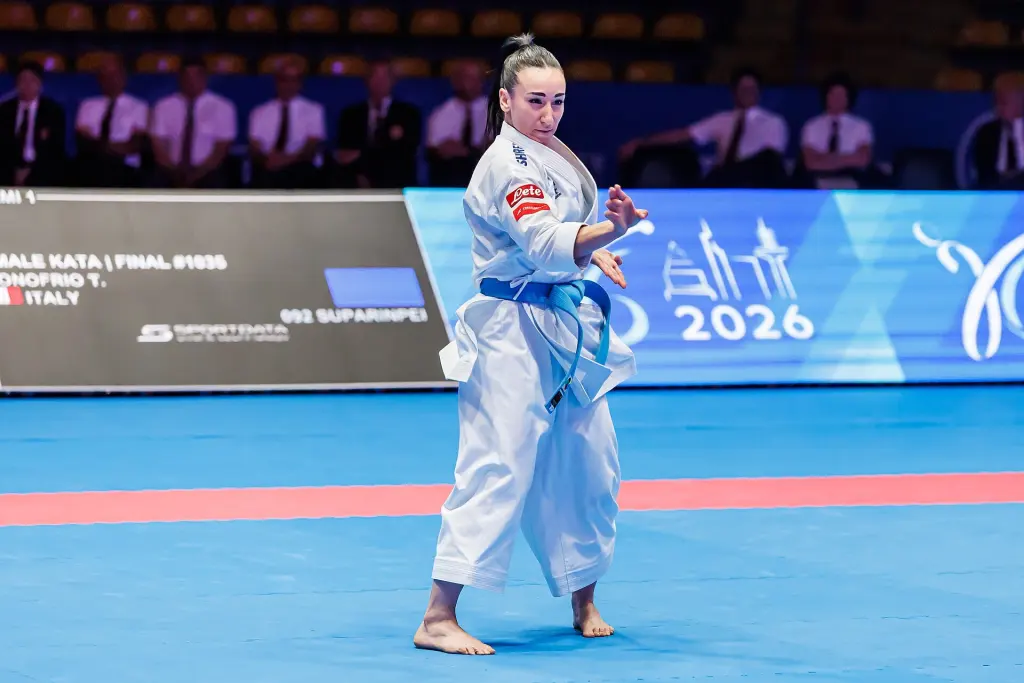
Image: Steffen Prößdorf / Wikimedia Commons · CC BY-SA 4.0
Overview
Kata preserves a sequence; a lineage supplies its movement, interpretation, and purpose.
Karate kata (空手の形) are prescribed sequences used to study stance, movement, receiving, striking, kicking, breathing, rhythm, and tactical relationships. A kata is more than choreography, but its visible sequence is not a self-explaining record of one fixed fight. Okinawan lineages, mainland schools, and later organisations have preserved, renamed, revised, and standardised forms for different purposes. Shared names therefore do not guarantee identical performance or interpretation. Competition selects and judges kata within a current ruleset; it cannot decide which version is historically original or universally correct.
A repeatable sequence gives movement a stable frame.
A teacher or organisation supplies version-specific detail.
- Japanese
- 形 or 型 · kata
- Basic structure
- Order · direction · rhythm
- Technical content
- Posture · movement · attack · receiving
- Interpretive study
- Bunkai and ōyō
- Variation comes from
- Teachers · lineages · pedagogy · rules
- Not universal
- No single catalogue covers all Karate
01Meaning & scope
A fixed performance frame supports several kinds of study.
“Imaginary opponents” is useful shorthand, but it is not the only way to read a sequence.
形 · form or configuration
The All Japan Karatedo Federation uses this character in its terminology and rules.
型 · mould or model
This character also appears in historical texts and wider martial-arts writing.
Both are read kata. Japanese does not mark grammatical plural, so the same word can mean one form or several; English “katas” is unnecessary here. A kata can develop alignment, direction changes, transitions, breathing, and continuing awareness without requiring a partner for every repetition.
02Historical role
Transmission was preserved through repetition—and reshaped through teaching.
The early written record is limited, so one timeless catalogue cannot be reconstructed with certainty.
Teacher and community
Kata organised movement before modern grading, mass classes, and sport competition.
Schools and demonstrations
Beginner forms, group commands, and public education encouraged selection and standardisation.
Documented modern presentation
Funakoshi’s publications of 1922, 1925, and 1935 show active revision rather than unchanged copying.
Documentation tells us when a version or explanation entered the record; it does not automatically establish what every earlier teacher performed.
03Okinawan transmission
Regional labels help locate networks, but kata crossed their boundaries.
The three familiar labels were grouped for organisational convenience in the twentieth century.
Shuri-te
Important to Itosu- and Funakoshi-related histories.
Naha-te
Important to Higaonna- and Miyagi-related histories.
Tomari-te
Material also travelled through teachers associated with other places.
Sanchin, Seisan, Naihanchi, and Passai occur in multiple Okinawan lines with different names, sequences, breathing, and applications. Modern introductory forms such as Fukyū-gata also show that deliberate pedagogy belongs inside “traditional” transmission.
04Mainland schools & kata families
Four major schools organise related Okinawan material in different ways.
Names, performance details, syllabuses, and grading orders are organisation-specific.
Shotokan
Pinan became Heian, Kushanku became Kankū, and Naihanchi became Tekki in Funakoshi’s mainland presentation.
Gōjū-ryū
Sanchin and Tenshō sit beside Gekisai, Saifa, Seiyunchin, Seipai, Kururunfa, Sūpārinpei, and other forms.
Shitō-ryū
Mabuni organised material from Itosu, Higaonna, and other teachers into an unusually wide repertoire.
Wadō-ryū
Pinan, Kūshankū, Naihanchi, Seishan, and Chintō reflect Ōtsuka’s movement priorities.
05Kihon, bunkai & kumite
The practices connect, but they do not collapse into one another.
Different organisations decide where fundamentals, interpretation, and resistance enter the curriculum.
Kihon
Isolates posture, receiving, thrusting, striking, and kicking.
Kata
Reconnects actions through transitions, direction, rhythm, and changing level.
Bunkai
Examines possible functions; one movement may support several plausible readings.
Kumite
Introduces another person’s distance, initiative, timing, and response.
A competition team bunkai is a choreographed event governed by rules, not proof that one demonstrated reading is historically exclusive.
06Named examples
Compare versions through focused entries, not by name alone.
The directory is the fastest route to the Wiki’s growing set of kata guides.
07Competition kata
A federation list defines an event—not the boundaries of Karate.
Rules and judging criteria must be identified by organisation and edition.
Current competition list
The public rules guide describes 52 available forms. That figure is not the total number practised in Japan or internationally.
Majority judgement and presentation
Changes effective 1 April returned decisions to majority judgement and stressed reducing unnecessary theatrical elements.
Incorrect pronunciation of a kata name can be penalised. During the 2026 transition, domestic treatment of stamping, striking the uniform, and inappropriate exhalation differs from the corresponding international operation, so the specific event rules must be checked.
Sources and further reading
- Okinawa Prefecture, Okinawa Karate: A Traditional Culture of Global Significance.
- Okinawa Karate Information Center, Okinawa Karate and Kobudo.
- Okinawa Prefecture, School Physical Education Karate Teaching Guide.
- All Japan Karatedo Federation, Karate Terminology Dictionary.
- All Japan Karatedo Federation, Basic Rules of Karatedo.
- All Japan Karatedo Federation, 2026 Competition Rule Changes.
- Japan Karate Association, Techniques: Kihon, Kata and Kumite.
- Japan Karate Association, Karate-dō Kata Books.
- Japan Karate Association, Tournament Rules and Regulations, 1 April 2025.
- National Diet Library, Funakoshi Gichin, Karate-dō Kyōhan.
- Research Journal of Budo, A Study of the Creation of Modern Karate Kata through Funakoshi Gichin’s Works.
- Research Journal of Budo, The Process of Establishing Karate in Modern Okinawan Youth Education.
Last updated: