
Karate
Kihon
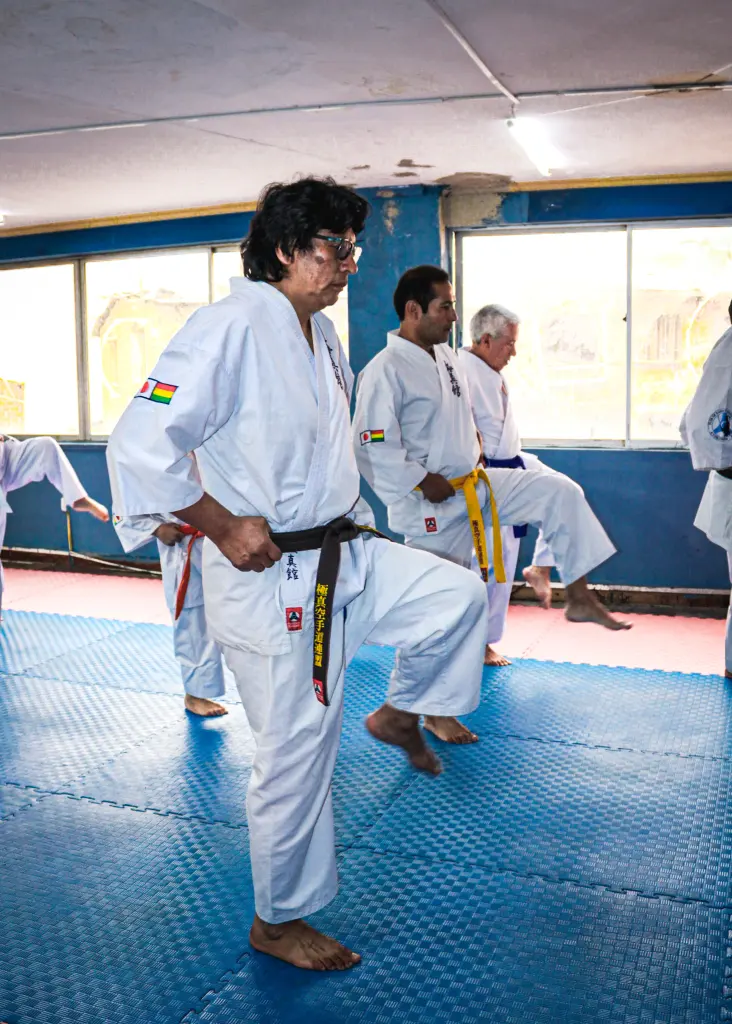
Image: Norkiña / Wikimedia Commons · CC BY-SA 4.0
Overview
Kihon isolates the fundamentals so their relationships can be seen and rebuilt.
Kihon (基本) means fundamentals or basics. In Karate it is the teaching category through which practitioners examine posture, stance, movement, receiving actions, thrusts, strikes, and kicks. Isolating a variable makes alignment, balance, direction, timing, and recovery easier to observe; the movement must then reconnect with kata and kumite. The Japan Karate Association’s three-part model of kihon, kata, and kumite is influential, but Karate schools do not organise fundamentals identically. Kihon is therefore a method of studying core movement, not one universal list.
Reduce variables without mistaking the exercise for the whole art.
- Japanese
- 基本 · fundamentals
- Primary purpose
- Isolate and refine core movement
- Support
- Posture · stance · balance
- Action families
- Tsuki · uchi · uke · geri
- Common formats
- Stationary · moving · combinations
- Wider relationship
- Kata · bunkai · kumite
01Meaning & teaching role
The foundation is a way of organising attention.
Basic practice separates variables so they can later work together under changing conditions.
Foundation or basis
The supporting principles on which later combinations depend.
Root or origin
A general Japanese word joined here to identify fundamentals.
Deliberate core practice
Standing, moving, repeating, or combining selected variables.
Modern grading and group teaching give kihon a prominent role. JKA syllabuses place named basics alongside kata and progressively structured kumite; Okinawa Prefecture’s school guide likewise introduces stance, receiving, thrusting, and kicking before combination.
02Stance, posture & balance
The visible action depends on an organised base.
Feet, knees, pelvis, torso, and head must support both the technique and what follows it.
Tachi or dachi
Weight distribution and foot position make support and transfer visible.
Whole-body relation
An upright appearance is insufficient if joints lock or the centre leaves the base.
Stability plus readiness
The action must finish in a position from which turning, stepping, or receiving remains possible.
The stance must move
Width, angle, and loading matter because they connect one action to the next.
Common practice positions include zenkutsu-dachi, kōkutsu-dachi, kiba-dachi, shikō-dachi, sanchin-dachi, and neko-ashi-dachi. Their exact proportions and emphasis vary among styles.
03Action families
Four familiar categories provide a practical—but incomplete—map.
A name identifies a family; stance, path, surface, target, and context complete the description.
The labels chūdan uchi-uke and chūdan soto-uke can reverse between organisations. Confirm the relevant school’s directional convention rather than treating one English gloss as universal.
04Coordination, hips & kime
Power is a timing problem across the whole body—not an instruction to maximise every motion.
Research on basic technique examines support, relaxation, withdrawing action, balance, and rotation together.
Rotation · transfer · opening · closing
Different actions and styles coordinate the lower body and torso in different proportions; maximum hip rotation is not always the goal.
Kime
A focused moment should not become continuous tension or theatrical stillness. Relaxation, balance, and readiness remain part of efficient movement.
Biomechanical findings about one straight punch should not be converted into prescriptions for every technique or lineage.
05Practice formats
Changing the format changes which error becomes visible.
The exercise remains useful only when its purpose is clear.
Isolate shape and path
Observe alignment, surface, direction, withdrawing action, and recovery with fewer moving variables.
Connect step and technique
Travelling basics expose weight transfer, stance transition, balance, and timing.
Coordinate and adapt
Linked actions, pads, or bags add rhythm and feedback under school-specific supervision.
06Kihon, kata, bunkai & kumite
The boundaries overlap, and information travels in both directions.
A posture problem found with a partner may require returning to a basic exercise.
Kihon
Reduces variables for observation and correction.
Kata
Connects actions through transitions, direction, rhythm, and style.
Bunkai
Tests possible functions and partner relationships.
Kumite
Introduces another person’s movement, distance, timing, and resistance.
The JKA describes kihon, kata, and kumite as an inseparable triad. It is a coherent Shotokan model, not an official classification binding every Karate tradition.
07Variation among styles
Different body methods require different basics.
Broad tendencies help orientation, but branch and instructor still matter.
Visible stance and hip organisation
Moving basics often make long stance, direct path, and rotation especially clear.
Breathing and conditioning
The teaching system associated with Chōjun Miyagi joins basics with kata and supplementary practice.
Body shifting and distance
Jujutsu-informed movement changes stance proportions and how receiving is organised.
Kata-centred foundations
Some schools extract fewer separate basics and use Sanchin, Naihanchi, or other kata as foundational training.
Sources and further reading
- Japan Karate Association, Techniques: Kihon, Kata and Kumite.
- Japan Karate Association, Instructor Technical Manual.
- Japan Karate Association, Dan Ranking and Grading Syllabus.
- All Japan Karatedo Federation, Karate Terminology Dictionary.
- Okinawa Prefecture, School Physical Education Karate Teaching Guide.
- Research Journal of Budo, Egawa, Theoretical Consideration of Karate-dō: Basic Offensive Techniques and Kumite, 1975.
- Research Journal of Budo, Michihara and Yen, A Study of Basic Technique in Karate, 1978.
- Research Journal of Budo, Yasuda, Tamura and Kaneko, Axis of Body Rotation during a Karate Thrust, 2013.
Last updated:
_en_Musha_Dojo.jpg)