Karate
Karate Terminology
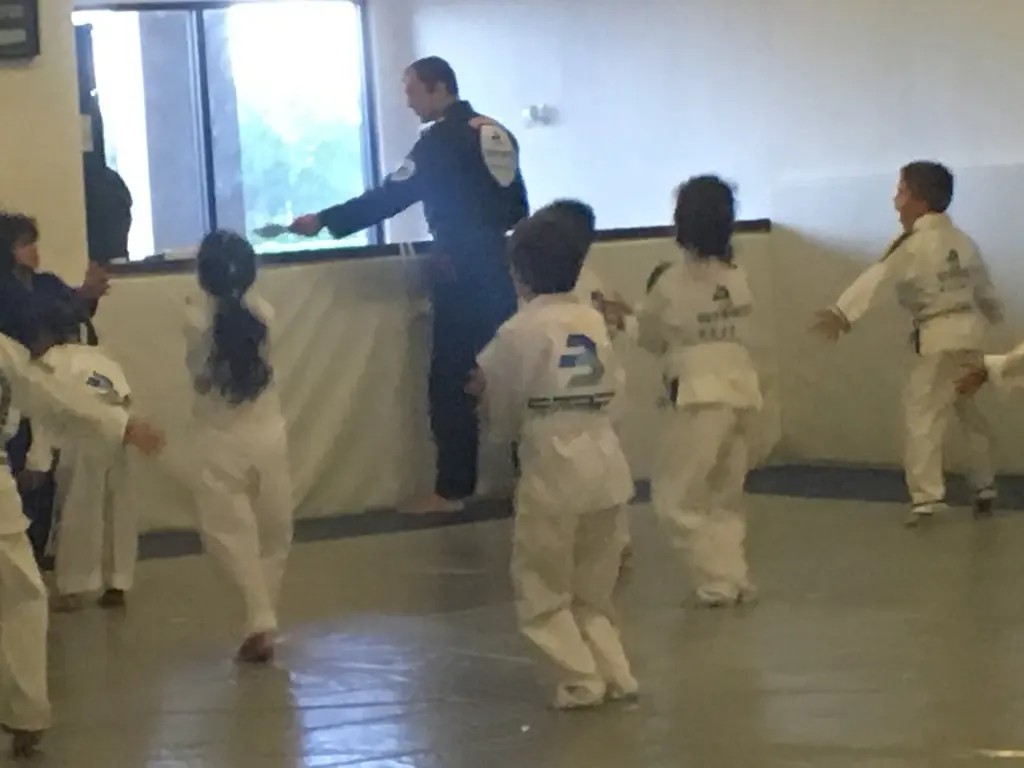
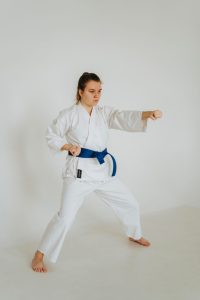
Image: Jlimpsey1963 / Wikimedia Commons · CC BY-SA 4.0
Overview
Karate vocabulary is a system for locating an action—not a universal command list.
Karate terminology (空手用語, karate yōgo) connects people, places, training methods, technical families, partner relationships, and competition. A term becomes clearer when its parts are read together: direction or level, action family, and training context. Shared words such as kihon, kata, and kumite travel widely, but pronunciation, romanisation, hyphenation, and technical meaning can differ among styles and organisations. This page is an international reference framework, not one school’s required vocabulary.
Front, reverse-side relation, or upper level.
Thrust, kick, or receiving action.
The compound locates an action, but the school still defines its performance.
- Japanese
- 空手用語
- Reading
- からてようご · karate yōgo
- Core contexts
- Dōjō · kihon · kata · kumite
- Name structure
- Relation or level + action family
- Main caution
- Usage differs by style and organisation
- Japanese reference
- All Japan Karatedo Federation dictionary
01Writing & pronunciation
Long vowels and compound sounds explain many apparent spelling conflicts.
Kanji, kana, and romanised forms may coexist in the same source tradition.
Dōjō · kōhai · Wadō-ryū
Macrons mark vowel length. Search and federation material often omit them: dojo and dōjō refer to the same word.
Tsuki → -zuki · keri → -geri
The independent and compound forms explain pairs such as tsuki / gyaku-zuki and keri / mae-geri.
Joined · spaced · hyphenated
Organisations may write the same compound differently. Japanese nouns also do not take an English plural -s; kata can be singular or plural.
02People, rank & dōjō
Role, grade, and place are different kinds of information.
Sensei is not a belt rank, and senpai is relational rather than permanent.
People and grades
- Karateka 空手家
- Karate practitioner.
- Sensei 先生
- Teacher or instructor.
- Senpai / kōhai 先輩 / 後輩
- Relative senior and junior.
- Kyū / dan 級 / 段
- Grade levels below and within the dan system.
- Shodan 初段
- First dan—not “master”.
- Yūdansha 有段者
- A person holding dan rank.
Place and equipment
- Dōjō 道場
- Place of practice.
- Shōmen 正面
- Front of the dōjō or competition area.
- Rei 礼
- Bow and the etiquette of bowing.
- Karate-gi 空手着
- Karate uniform; dōgi is broader.
- Obi 帯
- Belt.
- Makiwara 巻藁
- Traditional striking post.
03Training vocabulary
A small group of terms describes how fundamentals are organised.
They name a training category, body relationship, or quality of attention—not a single fixed movement.
Kihon 基本
Fundamentals or basics; the selected list differs by school.
Kamae 構え
Ready posture or guard.
Unsoku 運足
Footwork.
Tenshin 転身
Changing body direction.
Tai-sabaki 体捌き
Body management or evasion.
Hikite 引手
Withdrawing hand.
Kime 極め
Coordinated decisive focus, not prolonged tension.
Zanshin 残心
Continued attention and readiness.
04Technical architecture
Stance, level, direction, and action family combine to form a technical name.
The label is a reference point; exact pathway, surface, balance, and purpose remain style-specific.
Tachi / -dachi
Zenkutsu · kōkutsu · kiba · shikō · sanchin · neko-ashi
Front, rear, lateral, square, three-battles, and cat-foot examples.Tsuki / -zuki · uchi
Oi or jun · gyaku · kizami · uraken · shutō · empi
“Punch” and “strike” do not reproduce every Japanese distinction.Keri / -geri
Mae · mawashi · yoko · ushiro · hiza
Keage and kekomi describe actions in some systems, especially Shotokan.Uke
Age · soto · uchi · gedan-barai · shutō
Receiving is broader than a rigid block; uchi / soto may reverse by convention.05Kata & kumite
Sequence and partner practice use overlapping—but non-equivalent—vocabularies.
Kumite is broader than competition, and bunkai is not one unique historical answer.
Kata · 形
Embusen is the performance line; bunkai is analysis; ōyō is application or adaptation; kiai is focused vocal expression at designated moments.
Kumite · 組手
Yakusoku-kumite is prearranged; kihon-ippon is basic one-step; jiyū-ippon is semi-free one-step; jiyū-kumite is free practice; shiai-kumite is contest sparring.
The familiar five-step, three-step, one-step, semi-free, and free progression is published by the Japan Karate Association. Other traditions organise partner work differently.
06Distance, timing & competition
Concept language and referee language answer different questions.
Timing terms guide study; competition terms operate only inside the applicable ruleset.
Relation and initiative
- Maai 間合い
- Functional distance and the time needed to act.
- Hyōshi 拍子
- Rhythm or cadence.
- Sen 先
- Initiative.
- Sen no sen 先の先
- Acting with or ahead of initiation; definitions vary.
- Go no sen 後の先
- Responding after receiving the initiative.
Current JKF reference terms
- Aka / ao 赤 / 青
- Red and blue competitors.
- Shushin / fukushin 主審 / 副審
- Referee and assistant judge.
- Hajime / yame 始め / 止め
- Begin and stop.
- Yūko · waza-ari · ippon
- One-, two-, and three-point scores in the cited JKF framework.
- Senshu / hantei 先取 / 判定
- First-unopposed-score advantage where applicable / decision.
07How to verify usage
Identify the speaker, school, document, and date before resolving a disputed term.
Language is evidence of a teaching system, not proof that every Karate lineage shares one definition.
What is being named?
Separate a role, grade, training category, body action, kata instruction, and referee command.
Who defines it here?
Check the dōjō, style association, national federation, tournament organiser, or historical text.
Is the wording current?
Keep older terminology as historical evidence, but use dated official material for present rules and grading.
Sources and further reading
- All Japan Karatedo Federation, Karate Terminology Dictionary.
- All Japan Karatedo Federation, Basic Rules of Karatedo.
- All Japan Karatedo Federation, 2026 Competition Rule Changes.
- Japan Karate Association, Dan Ranking and Grading Terminology.
- Japan Karate Association, Instructor Technical Manual.
- Okinawa Prefecture, School Physical Education Karate Teaching Guide.
- National Diet Library, Funakoshi Gichin, Karate-do Kyohan.
- Miyazaki et al., English Translation of Basic Karate Techniques II, Research Journal of Budo.
Last updated: