Karate
Gōjū-ryū Karate
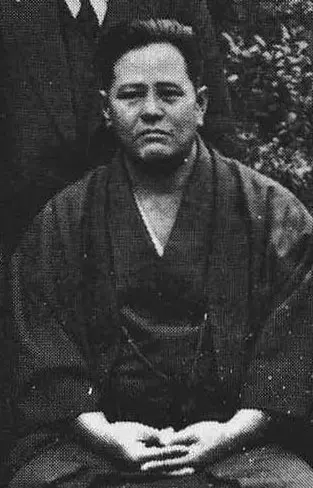
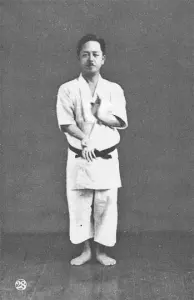
Image: Nakasone Genwa / Wikimedia Commons / A Broad View of Karatedo · Public domain
Overview
Hard and soft are coordinated qualities, not two separate halves of the style.
Gōjū-ryū (剛柔流) is a major Okinawan Karate tradition founded by Chōjun Miyagi. It grew from the Naha-te he learned under Kanryō Higaonna and from Miyagi’s later research, teaching, and organisation. Sanchin and Tenshō are central kata in many branches, supporting study of posture, breathing, tension, relaxation, and close-range body mechanics. Conditioning, partner drills, applications, and sparring may extend this foundation. After Miyagi’s death in 1953, several students and organisations transmitted distinct lines; no one modern body represents the entire Gōjū-ryū family.
A port-city transmission with important but variably documented Chinese connections.
Research, public teaching, kata, exercises, and systematic progression.
- Japanese
- 剛柔流
- Founder
- Chōjun Miyagi (1888–1953)
- Source tradition
- Naha-te · Kanryō Higaonna
- Formation
- Okinawa
- Name
- “Hard-soft school”
- Representative kata
- Sanchin · Tenshō
01Name & meaning
Gō and jū describe a relationship that changes with timing and context.
The name does not assign every technique permanently to “hard” or “soft”.
Forceful quality
Direct power, rooted posture, contraction, and decisive structure.
Hard and soft
Qualities alternate and combine through timing and body organisation.
Yielding quality
Deflection, circular movement, relaxation, and sensitivity.
Miyagi adopted the name around 1930, drawing on a phrase in the Bubishi, a Chinese-derived martial text circulated among Okinawan Karate practitioners. Ryū (流) means school or tradition.
02Kanryō Higaonna & Naha-te
The teacher–student link is clear; one exact Chinese source line is less secure.
Historical transmission and later system formation belong to different stages.
Naha-te
A retrospective label for transmission centred on the Ryukyuan and modern port city.
Kanryō Higaonna
Accounts connect his practice with Fuzhou, but teachers, dates, and duration are not equally secure in every source.
Miyagi began training with Higaonna as a youth. After his teacher’s death, he continued research, travelled, taught publicly, and organised the inherited material. Gōjū-ryū is thus Miyagi’s systematic development of Naha-linked practice, not a direct copy of one Chinese school.
03Chōjun Miyagi
Miyagi joined inherited kata with public teaching and a deliberate training progression.
His role was organisational and pedagogical as well as technical.
Study with Higaonna
A foundation in Naha-associated kata and body method.
Travel and comparison
Continued investigation after Higaonna’s death.
Public education
Kata, breathing, conditioning, partner work, preparatory exercises, and systematic instruction.
Born in Naha in 1888, Miyagi promoted Karate in schools and public institutions and demonstrated beyond Okinawa. He created Tenshō and is commonly credited with developing or formalising preparatory exercises used in Gōjū-ryū.
04Sanchin & Tenshō
Two compact kata make the hard-soft relationship visible without summarising the whole style.
Breathing, muscular tension, and external checking vary considerably by lineage.
Sanchin
Coordinates stepping, posture, breathing, concentration, and whole-body connection. Some schools use strong visible tension and checking; others do not.
Tenshō
Uses turning and coiling hand movements with controlled breathing and is often paired conceptually with Sanchin.
05Kata & close-range methods
A broad curriculum connects direct attacks, circular receiving, seizing, and off-balancing.
Exact spelling, sequence, order, and performance differ among organisations.
Gekisai Dai Ichi
A beginner form whose role and details vary by branch.
Compact positions and short distance are tendencies, not fixed limits.
Seisan
Several named transmissions require careful comparison.
Saifa to Sūpārinpei
Seiyunchin, Shisōchin, Sanseirū, Seipai, Kururunfa, and other forms.
Gōjū-ryū is often characterised by compact stances, circular receiving actions, low kicks, and close distance. Kata also contain direct force, longer transitions, and angle changes, so the description remains an orientation rather than a universal rule.
06Conditioning & partner practice
Supplementary work links strength and impact to Karate structure.
Tools and drills are methods inside a teaching system, not stand-alone tests of toughness.
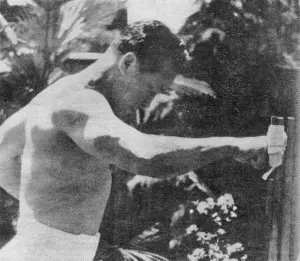
Chiishi · jars · stone implements
Used to integrate grip, stance, alignment, breathing, and controlled force.
Makiwara and related practice
Progression and supervision matter more than imitation or maximum intensity.
Application · sensitivity · sparring
Practice ranges from formal bunkai to controlled or freer exchanges and modern competition.
The proportions of conditioning, kata application, and WKF-style kata or kumite differ significantly among dōjō. Historical description should not be treated as unsupervised training instruction.
07Lineages & global practice
Miyagi left a shared inheritance, not one uncontested successor.
Post-war diversity belongs inside the history of the style.
Miyazato · Yagi · Toguchi · Higa · Yamaguchi
Senior students and later organisers established important lines in Okinawa, mainland Japan, and overseas.
Founder and kata · pedagogy and governance
Branches overlap in core material while differing in exercises, applications, competition, ranks, and identity.
Describing one branch as the whole of Gōjū-ryū obscures this diversity. A precise account names the organisation, teacher, and period.
Sources and further reading
Last updated: