Karate
Shitō-ryū Karate
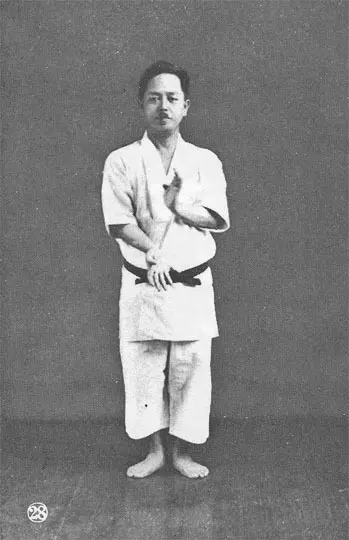
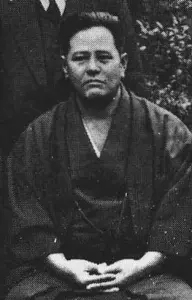
Image: Nakasone Genwa / Wikimedia Commons / A Broad View of Karatedo · Public domain
Overview
A broad synthesis preserves distinctions instead of forcing every kata into one outward style.
Shitō-ryū (糸東流) is a major Karate tradition founded by Kenwa Mabuni, an Okinawan teacher who settled in Osaka. Its name honours two principal teachers: the first characters of Itosu (糸洲) and Higaonna (東恩納) are read here as shi and tō. Mabuni organised material from their Shuri- and Naha-associated networks together with wider study. The result is known for a large kata repertoire and varied body methods—not a simple half-and-half mixture. Later organisations share a broad inheritance while differing in curriculum, performance, competition, and authority.
Comparative preservation, publications, clubs, and teaching in Osaka.
- Japanese
- 糸東流
- Founder
- Kenwa Mabuni (1889–1952)
- Name honours
- Ankō Itosu · Kanryō Higaonna
- Formation
- Okinawa and Osaka
- Core training
- Kihon · kata · applications · kumite
- Known for
- A broad Okinawan kata inheritance
01Name & lineage
The name records two teachers while the system preserves a wider field of study.
A dedication is not a mathematical description of curriculum.
Shi · 糸
The first character, read here to honour Ankō Itosu.
Shitō-ryū · 糸東流
Mabuni’s organised synthesis, not a neutral label for all source material.
Tō · 東
The first character, read here to honour Kanryō Higaonna.
Mabuni also studied with other Okinawan teachers and explored weapons and related practices. His system reflects that broader network and his own analysis, as well as the requirements of teaching on mainland Japan.
02Kenwa Mabuni
A wide study network became a comparative system in Osaka.
Police work, Karate study groups, publication, and mainland teaching widened Mabuni’s field of contact.
Born in 1889
Mabuni studied with Itosu and participated in broad Okinawan Karate networks.
Multiple teachers
Higaonna’s instruction and other contacts expanded the inherited material.
Teaching and organisation
Demonstrations, books, clubs, and a dōjō supported formal use of the Shitō-ryū name during the 1930s.
Kenwa Mabuni approached kata as material to analyse and transmit rather than merely collect. His writings and teaching helped make an unusually broad Okinawan inheritance accessible in modern institutional settings.
03Itosu & Higaonna inheritances
Different source traditions remain visible inside one modern family.
Mabuni preserved distinctions among kata rather than forcing every form into one movement stereotype.
Itosu inheritance
The Pinan family and major Shuri-line kata, with later variations across Shotokan, Shitō-ryū, and Okinawan groups.
Higaonna inheritance
Naha-line forms and methods in which breathing, rooted posture, and close-range body organisation can be prominent.
This breadth makes Shitō-ryū especially useful for comparative kata study. It also makes overgeneralisation risky: even the same named form can differ across Shitō-ryū organisations and in comparison with Shotokan or Gōjū-ryū.
04Kata curriculum
Breadth is a resource for comparison, not a requirement to collect every form.
Exact lists, priorities, and execution differ by organisation.
Pinan · Bassai · Kōsōkun · Naihanchi
Forms associated with Itosu and wider Shuri networks.
Mabuni emphasised understanding kata rather than accumulating sequences.
Seienchin · Seipai · Kururunfa
Forms connected with Higaonna’s transmission and later branches.
Jion · Sūpārinpei · others
A long catalogue does not mean equal depth or emphasis for every practitioner.
Modern competition has made Shitō-ryū kata highly visible because the repertoire gives athletes technically varied choices. Competition performance remains one use of the archive rather than its only meaning.
05Technical character
Several inheritances produce more than one stance height, rhythm, or receiving method.
The most accurate description allows variation before drawing a style-wide rule.
Compact and extended positions
Posture changes with kata family, branch, teacher, and tactical purpose.
Direct and circular receiving
Rapid transitions, varied breathing, and changing distance appear across the repertoire.
Strike · trap · throw · control
Partner interpretation may include off-balancing and joint control depending on the branch.
Fundamental training commonly develops precise posture, directional change, hip use, striking, kicking, and receiving techniques. It cannot be reduced to one outward cadence without ignoring the system’s stated breadth.
06Kumite & competition
Partner practice ranges from arranged application to modern federation competition.
Different dōjō assign different weight to timing, self-defence study, bunkai, and scoring rules.
Applications and self-defence
Structured exercises connect kata material with distance, contact, control, and decision-making.
Timing and controlled scoring
Competition-oriented groups prepare for federation kata and kumite under defined rules.
Shitō-ryū is one of the four major styles recognised in the Japan Karate Federation framework. This reflects institutional importance without erasing different priorities among Shitō-ryū organisations.
07Organisations & legacy
A shared founder led to several overlapping, non-identical organisations.
Family members and senior students developed separate associations after Mabuni’s death in 1952.
Founder · name · kata families
Recognisable historical and curricular relationships connect the major lines.
Pedagogy · rank · governance
Associations including Shitō-kai and other lines developed distinct technical and administrative identities.
Japanese instructors, national federations, and tournament Karate made Shitō-ryū one of the world’s most widely practised Karate families. Its enduring contribution is the preservation and comparative organisation of broad Okinawan material.
Sources and further reading
Last updated: