Martial Arts Figures
Gichin Funakoshi
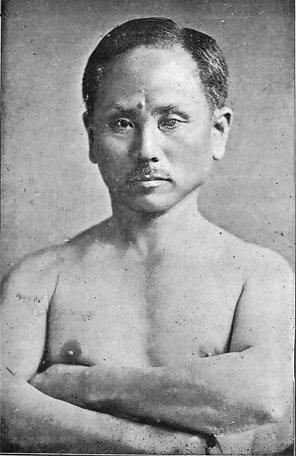
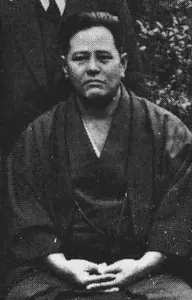
Image: Unknown photographer; published by Gichin Funakoshi / Wikimedia Commons · Public domain
Overview
| Japanese name | 船越 義珍 |
|---|---|
| Born | 10 November 1868, Shuri, Ryukyu Kingdom |
| Died | 26 April 1957, Tokyo |
| Occupations | Karate teacher, schoolteacher, and writer |
| Known for | Introducing Okinawan karate to mainland Japan |
| Associated tradition | Shotokan |
Gichin Funakoshi (1868–1957) was an Okinawan teacher who became one of the central figures in the development of modern Karate. He introduced Okinawan Karate to major audiences in mainland Japan, wrote influential books, trained university communities, and argued that martial practice should develop character rather than aggression.
An Okinawan educator
Funakoshi was born in Shuri, Okinawa, in 1868. He trained under Anko Azato and Anko Itosu, two important teachers connected with Shuri-te. His profession was school teaching, and the habits of an educator—clear explanation, orderly progression, repetition, and moral purpose—shaped the way he presented Karate.
He also studied poetry, calligraphy, and classical learning. The pen name Shoto, later used in the name Shotokan, reflects this literary side of his life.
Karate reaches Tokyo
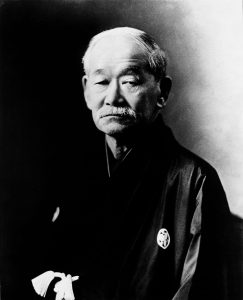
In 1922 Funakoshi demonstrated Okinawan Karate at a physical education exhibition in Tokyo. Jigoro Kano, founder of Judo, then invited Funakoshi and his student Shinkin Gima to demonstrate kata at the Kodokan. The event introduced Karate to an influential budo audience and helped persuade Funakoshi to remain in Tokyo.
He taught first in modest spaces, including Meiseijuku, a dormitory for Okinawan students. University clubs then became important centres for practice. Through these communities Karate reached new generations of students who later established dojo and organisations in Japan and abroad.
Writing a modern Karate
Funakoshi published Ryukyu Kempo Karate in 1922, giving mainland readers an early systematic introduction to the art. Later books continued to explain technique, kata, history, and ethical purpose.
He also supported changing the written characters of Karate from a term commonly understood as “Chinese hand” to “empty hand.” Adding do—the way—placed Karate within a modern educational language shared with Judo and other Japanese budo.
The Shotokan dojo
As Funakoshi’s community expanded, his students built a dedicated dojo in Tokyo in the late 1930s. They called it Shotokan: the hall of Shoto. The building was destroyed during the Second World War, but its name continued as the label for the broad Karate tradition associated with Funakoshi and his students.
Funakoshi himself did not present Shotokan as a personal brand. He repeatedly placed the unity and ethical purpose of Karate above rivalry between schools.
Karate begins and ends with respect
Funakoshi’s Twenty Precepts express his view of Karate as character education. The best known include “Karate begins and ends with rei” and “There is no first attack in Karate.” Rei means respect or courtesy, while the second principle places restraint before violence.
These statements do not make Karate passive. They ask practitioners to connect technical ability with judgement: avoid unnecessary conflict, remain aware, control pride and anger, and use skill responsibly.
Teaching through kata
Kata stood at the centre of Funakoshi’s teaching. He adjusted names, organised material for new students, and treated repeated form as a way to train the body and mind together. Later generations developed more systematic kumite and competition, sometimes creating debates about how best to preserve his priorities.
Funakoshi and the JKA
After the Second World War, followers of Funakoshi formed the Japan Karate Association. Funakoshi served as its Supreme Master, while younger leaders developed instructor education, technical standards, and tournament systems. He died in 1957, shortly after the association entered a new legal and organisational stage.
The JKA became one important line of Shotokan, but not the only one. Several organisations and teacher networks now trace their heritage to Funakoshi, sometimes interpreting his methods and priorities differently.
A short timeline
- 1868: Born in Shuri, Okinawa.
- 1922: Demonstrates Karate in Tokyo and teaches at the Kodokan by invitation of Jigoro Kano.
- 1924: Issues early dan-ranking certificates to students.
- 1929: Promotes the name Karate-do, “the way of the empty hand.”
- Late 1930s: The Shotokan dojo opens in Tokyo.
- Late 1940s: Followers form the Japan Karate Association, with Funakoshi as Supreme Master.
- 1957: Dies in Tokyo; a large public memorial follows.
Legacy
Funakoshi did not invent Karate, which had deep Okinawan roots and many teachers. His distinctive achievement was to translate an inherited practice for new institutions and audiences without abandoning its educational purpose. The worldwide reach of Shotokan, the use of Karate-do as a name, and the continued emphasis on courtesy and character all bear his influence.
How to separate Funakoshi’s work from later Shotokan
Place each claim in one of four layers: material directly documented in Funakoshi’s dated books, demonstrations, or surviving writings; teaching attributed to him by students; practices associated with the original Shotokan dojo; and postwar standards developed by the Japan Karate Association or other organizations. The layers are historically connected, but none is automatic proof for the others.
Version and date are especially important. A Research Journal of Budo study compares Funakoshi’s 1922, 1925, and 1935 publications and shows that the documented kata material changed, while the JKA history separately dates the postwar organization. Cite the exact book, edition, event, or institution instead of projecting a current rule, rank system, or technical standard back onto Funakoshi. This also keeps the broader history of Karate distinct from the institutional history of the Japan Karate Association.
Sources and further reading
Last updated: