Crafts & Skills
Yūzen Dyeing
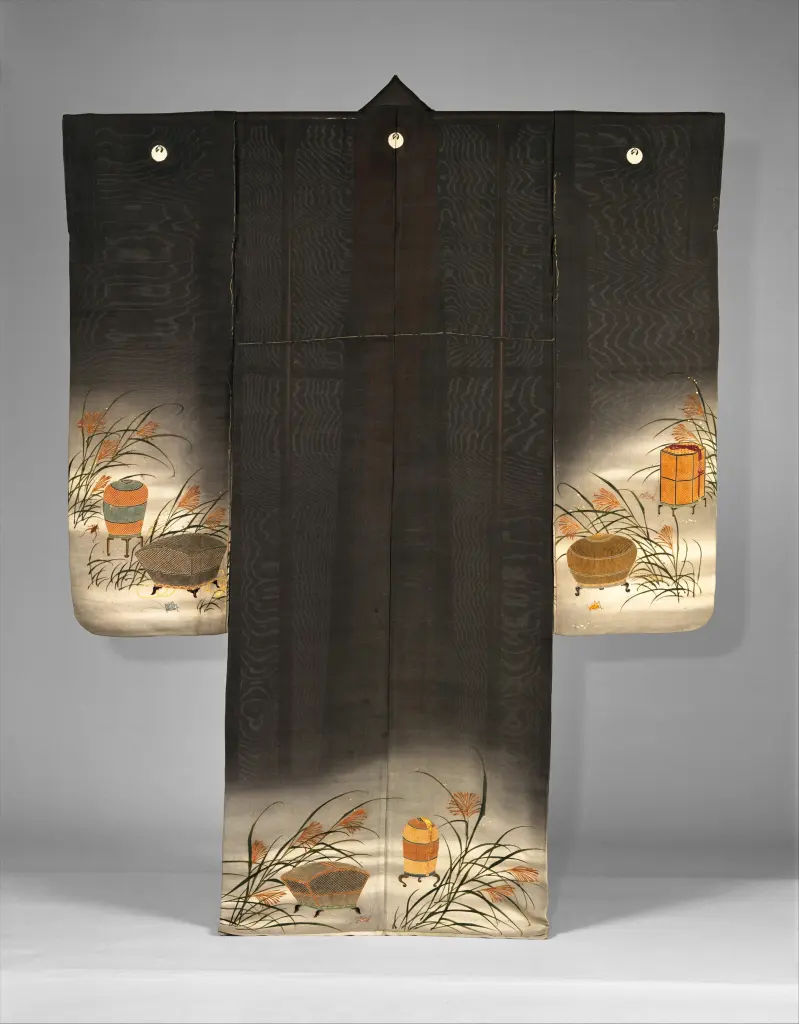
Image: Unknown Japanese maker / The Metropolitan Museum of Art · Public domain / Open Access
Yūzen (友禅) is a family of Japanese paste-resist dyeing methods used especially to create multicoloured pictorial designs on kimono cloth. In hand-painted tegaki yūzen, the maker draws the design, protects boundaries with fine rice-paste lines, applies colours within them, covers coloured areas with additional resist, and dyes or processes the ground. Washing removes the paste and reveals pale outlines that help separate motifs. The method developed in the Edo period and is traditionally associated with the Kyoto fan painter Miyazaki Yūzensai, but “Yūzen” now covers regional and industrial systems with different tools and divisions of labour. Kyō-yūzen, Kaga-yūzen, and Tokyo tegaki yūzen are related but not interchangeable labels. Stencil and mechanised forms also exist, so yūzen should not be reduced to one artist painting directly on finished clothing.
Overview
| Japanese name | 友禅染 |
|---|---|
| Romanization | Yūzen-zome |
| Technique family | Paste-resist and pictorial dyeing |
| Key feature | Fine resist outlines separate adjacent colours |
| Major regional names | Kyō-yūzen, Kaga-yūzen, and Tokyo tegaki yūzen |
| Primary historical use | Kimono and related dress textiles |
Name and scope
Yūzen-zome means yūzen dyeing. The name is traditionally linked to Miyazaki Yūzensai, whose fashionable designs helped shape an early market, but technical development involved dyers, paste workers, merchants, and changing materials. The term can refer narrowly to hand-drawn paste-resist work or more broadly to related stencil and production methods. A precise description states the region and process when known.
Hand-drawn process
A design is transferred or sketched onto prepared cloth. Fine paste is piped along motif boundaries, forming barriers called itome lines. Dyes are brushed into the enclosed areas, and shading can give flowers, birds, landscapes, or objects pictorial depth. Coloured motifs are then protected while the ground is dyed or otherwise finished. Steaming, rinsing, and specialist corrections complete a process whose sequence varies by workshop and fabric.
Paste, colour, and outline
The resist commonly uses rice-derived paste adjusted for flow and adhesion. It prevents adjacent wet colours from bleeding together and leaves characteristic light contours after removal. Pigment, dye, mordant, and ground preparation affect the result. Embroidery, gold or silver leaf, and other finishing may be added, so the visible image can combine dyeing and non-dyeing techniques rather than representing pure brush painting.
Edo-period development
Yūzen became conspicuous in the prosperous Genroku era around the turn of the eighteenth century, when urban consumers sought elaborate kosode designs. Paste-resist control allowed varied pictorial colour without relying entirely on embroidery or expensive woven pattern. Fashion books, pattern albums, merchants, and regulations all influenced its development. Surviving garments and sample books show change over time rather than one fixed classical style.
Regional traditions
Kyō-yūzen is associated with Kyoto’s extensive specialist network and often combines rich colour with embroidery or metallic decoration. Kaga-yūzen, centred in Kanazawa, is commonly described through naturalistic motifs, distinctive colour conventions, and painted gradation. Tokyo tegaki yūzen developed within Edo and Tokyo’s clothing culture. These summaries are useful entry points, but actual works vary by maker, date, market, and intended wearer.
Stencil and industrial production
Katagami stencils, chemical dyes, printing, and mechanised or semi-mechanised processes increased repeatability and market range from the modern period. Kata-yūzen can build multicoloured designs through successive stencils and pastes. Industrial production does not automatically mean that every stage is machine-made, while a hand-drawn work may still depend on prepared dyes, shared patterns, and many specialised workers.
Kimono design and use
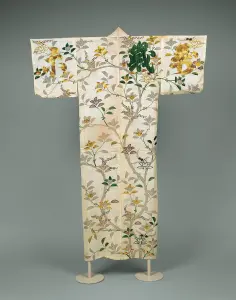
Yūzen allows a composition to cross seams or place motifs according to the garment’s final form. Furisode, hōmongi, tomesode, and other garments use different distributions of pattern and levels of formality. A Japanese obi can also be dyed, but many formal obi rely chiefly on figured weaving. Identifying the object requires examining construction and technique, not only a colourful floral surface.
Care, identification, and misconceptions
Historic silk, dyes, metallic additions, and embroidery can react differently to water, light, friction, and storage. Professional cleaning or conservation may be needed. Pale contour lines can suggest paste resist, but photographs alone may not distinguish hand drawing, stencil work, printing, or later imitation. Yūzen is neither a single motif style nor the name for all painted Japanese textiles.
Sources
- Kyoto National Museum, Yūzen Dyeing.
- Kyoto National Museum, Sample Book of Yūzen Patterns.
- Traditional Crafts Aoyama Square, Tokyo Tegaki Yūzen.
- The Metropolitan Museum of Art, Unlined Summer Kimono with Crickets.
- Government of Japan, Kaga-yūzen Kimono.
- Government of Japan, Japanese Fabrics and the Evolution of the Kimono.
- Kyoto National Museum, Past Textile Exhibitions.
- Victoria and Albert Museum, Kimono.
- Traditional Crafts Aoyama Square, Textiles.
Last updated: