Crafts & Skills
Shibori
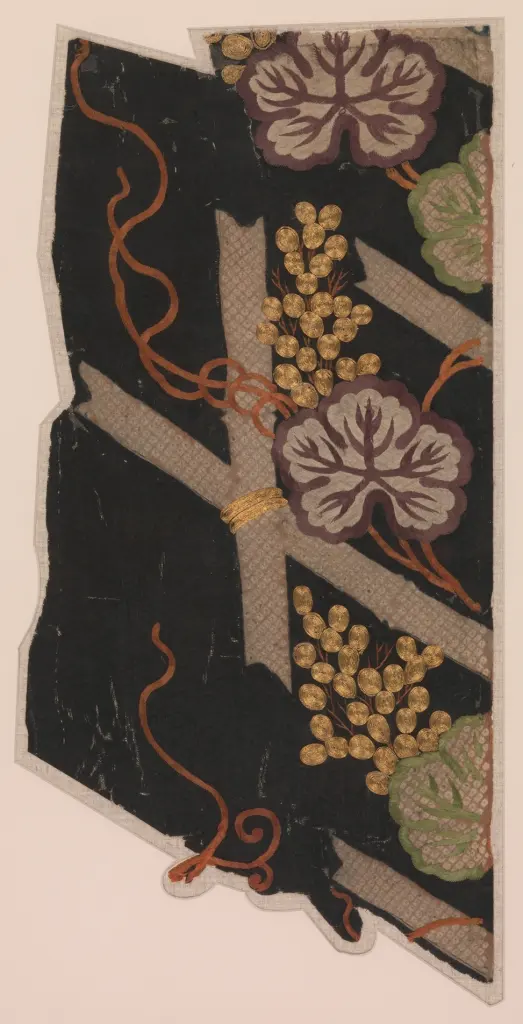
Image: Unknown Japanese maker / The Metropolitan Museum of Art · Public domain / Open Access
Shibori (絞り) is a broad family of Japanese resist-dyeing techniques in which cloth is shaped, bound, stitched, folded, clamped, or compressed so that dye reaches some areas more readily than others. When the resist is removed, the protected and exposed zones form patterns that may be crisp, softly edged, irregular, or three-dimensional. English often calls shibori “tie-dye,” but tying is only one method. Techniques range from minute bound dots associated with kanoko shibori to stitched, pleated, wrapped, and pole-bound effects. Shibori appears on kimono, furnishing cloth, workwear, accessories, and contemporary art. It can be used alone or combined with Yūzen dyeing, embroidery, gold leaf, and woven pattern. Material, resist method, dye sequence, and region must be identified separately.
Overview
| Japanese name | 絞り |
|---|---|
| Romanization | Shibori |
| Technique family | Shape-resist dyeing |
| Basic principle | Compress selected cloth before dyeing |
| Representative methods | Binding, stitching, folding, wrapping, and clamping |
| Major contexts | Kimono, workwear, furnishings, accessories, and art |
Name and range
The verb shiboru can mean to wring, squeeze, or press. Applied to textiles, shibori names a technical family rather than one repeated pattern. The English label “tie-dye” is convenient but incomplete because a resist can be made with thread, stitching, folds, boards, poles, or other means. Different catalogues and workshops may group or romanize sub-techniques differently.
How the resist works
The maker marks or judges the design, manipulates the cloth, and fixes the shaped areas before immersion or local dyeing. Pressure and multiple cloth layers slow penetration, while uncompressed areas take more colour. After rinsing and opening, small differences in tension, fibre, wetting, and dye movement remain visible. Repeated binding and dyeing can add colours or depth, but not every shibori textile follows the same sequence.
Major method families
Bound-dot techniques gather small pinches of fabric; stitched methods draw thread through planned lines; folded and clamped methods compress larger geometric zones; wrapped or pole-bound methods distort cloth around a core. Kanoko patterns evoke the spotted back of a fawn and can require dense, painstaking binding. Arashi shibori, a modern name associated with pole wrapping, produces diagonal, rain-like effects. These labels describe method or appearance, not a universal hierarchy of quality.
Historical development
Resist-dyed textiles survive from ancient Japan, while later court, temple, warrior, and urban clothing records show changing uses. Shibori reached conspicuous sophistication during the medieval and early modern periods. Sumptuary regulation, fashion, materials, and market demand altered what was made. The technique did not progress in a straight line from simple folk work to elite art; household, commercial, and luxury practices overlapped.
Arimatsu and regional production
Arimatsu and neighbouring Narumi, on the old Tōkaidō route in present-day Nagoya, became especially associated with commercial shibori from the seventeenth century. Travellers purchased locally patterned cloth, and specialised workers divided tasks such as designing, binding, dyeing, and finishing. Other centres and lineages developed their own methods, so Arimatsu-Narumi should be treated as a major regional history rather than the origin of every form of shibori.
Colour, fibre, and design
Indigo and white are visually familiar, particularly in cotton work, but shibori also appears in multicoloured silk, hemp, and modern fibres. A resist may be part of an overall pictorial design rather than an all-over geometric repeat. Historic garments can combine shibori with woven damask, painted dye, embroidery, and metallic thread, making “shibori fabric” only one part of a fuller object description.
Kimono and other uses
Shibori has decorated kosode, furisode, yukata, undergarments, wrappers, banners, and household cloth. Dense all-over work could signal expense because it required many individual bindings, while broader methods supported affordable commercial goods. Contemporary makers apply the family of techniques to scarves, fashion, interiors, and art textiles, often adapting synthetic dyes and new resist materials.
Care and common misconceptions
Freshly opened shibori may retain a puckered relief, but wear, washing, pressing, and mounting can change it. Care depends on fibre and dye stability; blanket advice to wash or iron all shibori alike is unsafe. Shibori is not synonymous with indigo, random circles, or one “ancient Japanese tie-dye” recipe. Identification should distinguish how the resist was made and whether the observed texture is original, later, or deliberately preserved.
Sources
- Kyoto National Museum, Shibori: The Art of Tie-Dyeing.
- Kyoto National Museum, Furisode with Noshi Bundle Design.
- Government of Japan, Formal Outer Kimono with Bamboo Curtains.
- The Metropolitan Museum of Art, Pieces from a Kosode with Grapevine and Fence.
- Government of Japan, Japanese Fabrics and the Evolution of the Kimono.
- Kyoto National Museum, Past Textile Exhibitions.
- Victoria and Albert Museum, Kimono.
- Traditional Crafts Aoyama Square, Textiles.
Last updated: