Social Customs
Kimono
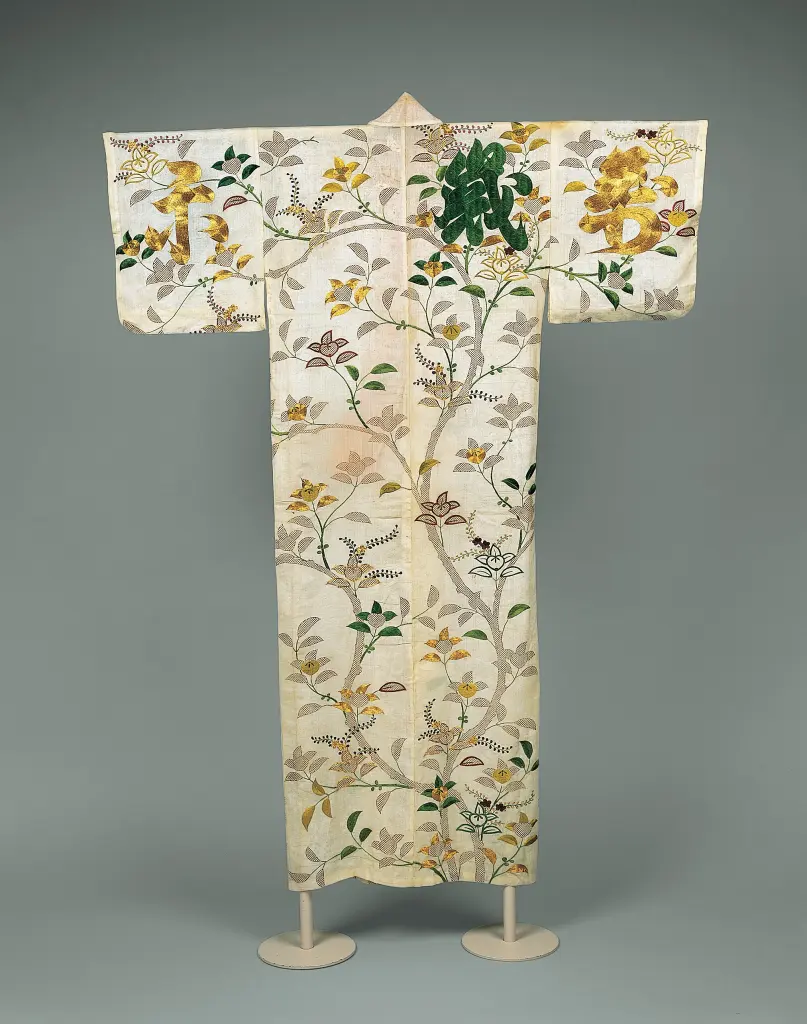
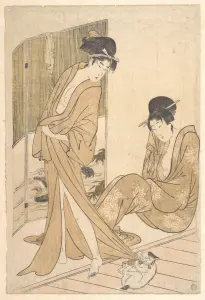
Image: Unknown Japanese maker / The Metropolitan Museum of Art · Public domain / Open Access
Structure · Types · Occasions
One garment, several ways to read it.
Kimono (着物) names a family of straight-seamed wrap garments. Structure describes its parts; type describes a category; formality and occasion depend on the complete ensemble. These questions should be considered separately.
The garment and the ensemble
- Eri · 衿CollarFrames the neck and runs along the upper front edges.
- Sode · 袖SleevesAttached at the sides; sleeve shape and hanging length vary.
- Migoro · 身頃Body panelsMain sections covering the torso and continuing down the garment.
- Okumi · 衽Front overlap panelsAdditional front panels provide width for the wrap.
- Suso · 裾Hem / lower edgeThe bottom region or edge, whose appearance depends on the garment and dressing.
Simplified unbelted schematic, not a cutting pattern or a guide to dressing. The obi is a separate sash; it is not a sewn-in part of the kimono.
At a glance
- Basic construction
- Rectangular cloth panels and straight seams
- Ordinary overlap
- Wearer’s left side over right
- Ensemble
- Kimono, underlayers, ties, obi and accessories
- Variation
- Garment, wearer, season, event and convention
Name and scope
Kimono combines kiru, “to wear,” and mono, “thing.” The word gained its narrower contrast with Western clothing in the modern period. In English it often means a traditional Japanese robe, but the category includes garments differentiated by gendered convention, age, season, material, sleeve length, decoration, and formality. A loose jacket merely inspired by the silhouette is better described as kimono-style when it does not follow kimono construction or dressing.
Construction and dressing
Kimono are assembled mainly from rectangular cloth panels with straight seams, allowing fabric to be unstitched, cleaned, altered, or reused. The garment wraps left side over right in ordinary wear; the reverse overlap is reserved for dressing the deceased. Undergarments, narrow ties, padding, collars, an obi, and smaller accessories build the finished silhouette. Dressing methods differ by garment and wearer rather than following one universal kit.
Type, formality and occasion are separate
Furisode are identified by their long hanging sleeves and are strongly associated with formal dress for unmarried women. Their place within kimono formality depends on the complete ensemble and occasion, not colour or decoration alone.
Named forms include long-sleeved furisode, black or coloured tomesode, understated iromuji, patterned komon, visiting dress called hōmongi, and unlined cotton yukata. These labels do not form a perfectly simple ladder. Crests, fibre, weave, dyeing, motif placement, accessories, relationship to the event, and local convention all affect appropriateness. Rental and professional dressing services now mediate many formal uses.
| Type | Identifying feature | Common context | Qualification |
|---|---|---|---|
| Furisode | Long hanging sleeves. | Formal occasions, strongly associated with unmarried women. | The full ensemble and occasion matter. |
| Tomesode | Black or coloured forms; decoration is commonly concentrated below the waist. | Formal and ceremonial settings. | Crests and the particular type affect formality. |
| Hōmongi | Visiting dress with coordinated patterned decoration. | Visits and celebratory or formal social occasions. | Suitability depends on event and styling. |
| Iromuji | A single-colour ground, apart from mourning wear as a separate category. | Tea and other settings where restrained dress may be appropriate. | Crests and accessories affect use. |
| Komon | Small-scale or repeating all-over patterning. | Often informal outings and everyday-style wear. | The label alone does not settle every formality question. |
| Yukata | A light, usually unlined garment, commonly cotton. | Summer leisure, festivals and bathing-related settings. | It is not interchangeable with formal kimono. |
This comparison introduces common conventions rather than prescribing attire for every wearer. Material, lining, crests, decoration, accessories, age, social role and the host’s expectations can change what is appropriate.
Read the whole ensemble
Construction & material
Start with the garment type, fibre, weave, lining, sleeves and decoration.
Role & expected formality
A guest, host, performer and family member may face different expectations at the same event.
Obi & accessories
The sash, underlayers and accessories contribute to the result. They are not interchangeable additions.
Textiles, motifs, and seasons
Kasuri patterns are dyed into selected warp or weft yarns before weaving, producing the characteristic softly shifted edges of many regional kimono textiles.
Yūzen dyeing uses fine paste-resist lines to separate pictorial colours and is especially important in the design history of kimono.
Shibori creates pattern by binding, stitching, folding, wrapping, or compressing cloth before dyeing and may be combined with painting or embroidery on kimono.
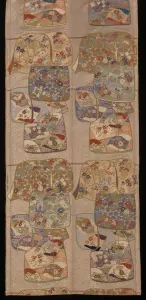
Kimono draw on a wider field of Japanese textile arts, in which fibre, weave structure, dye process, stitching, production region, and intended use all shape the finished cloth.
Silk, hemp, cotton, wool, and synthetic fibres appear in kimono. Weaving, stencil dyeing, resist dyeing, hand painting, embroidery, and metallic thread can be combined. Motifs may refer to plants, landscapes, literature, auspicious wishes, family identity, or a season that is approaching rather than already present. Interpretation depends on the whole ensemble and historical context; a crane, wave, or blossom does not carry one fixed meaning in every design.
Modern life and special occasions
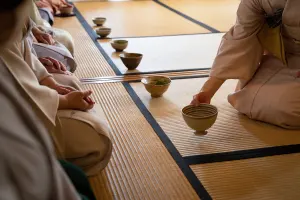
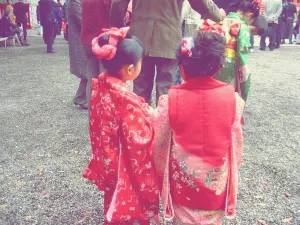
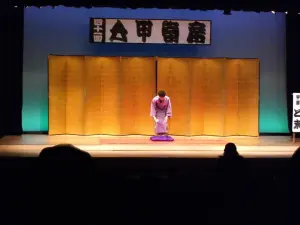
Western clothing spread through government, military, education, industry, and mass consumption from the Meiji period onward and became ordinary daily wear after the Second World War. Kimono continue at weddings, funerals, coming-of-age events, Shichi-Go-San, New Year visits, Japanese tea ceremony, theatre, and hospitality. Frequency varies widely, and many people borrow, rent, inherit, or wear second-hand garments.
From kosode to kimono
The kosode, named for its small wrist openings, began as an underlayer in elite dress and became increasingly visible as outer clothing. By the early modern period it was worn across social groups and developed into a major field of textile design and urban fashion. What is now called kimono therefore emerged through changes in layering, sleeve shape, sash width, production, commerce, and taste rather than at a single founding moment.
Craft, reuse, and contemporary fashion
Sashiko uses repeated running stitches to reinforce, quilt, join, repair, or decorate cloth and has influenced contemporary visible mending and fashion.
Kimono support regional weaving and dyeing traditions, tailoring, dressing instruction, repair, storage, and resale. Their panel-based construction permits reuse as other garments or household textiles, although conservation of fragile silk can be demanding. Contemporary designers and wearers combine kimono with boots, hats, jewellery, or Western layers, while artists and museums treat historic garments as material evidence of labour, trade, gender, class, and fashion exchange.
Common misconceptions
Kimono are not timeless uniforms and were never identical across all of Japan. They are also not exclusively women’s clothing, luxury silk, or ceremonial dress. Conversely, not every Japanese robe is interchangeable with a formal kimono. Accurate identification begins with date, construction, material, wearer, use, and accessories instead of judging only the T-shaped outline.
Sources
- Victoria and Albert Museum, Kimono
- The Metropolitan Museum of Art, Kimono: A Modern History
- Web Japan, Fashion: From Court Dress to Designer Brands
- Government of Japan, Japanese Fabrics and the Evolution of the Kimono
- Government of Japan, Formal Outer Kimono with Bamboo Curtains and Cherry Blossoms
- Kimono Culture Institute, Names of garment parts (Japanese)
- Kyoto Textile Retail Cooperative, Kimono types and occasions (Japanese)
Last updated: