Crafts & Skills
Sashiko
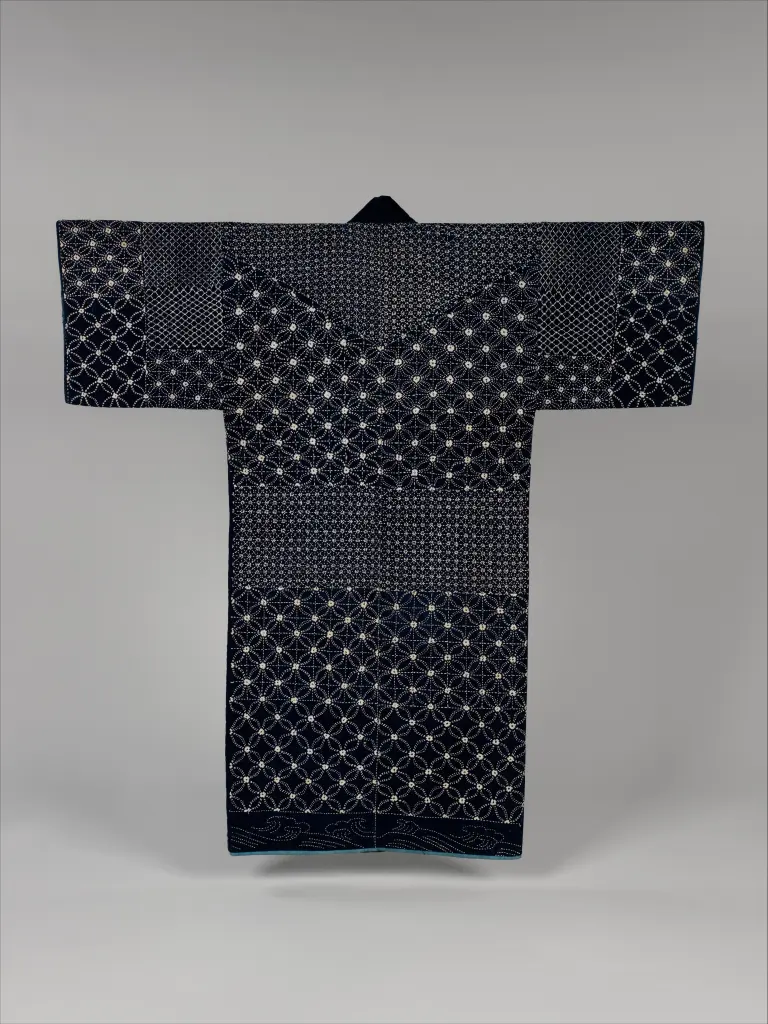
Image: Unknown Japanese maker / The Metropolitan Museum of Art · Public domain / Open Access
Sashiko (刺し子) is a family of Japanese running-stitch practices used to reinforce, quilt, join, repair, and decorate cloth. Historical examples are especially associated with rural and working communities that layered scarce fabric for warmth and durability, often using cotton thread on indigo-dyed cloth. Repeated stitches could stabilise worn areas while producing geometric or pictorial patterns. The familiar blue-and-white appearance is important but not universal, and sashiko is not simply ornamental embroidery. Regional traditions include kogin-zashi in the Tsugaru area and hishizashi in the Nanbu region, although museums and practitioners do not always classify every counted-stitch tradition in exactly the same way. Sashiko also intersects with boro, the repeated patching and reuse of textiles, but the terms are not synonyms: boro describes an object’s layered repair history, while sashiko identifies stitching. Contemporary mending, fashion, quilting, and community projects have expanded the practice worldwide.
Overview
| Japanese name | 刺し子 |
|---|---|
| Romanization | Sashiko |
| Core stitch | Repeated running stitch |
| Historical functions | Reinforcement, quilting, joining, repair, and warmth |
| Common historic palette | Light cotton thread on indigo-dyed cloth |
| Related but distinct term | Boro, meaning repeatedly patched and reused textiles |
Name and scope
Sashiko literally suggests small or repeated stabbing stitches. In modern use it can name practical reinforcement, regional counted-stitch systems, ornamental pattern stitching, or products inspired by them. That breadth makes context essential. Not every running stitch on Japanese cloth is historically labelled sashiko, and workshop, museum, and craft-community terminology can differ.
Running stitch and construction
The needle passes in and out of the cloth to create a line of separated stitches. Makers may load several stitches before pulling the thread through, control spacing by eye or grid, and stitch through one or more layers. Thread tension must hold the fabric without puckering it excessively. Lines can strengthen stress points, secure padding, or distribute forces across a garment.
Workwear, warmth, and durability
In regions where cloth and cotton thread were valuable and winters severe, layered stitching extended the life and insulation of jackets, trousers, gloves, and work textiles. Farmers, fishers, fire brigades, and other communities developed garments suited to local labour. These objects are evidence of material constraint and skilled maintenance, not merely predecessors of modern decorative hobby kits.
Pattern and decoration
Straight stitches build grids, waves, linked circles, hemp leaves, diamonds, and many other designs. Some patterns cover a field; others reinforce selected zones or follow a garment’s structure. Decorative elaboration grew from and alongside practical functions. Individual pattern names and claimed symbolic meanings should be checked against period and regional evidence rather than treated as universal codes.
Kogin-zashi and hishizashi
Tsugaru kogin-zashi and Nanbu hishizashi use counted stitches to build dense geometric patterns through the threads of the ground cloth. They developed in northern Honshu under particular climatic, material, and clothing conditions. They are frequently discussed with sashiko in English, but their regional names, stitch rhythms, and historical identities deserve separate recognition instead of being flattened into one generic pattern library.
Sashiko and boro
Boro textiles accumulated patches, joined remnants, and repairs through long use, sometimes across generations. Sashiko stitches may hold those layers, but a newly decorated cloth is not automatically boro, and not every patched object uses decorative sashiko. The contemporary appreciation of boro as abstract art can obscure histories of poverty, labour, recycling, and necessity.
Modern revival and community
Sashiko now appears in visible mending, quilts, denim repair, fashion, textile art, and educational or community projects in Japan and abroad. Printed grids, commercial threads, kits, machines, and online teaching make it accessible. Contemporary innovation is part of the living practice, but makers should distinguish personal adaptations from specific regional traditions and credit the communities whose work they reference.
Care and common misconceptions
Historic indigo, worn cotton, mixed fibres, and old thread can be fragile. Washing, bleaching, abrasion, or adding new stitches may remove evidence and cause damage. White thread on blue fabric is not a sufficient definition, and perfection is not the only historical standard: stitch density and alignment followed function, material, skill, and local convention. Conservation prioritises the object’s existing structure rather than making it look newly repaired.
Sources
- The Metropolitan Museum of Art, Sashiko Jacket.
- Japan House London, Sashiko: Reviving Communities Through Japanese Embroidery.
- Victoria and Albert Museum, Make Your Own Japanese Boro Bag.
- The Metropolitan Museum of Art, Notable Acquisitions 1979–1980.
- Government of Japan, Japanese Fabrics and the Evolution of the Kimono.
- Kyoto National Museum, Past Textile Exhibitions.
- Victoria and Albert Museum, Kimono.
- Traditional Crafts Aoyama Square, Textiles.
Last updated: