Crafts & Skills
Kintsugi

Image: Martin Howard (martinjhoward2) / Wikimedia Commons · CC BY-SA 2.0
Overview
| Japanese name | 金継ぎ |
|---|---|
| Type | Ceramic repair technique |
| Origin | Japan |
| Materials | Urushi lacquer and metallic powder |
| Purpose | Repairing breakage while making joins visible |
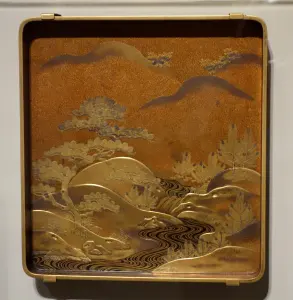
| Related technique | Maki-e |
Kintsugi (Japanese: 金継ぎ, “gold joinery”), also called kintsukuroi (金繕い, “gold repair”), is a Japanese method of mending ceramics with lacquer and finishing the joins with powdered gold. The repair remains visible and becomes part of the object’s appearance. Traditional kintsugi is a skilled branch of lacquer work rather than simply gluing fragments with gold-colored adhesive. The exact origins are uncertain, but gold-lacquer repairs became established in Japan through the culture of collecting and using valued ceramics.
Materials
The central material is urushi, lacquer obtained from the sap of the lacquer tree. It can act as an adhesive and durable coating. Fillers such as flour, clay powder, paper, or cloth may be combined with lacquer according to the stage and size of the damage. Fine metal powder is applied to the final surface.
Gold is the best-known finish, but silver and other finishes are also used. The metal usually decorates the upper layer; it is not normally the substance that holds the ceramic fragments together.
Process
A traditional repair is carried out in multiple stages. Broken edges are cleaned and joined with lacquer-based adhesive. Gaps and chips are filled and shaped. Each layer must cure under controlled humidity before it is refined. A final lacquer line receives metal powder, and the surface is finished after curing.
The process can take weeks or months because urushi hardens through a moisture-dependent reaction rather than simple drying. The method and sequence vary with the object, damage, and workshop.
History
Lacquer has been used to mend objects in East Asia since ancient times. Smithsonian research notes that gold-decorated ceramic repairs became widespread in Japan in connection with tea culture around the late sixteenth century, although a single inventor or precise origin cannot be confirmed.
Imported Chinese and Korean ceramics as well as Japanese wares were repaired in this way. A visible mend could preserve a valued vessel and add a new feature for appreciation. Historical objects also show staples, plain lacquer repairs, replacement fragments, and other techniques.
Aesthetic interpretation
Kintsugi is often presented as a philosophy in which damage is accepted rather than hidden. This modern interpretation draws attention to continuity, care, and the history of use. It can illuminate the visual effect of a repair, but kintsugi should not be reduced to a universal Japanese metaphor.
Associations with tea aesthetics, imperfection, or Zen depend on the object and historical context. Practical value, rarity, ownership, and the skill of lacquer artisans were also important. Some repairs follow cracks closely; others add decorative lines or motifs.
Traditional and modern methods
Contemporary workshops may use epoxy resin, synthetic adhesives, brass powder, or gold-colored pigment. These methods can be accessible and useful, but their behavior, repairability, and food safety differ from traditional urushi work. They should be identified accurately rather than marketed as materially identical.
Liquid urushi can cause severe skin irritation. Safe traditional practice requires training, protective measures, and careful curing. A repaired object’s suitability for food or hot liquids depends on all materials used and the condition of the repair.
Conservation and contemporary practice
Textile repair offers a useful comparison through sashiko, although stitched reinforcement and lacquer repair have different materials, histories, and conservation requirements.
Museum conservators distinguish historical kintsugi from new restoration decisions. An old visible mend may be evidence of an object’s ownership and use and can itself deserve preservation. Today, professional artisans, hobbyists, artists, and conservators continue the technique in different settings.
How to evaluate a kintsugi claim
A visible gold-coloured seam is not enough to identify a repair as traditional kintsugi. Ask what adhesive binds the fragments, whether natural lacquer or a modern resin was used, what metallic powder or substitute forms the finish, when the repair was made, who made it, and whether the object remains suitable for its intended use. These details distinguish technique, appearance, conservation history, and marketing language.
Museum records are useful because they name materials and separate an object’s original date from a later repair. The Metropolitan Museum of Art’s Shigaraki tea jar, for example, catalogues a ceramic object with lacquer-and-gold repair, while the Smithsonian’s materials guide explains gold’s role in Japanese art. Modern workshops and kits may pursue a related visible-repair aesthetic with different substances, so material disclosure matters more than resemblance alone. For the often-associated aesthetic concept, see Wabi-sabi.
Related entries
Sources and further reading
Last updated: