Food Culture
Japanese Fermentation
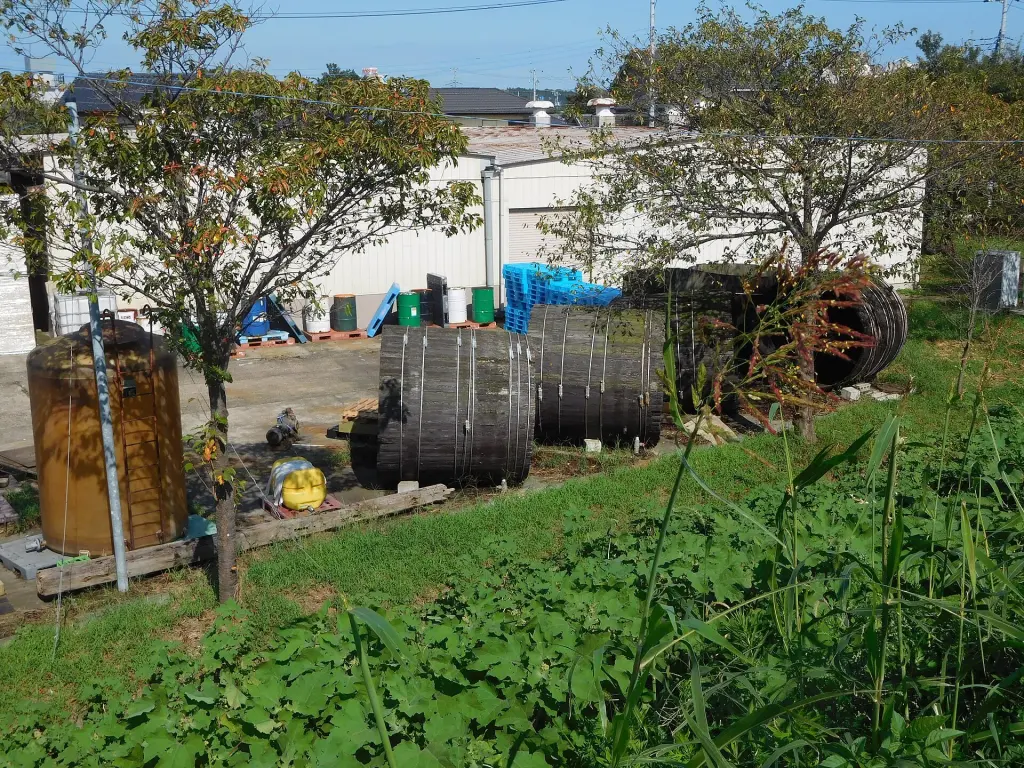
Image: Miyuki Meinaka / Wikimedia Commons · CC BY-SA 4.0
Raw materials · Microbes · Transformation
Different microbes. Different work.
Japanese fermentation (日本の発酵文化, Nihon no hakkō bunka) comprises distinct food-making systems. Ingredients become seasonings, drinks and accompaniments through microbial activity, enzyme action and controlled conditions—not simply through the passage of time.
Start with the transformation
- Raw materialStarch, protein, sugars and other components
- Biological workSelected microbes and their enzymes
- ConditionsSalt, acidity, oxygen, temperature and time
- Food & flavourSeasonings, drinks and accompaniments
At a glance
- Materials
- Grains, soybeans, vegetables, fish and other ingredients
- Agents
- Kōji moulds, yeasts and several groups of bacteria
- Controls
- Salt, water, oxygen, acidity, temperature and time
- Scope
- Cultural and process overview; not a home-production guide
Scope and terminology
Fermentation describes transformations driven by microorganisms and their enzymes. In Japanese food history, the category overlaps with jōzō, or brewing, especially for products made with kōji. Everyday classifications are less exact: foods may be grouped together because they are salted, aged, pickled, brewed, or stored, even when their microbial processes differ.
A broad account must therefore distinguish technology from cultural grouping. Vinegar pickles can be called tsukemono without undergoing fermentation, while nattō is fermented by bacteria rather than kōji mould. Dried foods, salted foods, and matured foods may involve no active fermentation at all.
Match the material, the work and the food
| Starting material | Main biological work | Result | Important distinction |
|---|---|---|---|
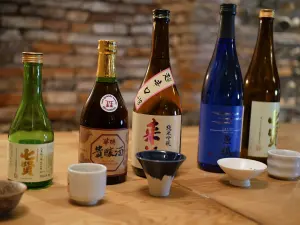
| Rice + rice kōji | Kōji enzymes release sugars; yeast produces alcohol. | Sake | Saccharification and alcoholic fermentation work together. |
| Soybeans + rice, barley or soybean kōji + salt | Enzymes break down starches and proteins; microbial activity and maturation vary. | Miso | Different substrates and ageing produce different miso. |
| Usually soybeans + wheat + salt water | Kōji enzymes act first; salt-tolerant yeasts and bacteria contribute during brewing. | Soy sauce | The brewing stages differ from those of miso. |
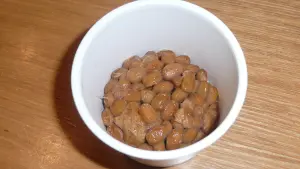
| Cooked soybeans | Bacillus subtilis natto produces the characteristic stringy texture. | Nattō | This row concerns stringy nattō, not every food historically called nattō. |
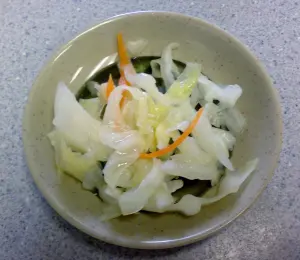
| Vegetables in an appropriate fermentation system | Lactic-acid bacteria produce acids. | Some tsukemono | Vinegar-pickled vegetables need not undergo fermentation. |
| An alcoholic liquid | Acetic-acid bacteria convert alcohol into acetic acid. | Vinegar | Acid production follows an alcohol-containing stage. |
The process comparison draws on NRIB’s explanation of kōji and MAFF’s introduction to fermented foods. It summarises functions rather than specifying production conditions.
Different raw materials require different conversions. Cereal starch is not directly fermentable by brewing yeast, so kōji enzymes first break it into smaller sugars. Proteases split proteins into peptides and amino acids that contribute savouriness. Yeasts convert sugars into alcohol and aromatic compounds, while lactic-acid and acetic-acid bacteria produce organic acids under suitable conditions.
Fermented foods are microbial communities rather than recipes controlled by time alone. Salt level, water activity, oxygen, temperature, acidity, sanitation, and the composition of the substrate all select which organisms can grow. Modern producers use defined cultures and measurement, but traditional processes also depended on repeated practice, vessels, seasonal timing, and established workshop environments.
Kōji supplies enzymes; other stages do different work
- Prepare kōjiCultivate suitable mould on a prepared substrate
- Release componentsEnzymes act on starch and protein
- Develop the productFurther microbial activity and maturation depend on the food
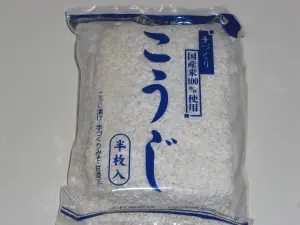
Kōji is grain or soybeans cultivated with useful filamentous fungi, most prominently Aspergillus oryzae. Its enzymes make starches and proteins accessible to other microorganisms. Rice kōji is central to sake and many kinds of miso; soybean-and-wheat kōji begins most modern soy-sauce brewing; barley and soybean kōji support other regional products.
Kōji does not perform every stage by itself. Sake also depends on yeast and an acidic starter environment, while miso and soy sauce develop through longer interaction among mould enzymes, yeasts, bacteria, salt, and maturation. The importance of kōji lies in coordinating these transformations, not in providing a universal starter for all Japanese ferments.
Hon mirin uses rice kōji, but its main transformation is enzymatic saccharification and maturation in already-present alcohol. This differs from sake, in which yeast produces alcohol while kōji enzymes release fermentable sugars.
Bacterial fermentations
Lactic-acid bacteria participate in many vegetable, grain, fish, and seasoning fermentations. By producing acid, they alter flavour and texture and can help create conditions that discourage competing organisms. The species and sequence vary with salt, temperature, ingredients, and place; there is no single Japanese lactic fermentation pattern.
Nattō follows a different route. Bacillus subtilis var. natto grows on cooked soybeans and produces the characteristic sticky poly-γ-glutamic acid matrix. Acetic-acid bacteria transform alcohol into acetic acid in vinegar production. These examples show why “Japanese fermentation” names a connected field rather than one microbial technique.
Salt, preservation, and flavour
Salt is important in miso, soy sauce, many pickles, and fish ferments because it draws out water and selects salt-tolerant microorganisms. It can extend keeping quality while shaping texture and taste. Salt alone, however, does not prove that fermentation occurred, and fermented foods are not necessarily low in salt.
Microbial and enzymatic changes generate organic acids, alcohols, esters, peptides, and free amino acids. These compounds contribute sourness, aroma, sweetness, and umami. Roasting, steaming, pressing, pasteurising, and ageing then modify the result further, so the finished flavour cannot be attributed to microorganisms alone.
Regional and household diversity
Local crops, water, climate, trade, and eating habits produced marked differences in miso, soy sauce, vinegar, sake, pickles, and fermented fish. Rice-growing regions developed many rice-kōji products, while barley, soybean, vegetables, and marine resources supported other traditions. Names may refer to a technique, a place, an ingredient, or a commercial standard.
Household production once preserved substantial variation, but monasteries, urban workshops, merchant networks, taxation, rail transport, refrigeration, and industrial starter cultures also shaped the field. “Traditional” products may therefore combine inherited regional methods with twentieth- or twenty-first-century equipment and hygiene controls.
Follow the process into cooking
Washoku
See how fermented seasonings and accompaniments take their place within a meal.
Dashi
Compare fermentation with extraction: drawing compounds into water does not itself create a fermentation.
Hokkaido Food Culture
Trace ingredients, preservation, farming and local histories together rather than labelling every stored food a ferment.
Industry, safety, and heritage
Modern fermentation is regulated food production. Commercial makers control starter cultures, temperature, sanitation, allergens, alcohol content, packaging, and labelling. Historical practice should not be converted into unsupervised home instructions: safe fermentation depends on the product, organism, salt and acid levels, equipment, and storage conditions.
Heritage recognition can support craftspeople and regional knowledge, but it does not freeze one authentic recipe. The 2024 UNESCO inscription of traditional sake-making with kōji highlights transmitted skills, while contemporary producers continue to develop new yeasts, low-salt products, temperature controls, and uses for kōji. Continuity and innovation operate together.
Sources
- Ministry of Agriculture, Forestry and Fisheries, An Introduction to Japanese Fermented Foods
- National Research Institute of Brewing, Information about Types of Alcoholic Beverages: What Is Koji?
- Koyanagi, Traditional Fermented Foods as Sources for Isolation of Diverse Strains of Lactic Acid Bacteria
- UNESCO, Traditional Knowledge and Skills of Sake-making with Koji Mold in Japan
- Yokotsuka, Traditional Japanese Fermented Foods Free from Mycotoxin Contamination
Last updated: