Historical Figures
Izumo no Okuni
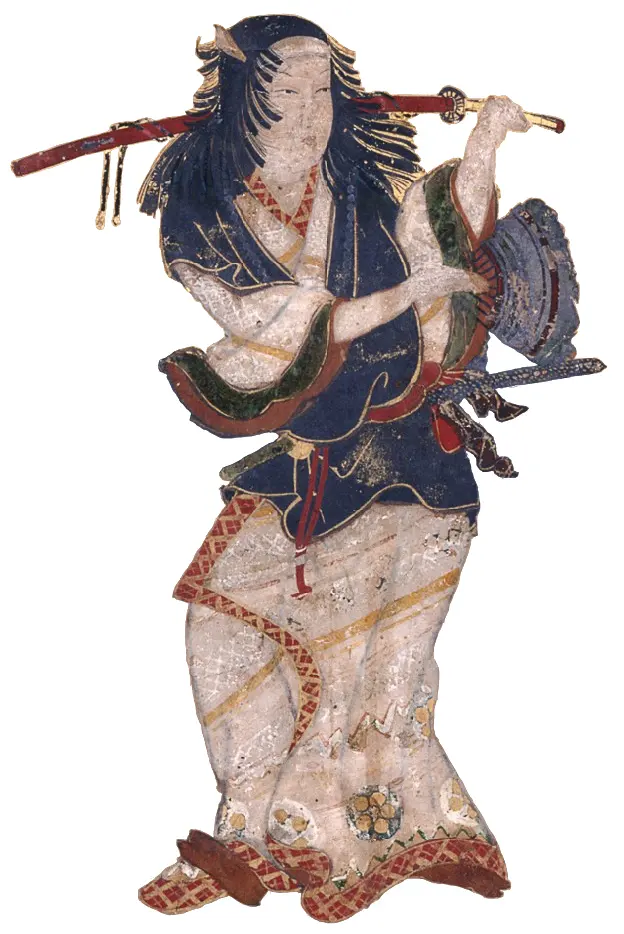
Image: Unknown artist, probably Hasegawa school / Wikimedia Commons; Kyoto National Museum · Public domain
Izumo no Okuni (出雲の阿国; birth and death dates unknown) is the name associated with the female performer and troupe leader whose kabuki odori appeared in Kyoto in 1603. Contemporary and near-contemporary evidence is limited, so claims that she was definitively a shrine maiden of Izumo Taisha or that every surviving story describes one securely documented individual should be treated cautiously. What is well established is that performances identified with Okuni became a sensation, inspired women’s and youths’ troupes, and stand at the beginning of Kabuki. The Okuni Kabuki Screen in Kyoto National Museum provides important visual evidence for the troupe’s stage, costume, music, and dramatic play with gender and social roles.
Overview
| Japanese name | 出雲の阿国 |
|---|---|
| Born | Unknown |
| Died | Unknown |
| Active | Early seventeenth century |
| Occupation | Dancer, actor, and troupe leader |
| Known for | Kabuki odori associated with Kyoto in 1603 |
| Evidence | Sparse records, pictorial sources, and later narratives |
Name and documentary limits
Izumo no Okuni means Okuni of Izumo. Japan Arts Council records that her dates of birth and death are unknown and that only a small number of reliable records survive. The name may combine a performer’s identity with an advertised geographic and religious association.
Okuni was represented as a shrine maiden connected with Izumo Taisha, but the same institutional source notes that this cannot be confirmed. A responsible biography separates that durable tradition from facts established by contemporary documentation.
Kyoto performances of 1603
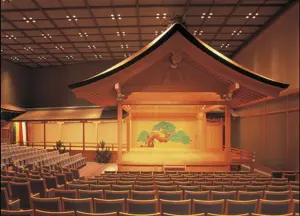
The Okuni troupe, described as coming from Izumo Province, performed kabuki odori on the Noh stage at Kitano Shrine in Kyoto in 1603. The year has become the conventional starting point for Kabuki history.
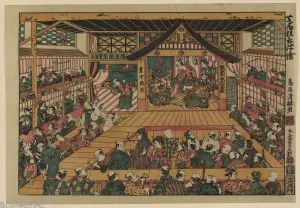
Performers of the period commonly used temporary stages at riverbanks and religious precincts. Japan Arts Council also records that Okuni later established a stage at Kitano after becoming famous and that a 1607 record places a performance at Edo Castle.
Kabuki odori and kabuku
The word kabuku carried associations of leaning away from convention, unusual dress, and conspicuous behaviour. Early kabuki odori used dance, music, comic scenes, and fashionable role-play rather than the mature dramatic structure of later Kabuki.
Okuni’s importance lies in organizing a striking public performance idiom from materials already circulating in song, dance, Nohgaku, festival entertainment, and urban fashion. The new form was recognizably innovative without being disconnected from earlier theatre.
The Okuni Kabuki Screen
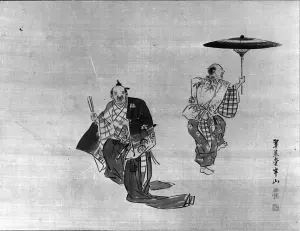
Kyoto National Museum’s seventeenth-century Okuni Kabuki Screen depicts a stage thought to be the Kitano stage. A sword-bearing actor, a tea-house woman, and a saruwaka clown identify the scene as Chaya Asobi, a representative piece of the Okuni troupe.
The musicians use flutes and drums but no shamisen, a feature the museum interprets as evidence of an early performance. The screen is a crucial source, but it is a painted representation made after the performances rather than a neutral photographic record.
Costume, gender, and character
Images and texts associated with Okuni show the attraction of male costume, swords, swaggering figures, comic partners, and scenes of urban sociability. Such role reversals made clothing and behaviour part of the dramatic event.
Later all-male Kabuki should not be projected back onto this beginning. The earliest phase was led by a woman and was followed by female and youthful imitators before official bans reshaped the profession.
Imitation and official bans
Women entertainers and courtesans imitated Okuni’s dances in forms called onna-kabuki, and adolescent male performers developed wakashu-kabuki. Their popularity spread the new performance style beyond one troupe.
The shogunate banned these forms in stages, citing public morals and disorder. Adult male performance was subsequently institutionalized, and by the later seventeenth century Kabuki had developed a more elaborate actor-centred dramatic system.
Okuni sōshi and source criticism
The illustrated narratives known collectively as Okuni sōshi are among the earliest surviving sources for Okuni-associated performance. They offer evidence for plot, costume, and atmosphere, including connections with Noh and Kyōgen.
Scholarly analysis cautions that they are not straightforward contemporary biographies. The historical existence of Okuni exactly as later depicted can be questioned even while the performances connected with her name remain a demonstrable force in early Kabuki.
Legacy
The modern institutional history of Kabuki is visible at venues such as Kabuki-za, founded in Tokyo in 1889—nearly three centuries after the early Kyoto performances associated with Okuni.
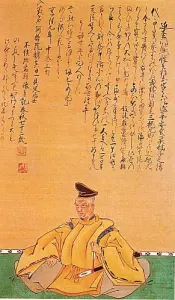
Okuni is remembered as Kabuki’s originator, but the term should describe a catalytic performer and troupe rather than a sole inventor working without predecessors or collaborators. Her performance world included musicians, actors, religious precincts, urban audiences, and imitators.
Her story also preserves an important reversal in theatre history: a form now characterized by male performers traces its conventional beginning to a woman whose bold presentation unsettled social and theatrical boundaries.
Timeline
- Before 1603 — Biographical details and origins remain uncertain.
- 1603 — Okuni-associated kabuki odori performed at Kitano Shrine in Kyoto.
- Early seventeenth century — Female and adolescent male troupes imitated the new performance style.
- 1607 — A record noted by Japan Arts Council places an Okuni performance at Edo Castle.
- Later seventeenth century — Kabuki developed into an institutionalized adult male theatre after official bans.
Sources
Last updated: