Historical Figures
Chikamatsu Monzaemon
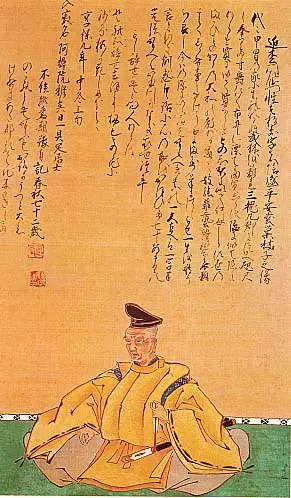
Image: Attributed to Chikamatsu Monzaemon / Wikimedia Commons · Public domain
Chikamatsu Monzaemon (近松門左衛門, 1653–1724), born Sugimori Nobumori, was a professional playwright of the Genroku period who wrote for both Kabuki and ningyō jōruri, the puppet theatre now widely known as Bunraku. In Kyoto he wrote closely for the actor Sakata Tōjūrō I; in Osaka his collaboration with the narrator Takemoto Gidayū and the Takemoto-za helped establish a script-centred dramatic repertory. His works include The Love Suicides at Sonezaki, The Courier for Hell, The Battles of Coxinga, and The Woman-Killer and the Hell of Oil. Chikamatsu did not write “Bunraku” in its later institutional form, but his jōruri plays became foundational to its repertory and were repeatedly adapted for Kabuki.
Overview
| Japanese name | 近松門左衛門 |
|---|---|
| Birth name | Sugimori Nobumori (杉森信盛) |
| Born | 1653, Echizen Province |
| Died | 1724 |
| Occupation | Playwright |
| Primary forms | Ningyō jōruri and Kabuki |
| Key collaborators | Sakata Tōjūrō I and Takemoto Gidayū |
Names and early life
Chikamatsu was born Sugimori Nobumori in 1653, the second son of a samurai family associated with Yoshie in Echizen Province, now Fukui Prefecture. After his father became a masterless warrior, the family moved to Kyoto and served aristocratic households.
Chikamatsu Monzaemon was a professional name; he also used literary names including Sōrinshi. Accounts of his early service and education are partly retrospective, but his knowledge of classical and theatrical literature is evident in the range of sources adapted in his plays.
Entry into theatre
By his twenties Chikamatsu had entered Kyoto’s theatrical world. His earliest known jōruri text, Yotsugi Soga, was performed in 1683, and Shusse Kagekiyo was presented at Takemoto Gidayū’s Takemoto-za after the Osaka theatre opened in 1684.
This work belonged to a transition from earlier narrative jōruri toward a more sustained dramatic form. Chikamatsu’s scripts gave narrators, musicians, puppeteers, and later actors complex structures through which character and conflict could unfold.
Kabuki and Sakata Tōjūrō
In Kyoto, Chikamatsu wrote many Kabuki plays for Sakata Tōjūrō I. The actor was associated with the softer, emotionally detailed wagoto style of Kamigata Kabuki, and the playwright shaped roles around his particular strengths.
Japan Arts Council credits Chikamatsu’s sustained professional writing with helping separate the playwright’s role from the older practice in which actors often constructed scripts themselves. Around thirty Kabuki works are associated with his career.
Takemoto Gidayū and jōruri
Takemoto Gidayū established the Takemoto-za in Osaka and developed the forceful narrative style known as gidayū-bushi. Chikamatsu supplied plays whose literary structure and emotional range allowed that vocal art to become a major form of theatre.
After the success of The Love Suicides at Sonezaki in 1703, Chikamatsu concentrated on jōruri and became closely attached to the Takemoto-za. More than one hundred jōruri works are attributed to him.
Sewamono and jidaimono
Chikamatsu wrote both sewamono, contemporary domestic plays about townspeople, and jidaimono, works placed in historical settings. The categories organize different worlds of action but share conflicts among duty, affection, household survival, reputation, and political obligation.
The Love Suicides at Sonezaki drew on a recent double suicide and was staged soon after the event. Its success demonstrated the theatrical power of present-day urban experience, though later official concern over imitation led to restrictions on love-suicide plays.
Major works
Among Chikamatsu’s best-known jōruri works are The Love Suicides at Sonezaki (1703), The Courier for Hell, The Battles of Coxinga (1715), The Love Suicides at Amijima, and The Woman-Killer and the Hell of Oil. The repertory ranges from intimate commercial households to war, travel, and transnational legend.
The Battles of Coxinga became an exceptional long-running success at the Takemoto-za. The contrast between that historical spectacle and the compressed pressure of his domestic tragedies shows why his achievement cannot be reduced to one genre or theme.
Writing for voice, puppets, and actors
A jōruri playwright wrote for a narrator and shamisen as well as for puppets. Description, dialogue, and shifting viewpoint are carried by the tayū, while the puppet body makes the verbal world visible through coordinated movement.
Many jōruri works later entered Kabuki, where multiple actors, vocal conventions, music, and stage machinery reorganized the same scenes. Chikamatsu’s dual experience made his repertory especially important to the continuing exchange between the two theatres.
Legacy and reception
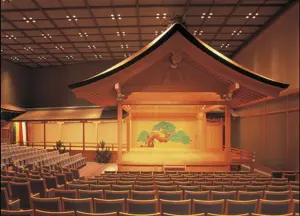
Chikamatsu’s puppet plays remain part of the repertory presented and interpreted at Osaka’s National Bunraku Theatre, which opened in 1984.
Chikamatsu is often compared with major European dramatists, but such comparisons can obscure the collaborative conditions of Japanese commercial theatre. His texts were created for named performers, narrators, theatres, and audiences rather than as literature detached from performance.
His plays remain active in Bunraku and Kabuki and have been translated, adapted, filmed, and reinterpreted internationally. Their survival depends on both written texts and the living performance systems that continually reshape them.
Timeline
- 1653 — Born Sugimori Nobumori in Echizen Province.
- 1683 — Earliest known play, Yotsugi Soga, performed.
- 1684–1685 — Takemoto-za opened; Shusse Kagekiyo established his jōruri reputation.
- Late seventeenth century — Wrote Kabuki for Sakata Tōjūrō I in Kyoto.
- 1703 — The Love Suicides at Sonezaki became a major success.
- 1715 — The Battles of Coxinga opened at the Takemoto-za.
- 1724 — Died after a career spanning more than one hundred jōruri works and about thirty Kabuki plays.
Sources
Last updated: