Judo
Ippon
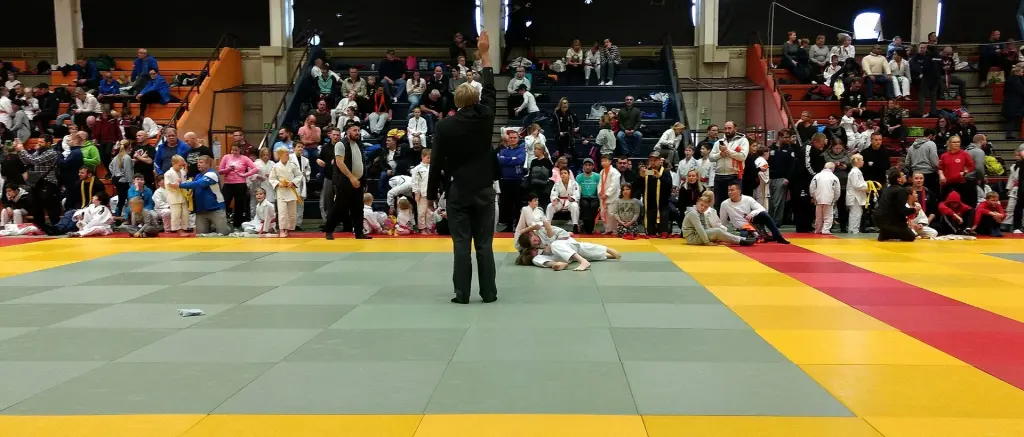
Image: Tvkosone / Wikimedia Commons · CC BY-SA 4.0
Ippon, written 一本, is the full technical score in a Judo contest. When the referee awards ippon, the contest ends immediately. Under current International Judo Federation rules, ippon can result from a qualifying throw, a completed duration of osaekomi, or a successful permitted strangle or joint technique; two waza-ari also combine to ippon. Exact scoring criteria, timings, and interpretations are governed by the rules in force for the event and have changed over time. Ippon is therefore both a durable ideal of decisive technique and a formal refereeing decision. It should not be confused with ippon-seoi-nage, the name of a particular shoulder throw in which ippon has a different compound meaning.
Overview
| Japanese | 一本 |
|---|---|
| Reading | Ippon |
| Contest value | Full score; contest ends |
| Standing route | Qualifying controlled throw |
| Ground routes | Osaekomi or submission |
| Combined score | Two waza-ari |
| Referee signal | One arm raised above the head |
Meaning in Judo
Literally, ippon can mean one point, one full unit, or one decisive instance depending on context. In contest Judo it names the highest technical score and brings the match to an immediate end.
The word also appears inside technique names such as ippon-seoi-nage. That compound does not mean the throw has automatically scored ippon; referees judge the actual execution and landing.
Ippon from a throw
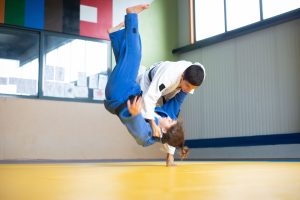
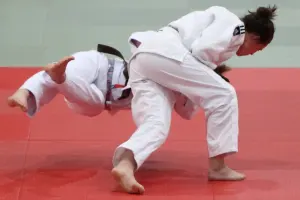
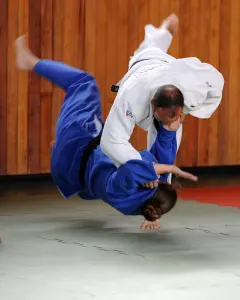
A throw is evaluated as an action, not only as a landing. Current rules consider the recognised Judo technique, control, continuity, force or dynamism, and how the opponent reaches the mat. A cleanly completed nage-waza can receive ippon.
Borderline landings and rolling actions require interpretation. Because the wording and examples can change, older videos or explanations should not be treated as the current rulebook.
Ippon in groundwork
In ne-waza, ippon can be awarded when an osaekomi is maintained for the full required time. A permitted shime-waza or kansetsu-waza also ends the contest when the opponent submits or the referee intervenes under the rules.
These routes are part of katame-waza. Age and event regulations may prohibit or limit some submission techniques even though they exist in the wider Judo curriculum.
Waza-ari and penalties
Two waza-ari combine as waza-ari-awasete-ippon under the current IJF scoring system. Each waza-ari records an action below the ippon threshold but with recognised scoring value.
A contest can also end because of hansoku-make, or disqualification. The opponent receives the win, but a penalty decision should be distinguished analytically from a technical ippon achieved by throw, hold, or submission.
Referee signal and announcement
For ippon the referee raises one arm above the head with the palm facing forward. The visible signal allows athletes, table officials, spectators, and video review personnel to identify the decision.
The signal reports the referee's judgement; it does not explain which criterion was decisive. Official review and event records provide the governing result when a live view is unclear.
History and rule change
The preference for a decisive ippon has remained central to modern Judo, but scoring categories and criteria have repeatedly changed as the sport expanded internationally. Research on All-Japan competition shows how IJF rule adoption altered match content and the frequency of ippon outcomes.
Terms such as yuko and koka have appeared, disappeared, or returned in different periods. An encyclopedic definition must therefore identify the rules date instead of presenting one era's scoring system as timeless.
Practice and the ideal of decisive technique
Dojo instruction often uses ippon as shorthand for a throw that is controlled, committed, and technically convincing. Uchikomi, nagekomi, kata, and randori develop different parts of that performance.
Training language should not encourage uncontrolled force. A technically decisive action includes responsibility for the partner and compliance with the safety rules of the practice setting.
Sources
- International Judo Federation, Sport and Organisation Rules, 14 August 2026.
- Judo Canada, Judo Lexicon.
- International Judo Federation, Detailed Explanation of the Refereeing Rules.
- Research Journal of Budo, Effects of IJF Refereeing Rules on the All-Japan Championships.
- Research Journal of Budo, Survey Research on IJF Contest Refereeing Rules.
Last updated: