Martial Arts Figures
Takeda Sōkaku

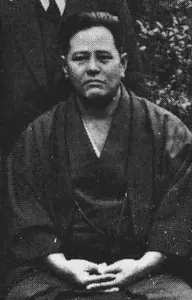
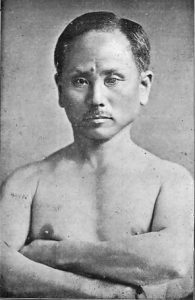
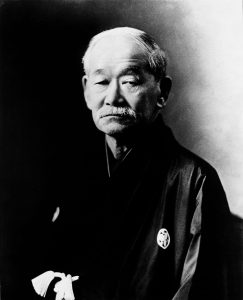
Image: Unknown photographer / Wikimedia Commons · Public domain
Overview
| Japanese name | 武田 惣角 |
|---|---|
| Born | 10 October 1859, Aizu, Mutsu Province (present-day Fukushima Prefecture) |
| Died | 25 April 1943, Aomori Prefecture |
| Occupation | Martial artist and itinerant instructor |
| Known for | Principal public transmission of Daitō-ryū Aiki-jūjutsu |
| Traditions | Daitō-ryū; Ono-ha Ittō-ryū; Jikishinkage-ryū |
| Notable students | Ueshiba Morihei, Hisa Takuma, Sagawa Yukiyoshi, and Takeda Tokimune |
Takeda Sōkaku (1859–1943) was a Japanese martial artist and itinerant instructor who became the principal public transmitter of Daitō-ryū Aiki-jūjutsu. Born in Aizu as Japan’s feudal order was ending, he trained in several martial traditions and later taught through travelling seminars rather than a single permanent school. His most consequential students included Ueshiba Morihei, whose later work became Aikido, Hisa Takuma, Sagawa Yukiyoshi, and his son Takeda Tokimune. Surviving enrolment books and payment ledgers make much of Takeda’s teaching career unusually traceable. Claims about Daitō-ryū’s medieval origins, however, should be distinguished from the documented modern transmission associated with Takeda.
Early life in Aizu
Takeda was born on 10 October 1859 in the Aizu region of Mutsu Province, now part of Fukushima Prefecture. His father, Takeda Sōkichi, belonged to a rural samurai family and practised martial arts including swordsmanship, staff methods, and sumō. Sōkaku grew up during a period of violent political change. The Boshin War reached Aizu in 1868, and the domain’s defeat was followed by the dismantling of the status system in which his family had lived.
Accounts of Takeda’s childhood combine family tradition, later recollection, and documentary evidence. The broad setting is clear: his early training belonged to a local martial culture undergoing rapid change after the Meiji Restoration. More colourful stories about his youth are difficult to verify and are best treated as part of the tradition’s later biography rather than as established fact.
Martial training
Takeda first learned martial skills in Aizu. Daitō-ryū sources identify his father as an early teacher and record his study of Ono-ha Ittō-ryū swordsmanship under Shibuya Tōma. In 1873 he entered the Tokyo dojo of the noted swordsman Sakakibara Kenkichi and trained in Jikishinkage-ryū. Other weapons traditions are also associated with him, although the surviving evidence varies in detail.
For much of his early adulthood Takeda travelled. Later biographies describe years of training and encounters across Japan, but few contemporary records survive for some of these journeys. The better documented phase of his career begins in the 1890s, when records of his instruction allow his movements and teaching activity to be followed more closely.
Daitō-ryū teaching and records
From the late nineteenth century, Takeda taught a system he called Daitō-ryū Jūjutsu and later Daitō-ryū Aiki-jūjutsu. Instruction was commonly organised as short, intensive seminars for groups in police offices, courts, businesses, private homes, and local dojo. This itinerant model differed from the permanent institutional structure that schools such as the Kodokan were developing at the same time.
Takeda kept eimeiroku, or enrolment books, and shareiroku, payment ledgers. These documents record names, locations, dates, fees, and in some cases the material taught. They provide unusually detailed evidence of a martial instructor’s network across late Meiji, Taishō, and early Shōwa Japan. Daitō-ryū organisations estimate that many thousands of people attended his instruction, although headline totals should be read as institutional estimates rather than exact independent counts.
Hokkaido and Ueshiba Morihei
Takeda increasingly worked in Hokkaido and made the island his principal base. In 1915, Ueshiba Morihei encountered him in Engaru and began studying Daitō-ryū. Ueshiba later invited Takeda to Shirataki, the settlement where he lived, and Takeda stayed and taught there. Their relationship continued through later meetings and seminars.
In 1922, during a visit to Ueshiba’s home in Ayabe, Takeda awarded him a kyōju dairi, a licence authorising him to teach on Takeda’s behalf. Ueshiba gradually reshaped his practice through religious ideas, personal experimentation, and changing social circumstances. The result eventually became Aikido. Aikido is therefore a distinct modern art, but its technical history cannot be understood without Takeda’s Daitō-ryū instruction.
Later teaching and students
Takeda continued to teach into old age. During the 1930s he travelled more frequently in Tōhoku, Kantō, and Kansai. He instructed a group connected with the Osaka Asahi newspaper, where Hisa Takuma became an important student. In 1939 Takeda awarded Hisa a menkyo kaiden, a licence of full transmission.
Other prominent students included Sagawa Yukiyoshi, Horikawa Kōdō, Yoshida Kōtarō, and Takeda’s son Tokimune. Their organisations and teaching lines developed different emphases, terminology, and methods. Takeda died on 25 April 1943 in Aomori Prefecture while away from home on a teaching journey.
Methods of transmission
Takeda’s teaching combined close physical instruction with a licence system and written catalogues of techniques. Daitō-ryū is associated with joint controls, throws, pins, and methods described with the term aiki. The meaning and use of that term changed across time and between lineages, so it should not be reduced to a single technique or supernatural explanation.
Because Takeda taught many groups for limited periods, students did not all receive the same curriculum. Some continued for years and received advanced licences; others attended only a short seminar. Later branches consequently preserve related but not identical bodies of practice.
Aiki in Takeda’s transmission
Takeda’s surviving enrolment books and payment ledgers make his itinerant teaching unusually visible, but they do not support the idea that every student received one fixed, complete syllabus. The names attached to his teaching also changed over time, including Daitō-ryū Jūjutsu and later Daitō-ryū Aiki-jūjutsu. Modern branches organize the inherited material differently, so present-day curriculum tables should be attributed to the organization that publishes them.
Aiki no jutsu is a defined curriculum category in at least one current Daitō-ryū mainline system, not a universal label for all subtle or internal martial skill. This distinction matters when tracing Takeda’s influence on Morihei Ueshiba: Ueshiba’s extensive Daitō-ryū training is central to the history of Aikido, but later Aikido organizations did not simply preserve Takeda’s terminology or teaching structure unchanged.
Lineage and historical debate
Daitō-ryū tradition traces the art through the Takeda family to the medieval warrior Minamoto no Yoshimitsu and later to the Aizu domain. Within that tradition, Takeda is often called the art’s “interim reviver” rather than its founder. Surviving documentary evidence, however, becomes much stronger with Takeda’s own late nineteenth-century teaching career.
Modern researchers therefore distinguish between the school’s traditional genealogy and its verifiable public history. Some describe Takeda as the founder of Daitō-ryū in its documented modern form; Daitō-ryū organisations generally retain the language of revival and transmission. Both formulations point to the same historical fact: Takeda is the central documented figure from whom the school’s modern lines descend.
Influence
Takeda’s influence extends beyond the organisations that use the Daitō-ryū name. Ueshiba’s Aikido is the best-known example. Other students and later descendants contributed to Hakkō-ryū, several aiki-jūjutsu schools, and modern discussions of Jūjutsu. These relationships are genealogical and historical; they do not mean that every later art preserves Takeda’s methods unchanged.
His career also illustrates how Japanese martial knowledge moved through the transition from domain society to modern institutions. Takeda relied on personal instruction, travel, licences, and dense social networks. The documents he left make those networks visible and give historians a way to compare inherited tradition with the record of actual teaching.
Timeline
- 1859: Born in Aizu on 10 October.
- 1868: The Boshin War reaches Aizu during his childhood.
- 1873: Trains at Sakakibara Kenkichi’s Jikishinkage-ryū dojo in Tokyo.
- 1890s: Surviving teaching records begin to document his travels and instruction.
- 1910: Establishes Hokkaido as his principal base.
- 1915: Meets and begins teaching Ueshiba Morihei in Hokkaido.
- 1922: Awards Ueshiba a kyōju dairi in Ayabe.
- 1936–1939: Teaches in Osaka; Hisa Takuma becomes a major student and receives full transmission.
- 1943: Dies in Aomori Prefecture on 25 April.
Related entries
Sources and further reading
- Daitō-ryū Aikijūjutsu, “Our History: Takeda Sokaku”
- Daitō-ryū Aikijūjutsu Shinbukan, “Takeda Sokaku”
- Nihon Kobudō Kyōkai, Daitō-ryū Aikijūjutsu
- Margaret Greenhalgh, Aikido and Spirituality: Japanese Religious Influences in a Martial Art, Durham University
- Mihály Dobróka, “The Self-Defence Scroll of Kyokushinkai Karate,” Journal of East Asian Cultures 17/1 (2025)
- Wikimedia Commons, “Takeda Sokaku” portrait (1888), public domain
Last updated: