Cultural Geography
Historic Capitals of Japan
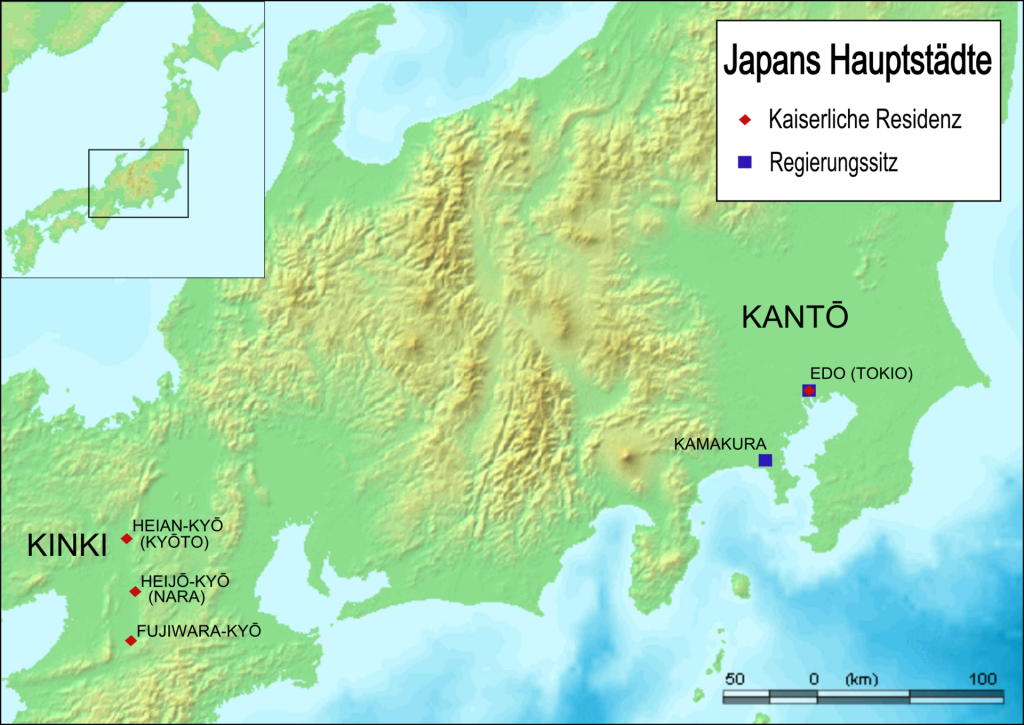
Image: Evening.star / Wikimedia Commons · Public domain
Japan has had multiple places described as capitals, but the term does not refer to one unchanging legal or urban category. Early rulers moved among palace sites; planned capitals later drew on continental models at Fujiwara-kyō, Heijō-kyō, and Heian-kyō. Kyoto remained the principal home of the imperial court for more than a millennium, while warrior governments exercised power from Kamakura and Edo. In 1868, Edo was renamed Tokyo and became the emperor's residence and the center of the modern state. A useful cultural geography therefore distinguishes imperial residence, court administration, military government, and the wider cities that grew around them rather than forcing every political center into a single sequence.
Overview
| Japanese terms | 都 (miyako); capital names commonly end in 京 (kyō) |
|---|---|
| Early planned capital | Fujiwara-kyō, founded in 694 |
| Nara-period capital | Heijō-kyō, founded in 710 |
| Long-lived imperial capital | Heian-kyō, founded in 794 and later known as Kyoto |
| Warrior-government centers | Kamakura and Edo |
| Modern transition | Edo renamed Tokyo in 1868 |
Terms and scope
Miyako can mean an imperial capital or the place of the ruler's residence, while kyō appears in names for planned capitals and literally evokes a capital city. Modern English accounts often use “capital” for court seats, shogunal headquarters, or the chief city of a national government, although these roles were not always located together.
The resulting list depends on the question being asked. Archaeologists may trace palaces and planned grids; historians may distinguish court and bakufu institutions; urban historians also examine commercial, religious, and residential districts. This article emphasizes the major spatial transitions rather than cataloguing every temporary palace or contested candidate.
Early courts and mobile palaces
Before permanent planned cities, sovereigns commonly established palaces in different locations, especially in and around the Yamato basin. A change of ruler, ritual concerns, political circumstances, fire, or access to resources could contribute to a move. Palace, court community, and surrounding settlement were related but did not necessarily form a later-style city.
Asuka preserves important evidence for this early political landscape. The concentration of palaces, temples, tombs, workshops, and engineered features in Asuka and Fujiwara shows how state formation reshaped the region before Nara and Kyoto became the best-known capitals.
Fujiwara-kyō and planned capitals
Fujiwara-kyō, occupied from 694, is generally described as Japan's first capital built on an extensive orthogonal plan. Its palace, avenues, wards, temples, and administrative facilities expressed a more concentrated form of government than the earlier pattern of shifting palace sites.
The design drew on East Asian precedents but was adapted locally. Scholarship has revised older reconstructions as excavations revealed a larger city and different relationships between palace and grid. A planned capital should therefore be understood through material evidence, not as a perfect copy of a single continental model.
Heijō-kyō and Nagaoka-kyō
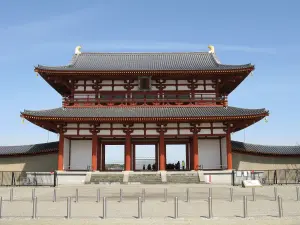
The court moved to Heijō-kyō in 710. The city organized an imperial palace and government offices within a broad grid, while major temples, markets, residences, and roads connected it to the provinces and overseas exchange. Temporary relocations interrupted its status between 740 and 745.
In 784 the court moved to Nagaoka-kyō, southwest of present-day Kyoto. The new site offered river transport and distance from powerful Nara temples, but construction and political difficulties accompanied the move. After only a decade, the court transferred again to Heian-kyō.
Heian-kyō, Kyoto, and imperial continuity
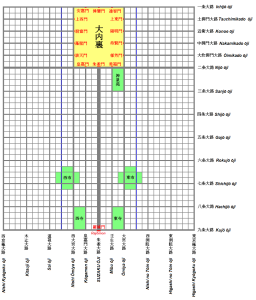
Emperor Kanmu established Heian-kyō in 794. Its grid, palace enclosure, avenues, waterways, aristocratic residences, temples, and markets framed court life, though the inhabited city changed substantially over time. The eastern districts grew in importance as western sectors declined or became agricultural land.
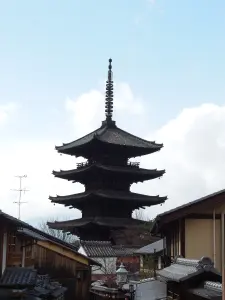
The name Kyoto gradually became standard, and the city remained the principal residence of the emperor and court until 1868. Modern Kyoto is neither a preserved eighth-century plan nor simply another name for Heian-kyō: it is a city formed through repeated rebuilding, expansion, institutional change, and selective conservation.
Warrior governments in Kamakura and Edo
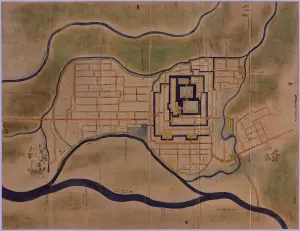
The rise of warrior government separated major political functions geographically. From Kamakura, the medieval shogunate exercised military and administrative authority while the emperor and court remained in Kyoto. Kamakura is therefore often called a political capital, but it did not replace Kyoto in every institutional or cultural sense.
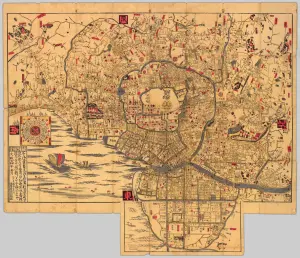
The Tokugawa shogunate made Edo the headquarters of a far more extensive early modern government from 1603. Daimyo residences, transport systems, commercial districts, and a huge population made it a de facto political center. The coexistence of Edo and Kyoto was a defining geography of Tokugawa rule.
Tokyo and modern capital geography
In 1868 Edo was renamed Tokyo, meaning “eastern capital,” and Emperor Meiji moved there. Imperial institutions, ministries, military facilities, transport, industry, and a national media economy increasingly concentrated in the new capital, even as Kyoto retained powerful historical and ceremonial associations.
Present-day debates about Japan's capital can turn on constitutional wording, customary recognition, or the location of central institutions. For cultural geography, the more important point is that political centrality accumulated through different practices—residence, administration, infrastructure, representation, and memory—rather than through one timeless definition.
Sources
- Japan Tourism Agency, The Imperial Family and the Evolution of Japan's Capitals.
- UNESCO World Heritage Centre, Archaeological Sites of the Ancient Capitals of Asuka and Fujiwara.
- Kyoto City, History of Kyoto.
- Nagaokakyo City, The Ancient Capital Nagaoka-kyo.
- Tokyo Metropolitan Government, Tokyo's History, Geography, and Population.
Last updated: