
Historic Cities
Nara
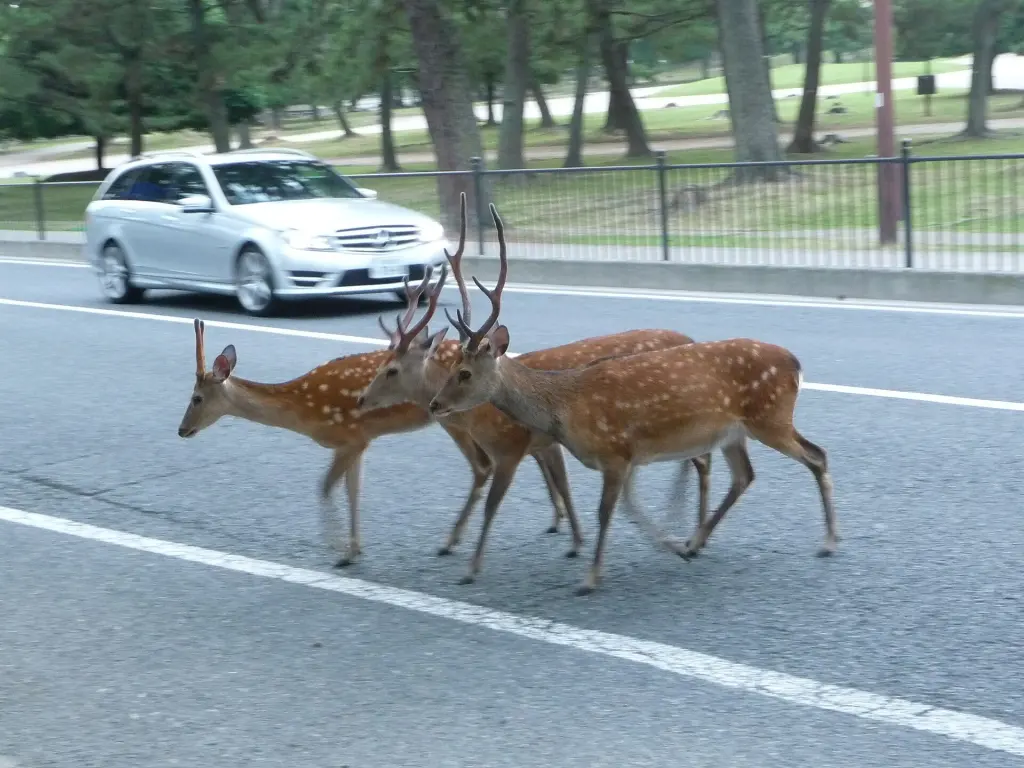
Image: Immanuel Giel / Wikimedia Commons · CC0 1.0
Nara is a city in the Kansai region and the capital of Nara Prefecture. The planned capital Heijō-kyō was established here in 710 and remained the principal seat of government until 784. Court institutions, continental exchange, Buddhist temple networks, Shinto worship, and poetic culture made the city foundational to the Nara period. The modern city includes both celebrated monuments and ordinary urban districts. Eight components form the UNESCO property Historic Monuments of Ancient Nara: five Buddhist temples, Kasuga Taisha with Kasugayama Primeval Forest, and the Nara Palace Site. Nearby Hōryū-ji and the monuments of the Kii mountain region belong to different World Heritage properties. “Nara” can mean the city or the much larger prefecture; this article concerns Nara City while noting those regional connections.
Overview
| Japanese name | 奈良市 |
|---|---|
| Romanization | Nara-shi |
| Prefecture | Nara Prefecture |
| Region | Kansai |
| Ancient capital | Heijō-kyō, 710–784 |
| UNESCO property | Historic Monuments of Ancient Nara, inscribed in 1998 |
Name and setting
Modern Nara City lies in the northern part of Nara Prefecture, east of Osaka and south of Kyoto. Its urban landscape stretches from the archaeological remains of the palace in the west to Nara Park, temple precincts, and the Kasugayama hills in the east.
The name Nara is used for the city, prefecture, and historical period. The Nara period is conventionally dated 710–794, while Heijō-kyō served as the principal capital from 710 to 784, with temporary moves during that span and a final transfer before the establishment of Heian-kyō.
Heijō-kyō and government
Heijō-kyō denotes the wider planned capital founded in 710; Heijō Palace was its governmental core, and modern Nara is a different urban and administrative entity. This distinction places Nara within the broader history of Japan’s historic capitals.
Heijō-kyō was planned on a rectilinear model informed by continental capitals. The palace stood at the northern end of the main avenue and contained the imperial residence, audience halls, ceremonial spaces, and government offices serving the ritsuryō state.
Much of the palace disappeared after the capital moved, and archaeological research has been essential to understanding it. The Nara Palace Site Historical Park combines protected remains, museums, reconstructed buildings, and open land. Reconstructions represent research-based interpretation rather than untouched eighth-century fabric.
Temples, shrines, and state formation
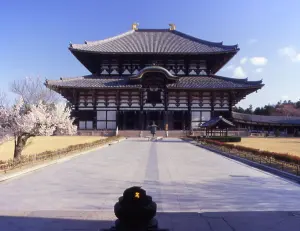
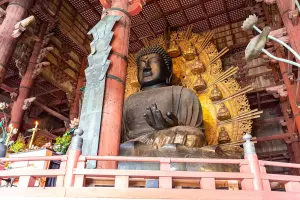
Large Buddhist institutions such as Tōdai-ji, Kōfuku-ji, Yakushi-ji, Gangō-ji, and Tōshōdai-ji preserve different relationships to court patronage, doctrine, education, ritual, and artistic production. Their buildings have histories of destruction, repair, and reconstruction.
Kasuga Taisha and the adjacent Kasugayama Primeval Forest express a sacred landscape connected with the Fujiwara family and local kami worship. Modern labels separating Shinto and Buddhism should not be projected unchanged onto every historical period.
Literature, art, and exchange
Nara-period elites participated in diplomatic, religious, and artistic networks linking the Japanese archipelago with the Korean peninsula, China, and regions reached through Silk Road exchange. Architecture, sculpture, ritual objects, texts, music, and administrative documents reflect selective adaptation rather than simple copying.
The Man’yōshū preserves poetry from this broad era and earlier generations, but it is not a guidebook to one city. Nara museums, temple treasuries, archaeological collections, and annual exhibitions place surviving objects within more specific institutional histories.
Nara Park, deer, and sacred landscape
Nara Park connects major monuments with lawns, wooded slopes, roads, museums, and living religious precincts. Free-roaming sika deer have long been associated with Kasuga belief and now also function as a powerful civic and tourism symbol.
The deer are wild animals, not pets. Visitors should use approved food only where permitted, avoid teasing or crowding them, protect maps and paper from being eaten, and follow seasonal safety guidance. Their visibility should not reduce the park to a wildlife attraction detached from its sacred and historical setting.
World Heritage and conservation
The Historic Monuments of Ancient Nara include eight component parts and their buffer zones. The property brings together temple architecture, a Shinto shrine and sacred forest, and an archaeological palace site to represent the political and religious landscape of the eighth-century capital.
World Heritage status applies to those defined components, not to every site in Nara City. Conservation ranges from maintaining active worship buildings to protecting buried archaeology and a primeval forest. Routine repair and periodic reconstruction must be understood within documented Japanese conservation traditions.
Visiting the city
JR Nara and Kintetsu Nara stations serve different approaches to the center. Many eastern sites are walkable from Kintetsu Nara, while the palace site and western temples require separate routes. Hōryū-ji, Asuka, Yoshino, and other famous places are outside Nara City and need additional travel.
Temple halls, museums, gardens, and ritual areas keep their own hours, fees, and photography rules. A route that combines palace archaeology with eastern temple and shrine landscapes gives a fuller picture than treating all “ancient Nara” sites as one compact precinct.
Sources
Last updated:

.jpg)