Karate
Geri
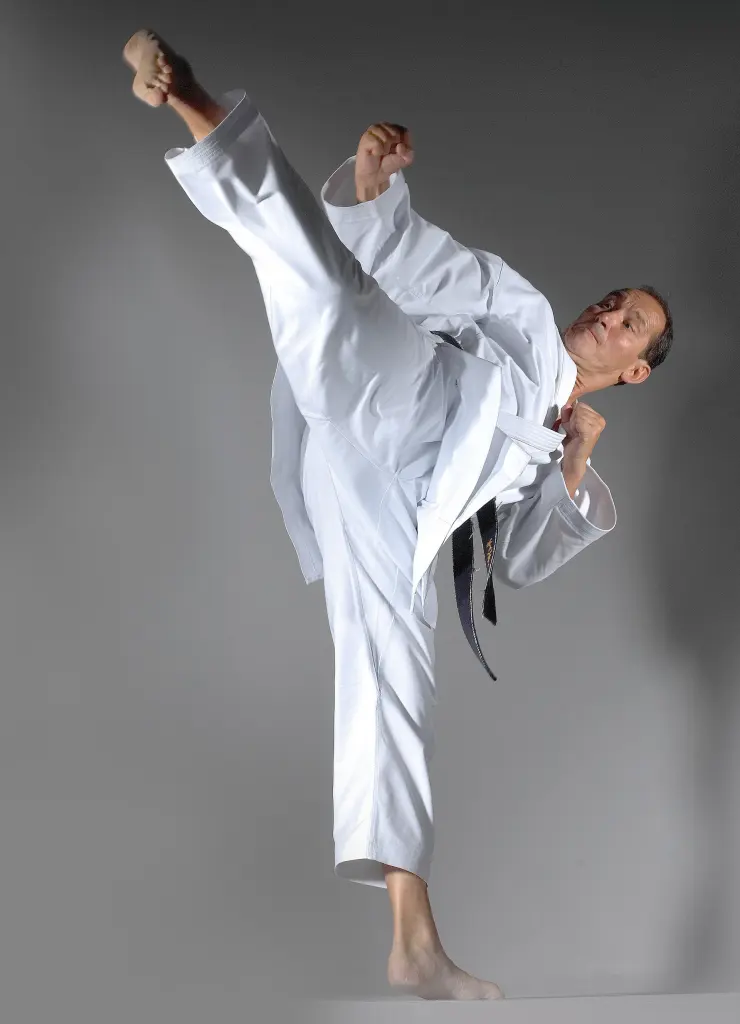
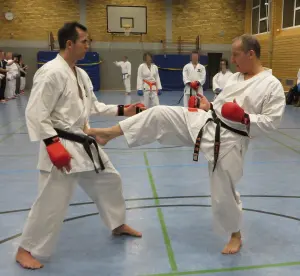
Image: Ridsac / Wikimedia Commons · CC BY-SA 4.0
Overview
A kick is a whole-body balance problem organised around one leg leaving the floor.
Geri (蹴り) is the compound form familiar in Karate kick names such as mae-geri, mawashi-geri, yoko-geri, and ushiro-geri; the independent noun is pronounced keri. Direction, path, contact surface, supporting-leg action, posture, recovery, and intended contact all help define a kick. The chamber and extension are only its most visible phase. Schools differ in hip use, foot formation, retraction, height, and whether they distinguish snapping and thrusting versions. Competition recognises only the kicks satisfying its current target, control, and safety rules.
Guard and trunk organise the centre while the leg leaves and returns to the floor.
- Japanese
- 蹴り
- Independent form
- Keri
- Compound form
- -geri
- Name variables
- Direction · path · action
- Body variables
- Support · surface · balance · recovery
- Training contexts
- Kihon · kata · kumite
01Name & classification
The word begins as keri and voices to -geri inside a compound.
The compound normally adds direction, path, or action rather than defining one universal performance.
Keri · 蹴り
The base word for kicking.
-geri
Used in names such as mae-geri, not normally mae-keri.
Direction or path + geri
Mae, mawashi, yoko, and ushiro orient the kick family.
Knee actions may be called hiza-geri, while some sources draw the boundary between foot and broader leg techniques differently. Competition scoring is another classification and does not catalogue every traditional kick.
02Whole-body architecture
The supporting side organises the body while the kicking side changes shape and direction.
Floor, centre of mass, pelvis, trunk, guard, and leg must remain related throughout the cycle.
Manage weight on one leg
The standing foot, ankle, knee, and hip adapt to the kick’s path and range.
Fold without freezing
A chamber can organise the leg before the main action; its height and shape vary.
Match path, surface, and target
Pelvis and trunk coordinate without losing posture or tactical guard.
Retract or land under control
The body must regain a usable stance or move directly into the next action.
03Contact surfaces
The chosen part of the foot must suit the technique, target, and training condition.
Foot formation and protective equipment are not interchangeable across kicks.
Jōsokutei / chūsoku
Ball of the foot.
Haisoku
Instep.
Sokutō
Outer edge of the foot.
Kakato
Heel.
Tsumasaki
Toe tips in methods that specifically train this surface.
04Common Karate kicks
Direction and path organise the main families; tactical versions multiply within them.
Front or rear leg, rising or penetrating action, height, and landing can change without changing the familiar family name.
Front kick directed forward.
Curved pathMawashi-geri回し蹴りRound kick approaching from the side.
Side directionYoko-geri横蹴りSide-kick family; snap and thrust models depend on organisation and context.
Rear directionUshiro-geri後ろ蹴りDirect back kick driving along a backward line as the body turns.
Knee strike or knee kick.
Jumping kick; the directional technique must still be identified.
05Supporting leg, guard & balance
The leg that stays on the floor governs the freedom of the leg that moves.
Knee, ankle, foot orientation, pelvis, trunk, and guard change with direction and range.
Supporting foot and ankle
Manage pressure and turn according to the kick rather than remaining mechanically fixed.
Knee, hip, pelvis, trunk
Keep the centre controlled while the other leg accelerates and changes reach.
Guard and visual attention
Protect the upper body and preserve awareness of partner, target, and landing space.
Research comparing experienced and less experienced Karate athletes supports the importance of whole-body neuromuscular control during front kicking; it does not prescribe one method for all styles.
06Retraction & landing
The kick is not finished at extension.
Recovery regulates contact, protects balance, and determines what the practitioner can do next.
Hiki-ashi
Retracts the kicking leg to regulate contact and reduce the time it remains exposed.
Recover to the starting base
Useful when the exercise prioritises repeatability, distance control, or immediate defence.
Land into continuation
Useful when the kick changes distance or leads directly into another action.
Both returning and landing forward can be legitimate; neither choice defines the whole technique family.
07Practice, competition & style variation
Training format decides which part of the kick becomes most visible.
Conspicuous head-height kicking does not define historical or modern Karate as a whole.
Kihon
Examines fold, path, surface, supporting side, retraction, and landing.
Kata
Places selected kicks within prescribed direction, rhythm, and continuation; many kata contain relatively few high kicks.
Kumite
Adjusts range, timing, guard, target, and control to another person.
Chūdan 2 · jōdan 3
Valid middle-level kicks score two points and upper-level kicks three under the cited 2026 framework; kicks against a downed opponent are prohibited.
Full-contact and association events use other targets and scores. Styles also differ in chamber height, pelvic action, foot surface, breathing, and the use of Shotokan terms such as keage and kekomi.
Sources and further reading
- All Japan Karatedo Federation, Karate Terminology Dictionary.
- Japan Karate Association, Instructor Technical Manual.
- Japan Karate Association, Techniques: Kihon, Kata and Kumite.
- Okinawa Prefecture, School Physical Education Karate Teaching Guide.
- National Diet Library, Funakoshi Gichin, Karate-do Kyohan.
- Japan Karate Association, Dan Ranking and Grading Syllabus.
- Egawa, Theoretical Consideration of Karate-do: Basic Offensive Techniques and Kumite, Research Journal of Budo.
- Sbriccoli et al., Neuromuscular Control Adaptations in Elite Karate Athletes, PubMed.
- All Japan Karatedo Federation, Summary of Competition Rule Changes Effective 1 April 2026.
Last updated: