Karate
Karate Techniques
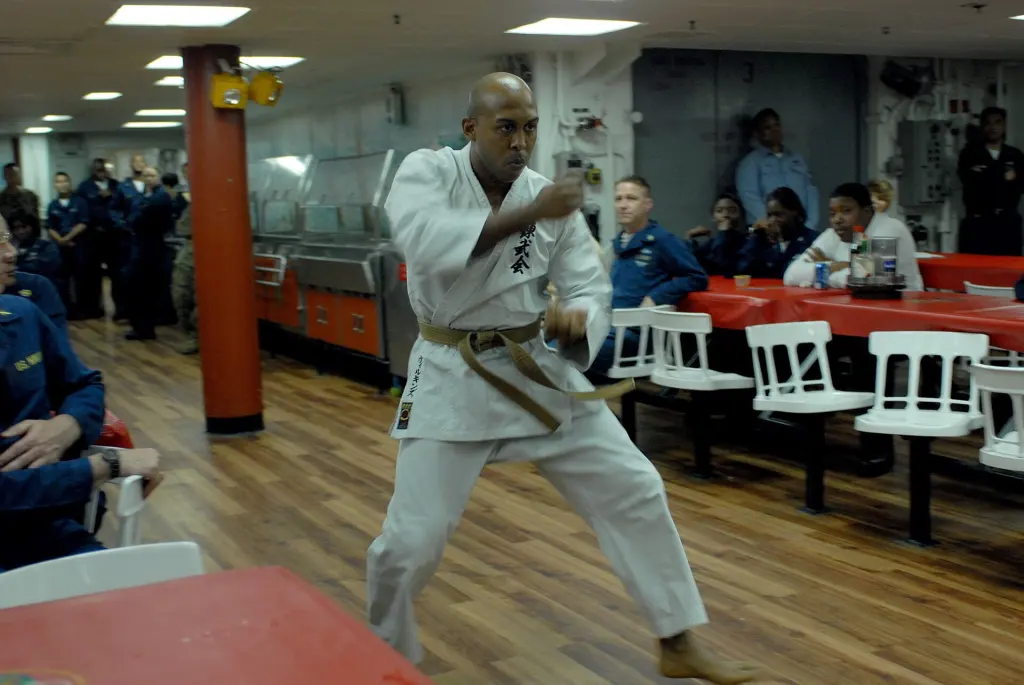
Image: Petty Officer 2nd Class David Didier, U.S. Navy / U.S. Navy and DVIDS via Wikimedia Commons · Public domain (U.S. Government work)
Overview
A technique name identifies a movement family—not its complete use.
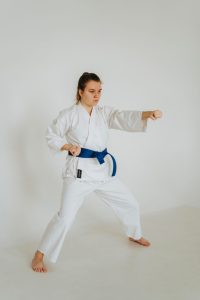
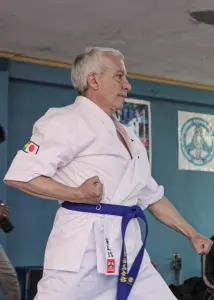
Karate techniques include thrusts, strikes, receiving actions, kicks, stances, footwork, and less universally emphasised grappling methods. Japanese sources commonly organise core fundamentals around tsuki, uchi, uke, and geri. These families connect kihon, kata, bunkai, and kumite, but they are not one exhaustive catalogue shared by every school. A name must still be paired with body mechanics, stance, target, distance, teacher, style, and training context. Competition selects only part of this wider inheritance.
Thrust, strike, receive, and kick are useful teaching categories.
- Japanese umbrella term
- 技 · waza · technique or skill
- Thrusting
- Tsuki-waza
- Striking
- Uchi-waza
- Receiving
- Uke-waza
- Kicking
- Geri-waza
- Movement foundation
- Stance · posture · footwork
01Name & scope
Waza can mean one action, one family, or a style’s wider technical content.
“Karate techniques” therefore covers more than punches and kicks.
One recognisable action
A term may specify path, contact surface, stance relationship, direction, or tactical role.
A practical classification
Organisations group movements to structure instruction; the boundaries are pedagogical rather than universal.
Some traditions give greater weight to open-hand actions, elbows, knees, close control, throws, or joint methods preserved through kata and partner study. No single list captures every method in every Karate organisation.
02How techniques are grouped
Four core action families sit on one moving base.
The same movement can be classified differently according to what a syllabus emphasises.
The All Japan Karatedo Federation separates hand, stance, foot, and receiving terminology. JKA materials distinguish punches, strikes, blocks, and kicks inside a Shotokan syllabus. Both are useful attributed references.
03Tsuki & uchi
English “strike” can hide a useful Japanese distinction.
Path, surface, stance relationship, and timing refine the family name.
Tsuki
The straight-fist punch is familiar; choku-zuki, jun-zuki, gyaku-zuki, and kizami-zuki further describe path and relationship to stance.
Uchi
Examples include uraken-uchi, shutō-uchi, enpi-uchi, and tettsui-uchi.
A contact surface alone does not define one stance, target, trajectory, application, or competition status. Enpi-uchi, for example, can be studied technically while elbow attacks remain prohibited in current JKF kumite.
04Uke
“Receiving” is broader than colliding with an attack.
The common English translation “block” can make the category sound narrower than it is.
Age-uke
Receives or clears an upper line; mechanics vary by school and context.
Uchi-uke · soto-uke
The two labels may be reversed between styles and dōjō.
Shutō-uke · gedan-barai
Hand form, level, body turn, and follow-up shape interpretation.
Uke can intercept, redirect, cover, clear a line, affect posture, or create a position for counteraction. The named solo form does not settle every application.
05Geri
Direction gives a first orientation; mechanics complete the description.
Geri is the voiced form commonly heard inside compound kick names.
Supporting-leg action, hip position, balance, recovery, range, and degree of contact differ across styles and training settings.
06Stance, posture & movement
No hand or foot action exists independently of its supporting base.
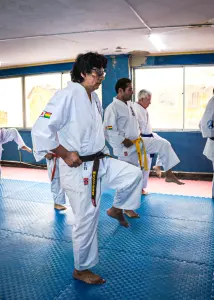
A clear basic stance and an adaptable partner posture answer different teaching needs.
Defined structure
Deeper or clearer positions can expose balance, alignment, weight distribution, and recovery.
Adaptable structure
A higher mobile posture can support changing distance, timing, and response.
Karate Stances explains how the base changes turning, advancing, force transfer, and the ability to continue after an action.
07Practice context, style & rules
The same name changes meaning when the training question changes.
Kihon, kata, bunkai, kumite, and competition select different information.
Kihon
Build accuracy, posture, balance, recovery, and repeatability.
Kata
Place movements inside sequence, transition, rhythm, and direction.
Bunkai
Examine possible function and adaptation with school-specific caution.
Kumite
Introduce changing distance, timing, initiative, and rules.
Shotokan, Gōjū-ryū, Shitō-ryū, Wadō-ryū, and Kyokushin do not prescribe identical stances, trajectories, breathing, contact, or tactical priorities. Current competition rules reward only permitted targets and actions; they do not define the whole art.
Sources and further reading
- All Japan Karatedo Federation, Karate Terminology Dictionary.
- Japan Karate Association, Instructor Technical Manual.
- Japan Karate Association, Techniques: Kihon, Kata and Kumite.
- Okinawa Prefecture, School Physical Education Karate Teaching Guide.
- National Diet Library, Funakoshi Gichin, Karate-dō Kyōhan.
- Research Journal of Budo, Egawa, Theoretical Consideration of Karate-dō: Basic Offensive Techniques and Kumite.
- Research Journal of Budo, Michihara and Yen, A Study of Basic Technique in Karate.
Last updated: