
Karate
Tsuki
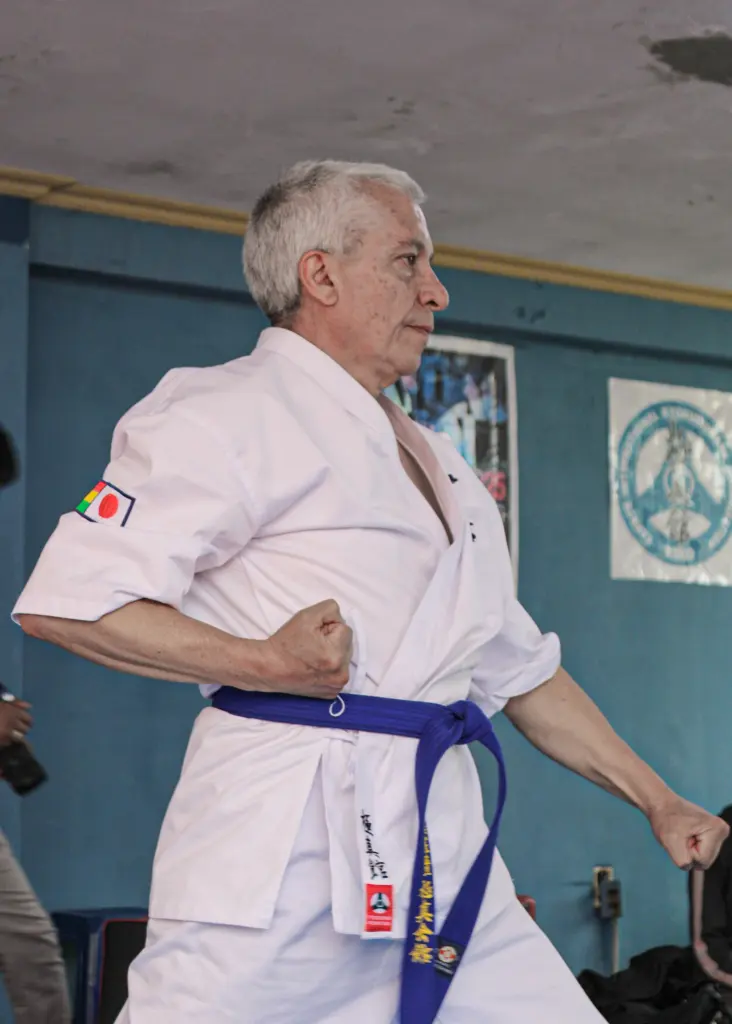
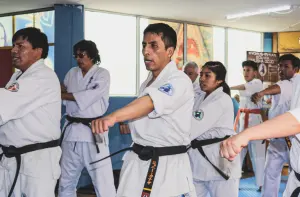
Image: Norkiña / Wikimedia Commons · CC BY-SA 4.0
Overview
A tsuki is a thrusting family whose visible fist depends on the whole body.
Tsuki (突き) names thrusting hand techniques in Karate, most commonly closed-fist actions translated as punches. It does not prescribe one rigid execution. Terms such as choku-zuki, oi-zuki, gyaku-zuki, and kizami-zuki identify path or the relationship among hand, stance, and movement. The arm is only the visible end of a coordinated action involving support, posture, distance, timing, recovery, and control. Shotokan manuals provide influential models, but rotation, stance, hikite, breathing, and preferred range vary among Karate traditions.
Creates a usable base and permits movement.
Coordinates weight, rotation, and direction.
Organises the path to the selected target.
Completion is useful only if movement can continue.
- Japanese
- 突き
- Base verb
- Tsuku · to thrust or pierce
- Compound form
- -zuki
- Technical family
- Hand thrusts, commonly punches
- Key relationships
- Path · stance · movement · target
- Training contexts
- Kihon · kata · kumite
01Name & classification
“Punch” is convenient; “thrust” preserves the Japanese technical distinction.
The family belongs to hand techniques but is normally separated from uchi, or striking actions.
Tsuki · 突き
Derived from tsuku, to thrust or pierce.
-zuki
Sequential voicing produces gyaku-zuki and oi-zuki.
Uchi · 打ち
A strike such as uraken or shutō may share a target while following a different path and classification.
English sources also use joined, spaced, or unvoiced forms such as gyakuzuki, gyaku zuki, and gyaku-tsuki. TokyoWaltz uses the hyphenated, voiced form.
02Whole-body coordination
The fist travels because the body organises support, direction, and time.
Calling the action an “arm punch” hides the contribution of the lower limbs, pelvis, trunk, and moving base.
Keep support usable
The feet and legs manage the centre without freezing the stance.
Coordinate, do not merely rotate
Pelvic and trunk action varies with target, stance, path, and style.
Connect elbow, forearm, and fist
The selected path must preserve wrist structure and shoulder organisation.
Arrive as one action
Support, movement, and hand action must meet the target relationship together.
Kinematic and electromyographic studies find organised joint and muscle patterns that differ between experienced practitioners and beginners. They describe tested groups rather than one universal ideal for every lineage.
03Fist, forearm & endpoint
Rotation is one variable inside the thrust—not its definition.
Target height, range, hand formation, and school method determine the useful alignment.
Wrist behind the striking knuckles
Many systems rotate the forearm during a straight thrust and organise the wrist behind the first two knuckles.
Vertical or partly rotated fist
Tate-zuki and other named forms show that full rotation is not required for classification as tsuki.
Elbow position and endpoint change with the line being trained. Controlled extension preserves the joint and keeps the practitioner ready to recover or continue.
04Stance, hikite, kime & recovery
A thrust is a relationship between the striking hand and a moving base.
Natural stance, long basic stance, stepping, sliding, or mobile guard changes what the name describes.
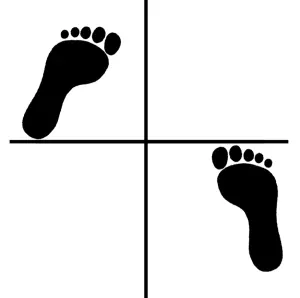
Karate Stances
Provide temporary support while stepping, sliding, and turning alter reach and hand–leg relationship.
Hikite
Basic practice often withdraws the other hand to expose coordination; guards and applications do not always return it to the hip.
Kime and recovery
Coordinated focus should not become prolonged rigidity. The posture must remain available for the next action.
05Common types
Names identify path, side relationship, guard position, or fist orientation.
Exact English equivalents and execution should still be checked against the relevant organisation.
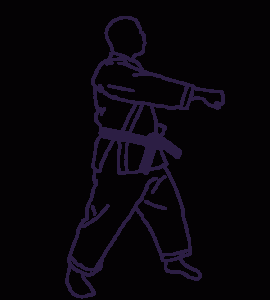
Straight thrust, often practised without stepping.
Same-side advanceOi-zuki / jun-zuki追い突き / 順突きThrusting arm and advancing or forward leg relate on the same side; terminology varies.
Opposite-side relationGyaku-zuki逆突きThe thrusting arm is opposite the forward leg.
Leading handKizami-zuki刻み突きLeading-hand thrust, commonly combined with an entry.
Vertical-fist thrust.
Hooking or angled thrust.
06Kihon, kata & kumite
The same family changes when the training problem changes.
A large basic motion may reveal alignment without becoming the only functional version.
07Competition, variation & safety
Legality and scoring belong to a ruleset; mechanics belong to a school and training task.
Neither can be inferred from the word tsuki alone.
Hand technique: normally one point
The 1 April 2026 changes retain the specified three-point case against an opponent whose torso is on the floor. Target, timing, form, distance, and control still determine validity.
Rotation, stance, range, and contact differ
JKA, JKF, Wadō-ryū, Okinawan lines, and full-contact events do not turn one shared name into identical execution or judging.
Sources and further reading
- All Japan Karatedo Federation, Karate Terminology Dictionary.
- Japan Karate Association, Instructor Technical Manual.
- Japan Karate Association, Techniques: Kihon, Kata and Kumite.
- Okinawa Prefecture, School Physical Education Karate Teaching Guide.
- National Diet Library, Funakoshi Gichin, Karate-do Kyohan.
- Japan Karate Association, Dan Ranking and Grading Syllabus.
- Michihara and Yen, A Study of Basic Technique in Karate, Research Journal of Budo.
- VencesBrito et al., Kinematic and Electromyographic Analyses of a Karate Punch, PubMed.
- All Japan Karatedo Federation, Summary of Competition Rule Changes Effective 1 April 2026.
Last updated:
_en_Musha_Dojo.jpg)