
Karate
Kime
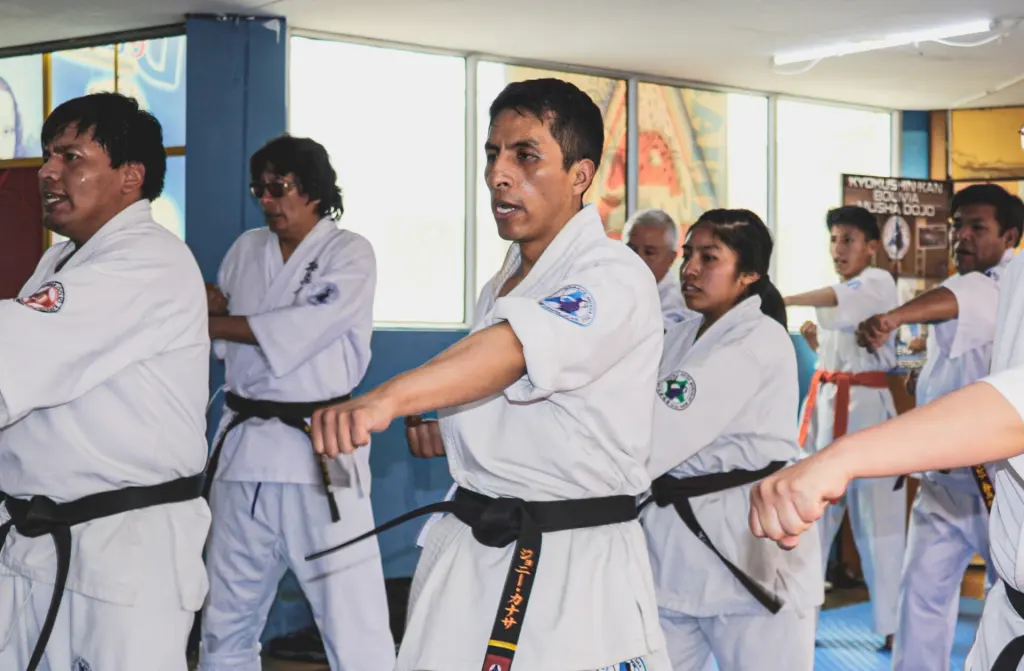
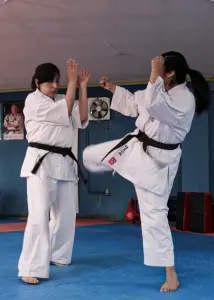
Image: Norkiña / Wikimedia Commons · CC BY-SA 4.0
Kime (決め) is a Karate concept describing the coordinated completion or decisive focus of a technique. It belongs to technical training across Kihon, Karate Kata and Kumite, although schools explain and express it differently. Kime matters because effective technique depends on more than moving a limb quickly: posture, ground reaction, body alignment, timing, breathing, target control and continued readiness must be organised together. It should not be reduced to freezing in place or contracting every muscle for as long as possible. Japan Karate Association teaching gives kime a central role in its kihon–kata–kumite model, but that is an influential Shotokan formulation rather than a definition imposed on every Karate tradition.
Overview
| Japanese | 決め |
|---|---|
| Reading | きめ |
| Romanisation | kime |
| Meaning | Decision, completion or technical focus |
| Martial art | Karate |
| Main contexts | Kihon, kata and kumite |
| Associated qualities | Timing, alignment, force transmission, control and recovery |
| Not equivalent to | Long-duration whole-body tension or kiai |
Name and meaning
Kime derives from the Japanese verb kimeru, to decide, determine or bring something to a conclusion. In Karate vocabulary it refers to the decisive organisation of a technique rather than a separate technique of its own.
English expressions such as “focus” and “finishing point” are approximations. They can suggest a visual stop, while kime may also be present in actions that must immediately recover, flow into another movement or remain controlled short of contact.
Technical coordination
Kime coordinates the supporting foot or feet, legs, pelvis, trunk and striking or receiving limb so that they contribute at the appropriate instant. The exact sequence depends on the technique, direction and training purpose.
Biomechanical research on Karate punching documents interaction among joint motion, ground forces and whole-body timing. Such studies help explain why kime cannot be located in the fist alone, but they do not create one scientific definition accepted by every school.
Relaxation and tension
Efficient movement requires muscles to activate and release in sequence. A practitioner who is rigid throughout may slow the technique and disrupt balance. The moment of greatest organisation is therefore normally brief and task-specific.
A 1978 Research Journal of Budo study used kime as an observable phase and described muscular tension becoming less pronounced after that point. The finding supports a distinction between momentary focus and sustained, indiscriminate tension.
Posture and alignment
Stable posture allows force to be transmitted without unnecessary collapse or overextension. Alignment is not a single pose: it changes with stance, technique and whether the practitioner is advancing, turning or receiving force.
In basic practice, instructors may pause at completion to make errors visible. That pedagogical pause should not be mistaken for proof that functional Karate always ends in a static position.
Breathing and kiai
Breathing supports posture and timing, and some methods use a short exhalation at technical completion. Breathing patterns differ among styles; pronounced breath control in some Gōjū-ryū kata should not be generalised to all Karate.
Kiai is a focused vocal expression and may coincide with kime, especially at designated moments in kata or competition performance. The two terms are not synonyms: a technique can be organised without a shout, and loud vocalisation alone does not demonstrate kime.
Kime in kihon, kata and kumite
In kihon, repeated techniques make posture, sequencing and completion easier to examine. In kata, kime contributes to the rhythm and technical character of prescribed movements. In kumite, it must coexist with distance, initiative, control and rapid recovery.
The JKA describes kihon, kata and kumite as interdependent training elements leading to kime. This is an official description of its Shotokan pedagogy and a useful historical influence, but other systems may emphasise continuous power, close-range structure, breathing or impact in different language.
Control and contact
In non-contact or controlled-contact formats, kime includes the ability to direct a technique accurately and stop or regulate it according to the target and rules. Control is therefore a positive technical quality, not simply the absence of force.
Full-contact schools assess completion under different conditions. Neither format should be treated as defining the entire concept for Karate. Competition judging criteria and dōjō training goals must be identified separately.
Differences among Karate traditions
Shotokan sources often use kime explicitly and visibly. Other traditions may use the same word less often, distribute tension differently, avoid a pronounced pause or explain comparable coordination through concepts such as posture, breathing and connected movement.
These differences can be technical as well as terminological. An encyclopedia should attribute claims to the relevant organisation and avoid ranking one visual expression as the universal standard.
Common misunderstandings
Kime is sometimes romanticised as a mysterious release of internal power. Official instruction and movement research instead point to trainable factors: timing, support, alignment, acceleration, muscular coordination, breathing and control.
It also does not guarantee effectiveness by itself. Distance, target selection, perception and the opponent’s movement remain decisive, especially in partner practice.
Sources
- Japan Karate Association, Techniques: Kihon, Kata and Kumite.
- Japan Karate Association, Instructor Technical Manual.
- All Japan Karatedo Federation, Karate Terminology Dictionary.
- Michihara and Yen, A Study of Basic Technique in Karate, Research Journal of Budo, 1978.
- A Study of the Interpretation of Non-contact Karate Techniques, Research Journal of Budo, 2018.
- Witte et al., Kinematic and Dynamic Analysis of the Karate Straight Punch, PubMed.
Last updated:
_y_Tsuki_(golpes)_en_Musha_Dojo.jpg)