Karate
Mae-geri
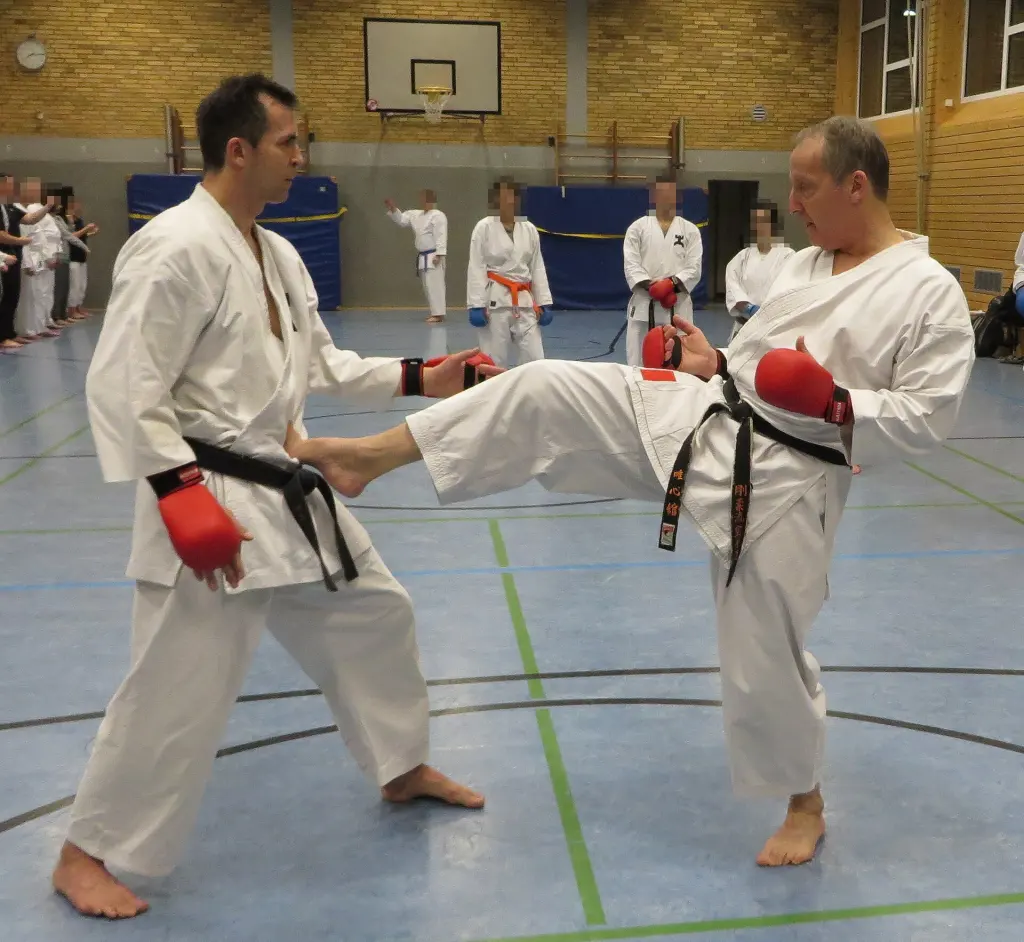
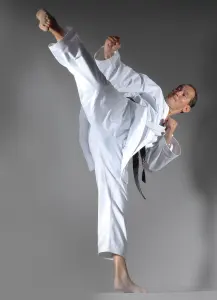
Image: Reclus / Wikimedia Commons · CC0 1.0
Overview
Mae-geri organises a kick toward the front without fixing one universal version.
Mae-geri (前蹴り) is the forward-directed family of Karate kicks. In the All Japan Karatedo Federation description, the kicking knee folds before the lower leg opens toward the target, normally using the ball of the foot. The name does not itself decide whether the front or rear leg kicks, how high the target sits, how far the supporting foot turns, or where the foot lands afterwards. A useful reading follows the complete action: establish support, organise the lifted leg, travel forward, make controlled contact, retract, and recover balance for the next movement.
The supporting side carries the changing centre of mass.
Direction, target, and foot formation shape the line.
Control continues after the most visible extension.
- Japanese
- 前蹴り
- Reading
- まえげり
- Reference meaning
- Front kick
- Classification
- Geri · kicking technique
- Defining relation
- Forward-directed path
- Common contact
- Ball of the foot, with documented alternatives
01Name & classification
The compound identifies “front” plus “kick”.
The direction remains stable even when leg choice, height, and use change.
Common spellings include mae geri and maegeri. The name does not specify a front-leg or rear-leg delivery, a tactical purpose, or a target level; those details belong to the named exercise, school, or ruleset.
02Forward path
Folding the knee prepares a forward line without turning the chamber into the whole technique.
The visible opening phase depends on what happened before it and what remains possible afterwards.
Organise the lifted leg
A compact preparation positions the lower leg and foot while the body balances on one side.
Travel toward the chosen target
The JKF definition gives the frontward relation; school instruction supplies the detailed trajectory.
Use hiki-ashi under control
The leg returns before landing behind, setting down ahead, or connecting to another action.
03Supporting side & posture
The leg that stays on the floor governs the freedom of the leg that kicks.
Balance is organised from the ground through the pelvis and trunk.
Maintain a usable base
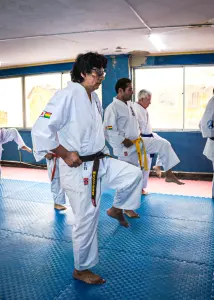
Turn varies with mobility, target, style, and the selected version.
Carry the changing load
Alignment should remain comfortable as the other leg leaves the floor.
Support reach without collapse
Excessive backward lean can trade apparent height for reduced recovery.
Keep the wider task present
The kick remains part of a continuing sequence, not an isolated pose.
04Surface, level & recovery
Contact choices must be read with target, range, equipment, and school.
The official reference offers a default while leaving documented alternatives visible.
Ball of the foot in the JKF definition
Toes are organised away from the contact surface; other formations should be named as variants.
Gedan, chūdan, or jōdan
Height changes balance, range, and safety without creating a different directional family.
Retract before choosing the landing
Hiki-ashi limits uncontrolled extension and prepares the next movement.
05Compare the geri family
Start with direction and path before comparing surface or tactical use.
The four names organise different relationships; they do not eliminate school variation.
The knee folds before the lower leg opens toward a target in front.
Sideward lineYoko-geri横蹴りA side-directed family that may separate snapping and thrusting models.
Curved approachMawashi-geri回し蹴りThe kicking leg approaches the target along an arc from the side.
Backward lineUshiro-geri後ろ蹴りThe body turns and the leg or heel drives directly behind the practitioner.
06Kihon, kata & kumite
Training format changes which part of mae-geri becomes easiest to see.
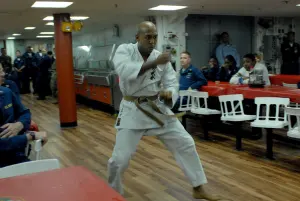
The same family can appear as a large basic action or a compressed response to changing distance.
07Research, rules & safety
Measurement clarifies a task; rules decide a score.
Neither a laboratory protocol nor the name mae-geri creates one universal execution.
Execution time, force, motion, and muscle activity
Published studies show whole-body coordination in bounded samples. Group differences and test conditions must remain part of the interpretation.
Valid chūdan and jōdan kicks receive different values
A named kick scores only when the current target, technique, distance, timing, control, and safety criteria are satisfied.
Sources and further reading
- All Japan Karatedo Federation, Karate Terminology Dictionary.
- Japan Karate Association, Instructor Technical Manual.
- Japan Karate Association, Techniques: Kihon, Kata and Kumite.
- Okinawa Prefecture, School Physical Education Karate Teaching Guide.
- National Diet Library, Funakoshi Gichin, Karate-do Kyohan.
- Japan Karate Association, Dan Ranking and Grading Syllabus.
- Pozo, Bastien and Dierick, Execution Time, Kinetics and Kinematics of the Mae-geri Kick, PubMed.
- Kaczmarski, Błaszczyszyn and Borysiuk, Range of Motion and Muscle Activity during the Front Kick in Kyokushin Karate, PubMed.
- All Japan Karatedo Federation, Summary of Competition Rule Changes Effective 1 April 2026.
Last updated: