Judo
Shime-waza
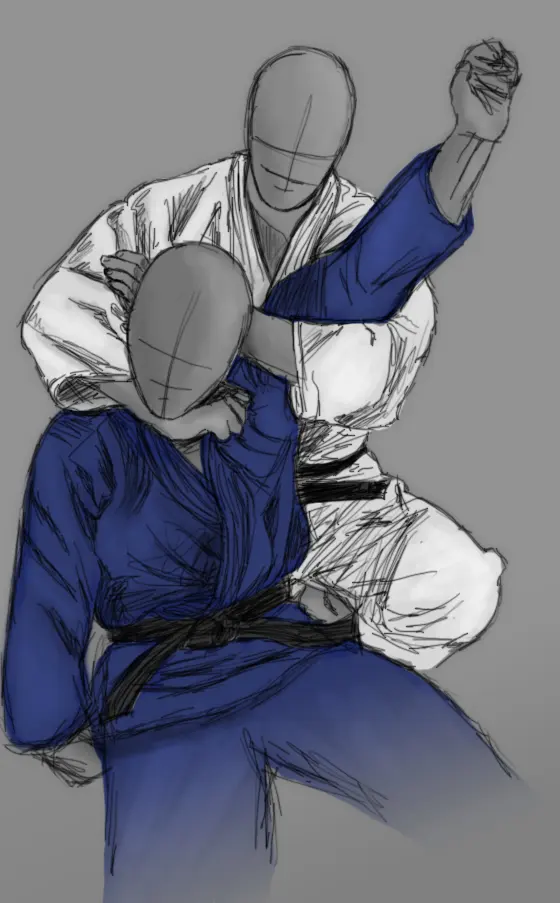
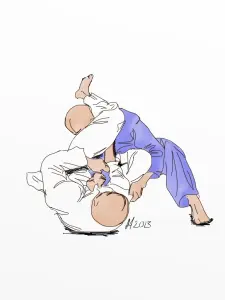
Image: Jdcollins13 / Wikimedia Commons · CC BY-SA 3.0
Shime-waza (絞技) are the strangling techniques within Kodokan Katame-waza. The current Kodokan list contains twelve named techniques, using the judogi, arms, hands, or leg-and-arm configurations to obtain controlled submission. This is a classification and training article, not a guide to causing unconsciousness. Shime-waza matter in kata, randori, and adult competition, but their practice depends on immediate communication, early submission, and immediate release. Kodokan classification must also be separated from current IJF legality: for example, dō-jime remains one of the twelve named Kodokan techniques but is prohibited in IJF contest. Age divisions and national bodies may impose additional restrictions.
Overview
| Japanese | 絞技 |
|---|---|
| Reading | しめわざ |
| Romanisation | shime-waza; common search form: shime waza |
| Meaning | Strangling techniques |
| Martial art | Judo |
| Parent category | Kodokan katame-waza |
| Current Kodokan list | 12 techniques |
Name and terminology
Shimeru means to tighten or constrict, and waza means technique. English Judo sources use both “strangling techniques” and “choking techniques.” TokyoWaltz uses the former for the category while retaining the Japanese name where precision matters.
The English words are not always used consistently across medicine, combat sports, and everyday speech. The Kodokan names and current rules are more reliable identifiers than attempts to build a rigid English physiological taxonomy.
Definition and classification
The Kodokan classifies twelve shime-waza within katame-waza, alongside ten osaekomi-waza and ten kansetsu-waza. The techniques obtain submission through controlled constriction around the neck area or, in the exceptional historical case of dō-jime, around the trunk.
Classification records Judo’s technical syllabus. It does not mean that every named technique is permitted in current contest, suitable for every age, or safe to practise without supervision.
The 12 Kodokan shime-waza
The current Kodokan technique list names the following twelve techniques. The short descriptions identify the principal relationship without giving application instructions.
| Technique | Japanese | Name or relationship |
|---|---|---|
| Nami-juji-jime | 並十字絞 | Normal cross strangle |
| Gyaku-juji-jime | 逆十字絞 | Reverse cross strangle |
| Kata-juji-jime | 片十字絞 | Half-cross strangle |
| Hadaka-jime | 裸絞 | Unclothed or naked strangle |
| Okuri-eri-jime | 送襟絞 | Sliding-collar strangle |
| Kataha-jime | 片羽絞 | Single-wing strangle |
| Katate-jime | 片手絞 | One-hand strangle |
| Ryote-jime | 両手絞 | Two-hand strangle |
| Sode-guruma-jime | 袖車絞 | Sleeve-wheel strangle |
| Tsukkomi-jime | 突込絞 | Thrusting strangle |
| Sankaku-jime | 三角絞 | Triangular strangle |
| Dō-jime | 胴絞 | Trunk constriction; prohibited in current IJF contest |
How shime-waza are classified
Names may refer to grip orientation, number of hands, use of the collar or sleeve, or the visible body relationship. The three jūji-jime names, for example, distinguish hand orientation within a cross-grip family; other names identify a collar, sleeve-wheel, single-wing, or triangular relationship.
Dojo labels and competition commentary may use broader terms such as collar choke or triangle. These can describe a family but should not automatically replace the Kodokan name of an identifiable technique.
Technical principle
At a general level, shime-waza controls the opponent’s posture and neck line so that a regulated constriction produces submission. The decisive skill is stable, recognisable control with the ability to release immediately—not maximum force or persistence after a signal.
Detailed instruction on pressure placement, force, or methods of causing unconsciousness is intentionally excluded. Those matters require direct, qualified coaching and a cooperating partner.
Training and safety
The Kodokan has stated that shime-waza should obtain maitta—submission—rather than injury. The receiver should tap clearly or say maitta as soon as control is effective. The holder must release immediately on that signal, the instructor’s command, or the referee’s intervention.
Practice requires suitable tatami, progressive instruction, and direct supervision. It should stop at once if a partner cannot respond normally, becomes confused, or loses safe posture. Shime-waza must never be used for unsupervised experimentation.
Shime-waza in Katame-no-kata
Katame-no-kata presents five selected shime-waza: kata-juji-jime, hadaka-jime, okuri-eri-jime, kataha-jime, and gyaku-juji-jime. They form the middle group of the kata between osaekomi-waza and kansetsu-waza.
The five kata techniques are not the complete current Kodokan list of twelve. Kata selection, technical classification, and contest legality are three separate questions.
Shime-waza in randori
In randori, shime-waza may develop from turnovers, back control, failed throws, or transitions from Osaekomi-waza. Partners must preserve the ability to communicate and stop; the training objective is technical recognition and control.
The intensity appropriate for experienced adult competitors is not automatically appropriate for beginners, children, older practitioners, or people with medical risk factors. Instructor and governing-body policy controls participation.
Shime-waza in competition
Current IJF rules researched: 14 August 2026. Ippon is awarded when a contestant taps at least twice or says maitta because of shime-waza. Loss of consciousness also ends the contest by ippon, but it is not a training objective and early submission is the safety standard.
Current rules prohibit using the belt, the bottom of the jacket, or fingers alone to apply shime-waza. Encircling the neck with the legs without including an arm is stopped and penalised. Standing shime-waza and its transition are regulated according to continuity, control, and risk.
Dō-jime and prohibited actions
Dō-jime is included among the twelve Kodokan shime-waza, but the current IJF rules prohibit it and prescribe direct hansoku-make. This is a clear example of why official technical classification and competition legality must not be merged.
Other dangerous actions can also produce penalties or immediate disqualification. A technique’s familiar name does not protect an unsafe application.
Age and national differences
IJF events are not organised for competitors under 15, and national youth federations often impose additional limits on shime-waza. In IJF cadet competition, an athlete who loses consciousness from shime-waza cannot continue in the competition, whereas an athlete who submits before losing consciousness may continue if otherwise fit.
IJF veteran rules also restrict shime-waza in older divisions. Because age bands and domestic provisions change, instructors and competitors must check the governing organisation and dated event rules rather than assume one universal policy.
Sources
- Kodokan Judo Institute, Judo Technique Names.
- Kodokan Judo Institute, Definitions of Judo Techniques, 2022.
- Kodokan Judo Institute, Katame-no-kata.
- Kodokan Judo Institute, New Year Message on Safe Practice, 2025.
- Kodokan Judo Institute, Bulletin of the Association for the Scientific Studies on Judo, Volume 1, 1958.
- International Judo Federation, Sport and Organisation Rules, 14 August 2026.
- All Japan Judo Federation, Application of the 2025–2028 IJF rules from 1 April 2026.
Last updated: